

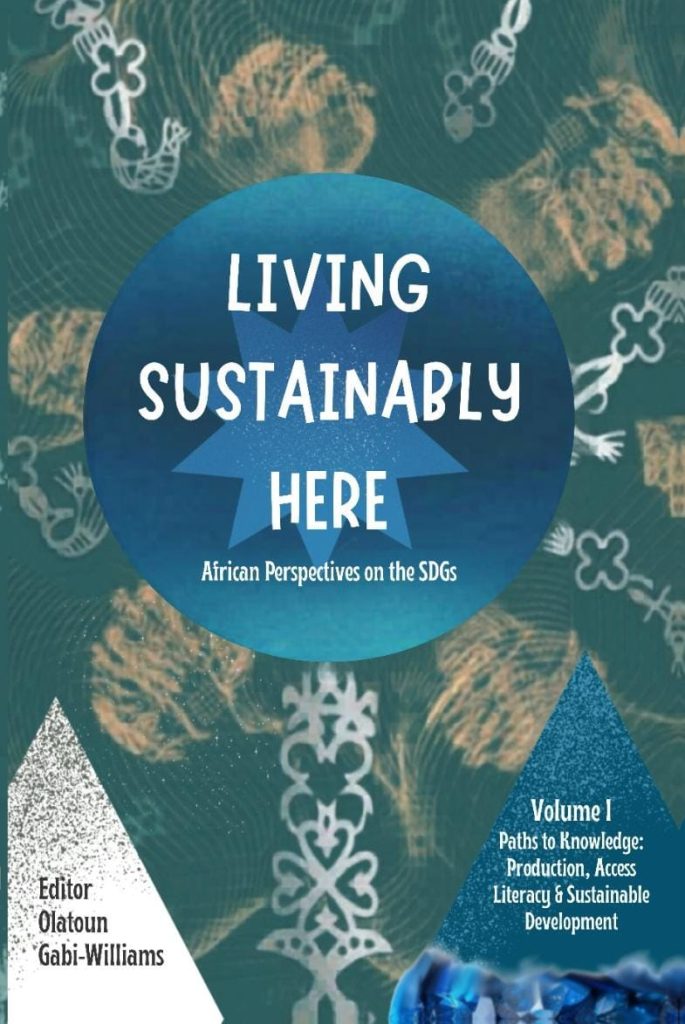
A review of Gabi-Williams’ Living Sustainably Here: African Perspectives on the SDGs

By Olawale Olayide
LIVING Sustainably Here: African Perspectives on the SDGs, edited by Olatoun Gabi-Williams, is, at its core, a civic act. Volume 1 — Paths to Knowledge — assembles voices from across Africa’s knowledge infrastructure: publishers, booksellers, librarians, researchers, and educators. What distinguishes this anthology from more conventional academic treatments of the SDGs is precisely its refusal to speak only in the register of policy. These are working practitioners reflecting on what they actually do, and on the structural conditions that determine whether that work is possible.
The anthology makes a strong, implicit argument: that the SDGs will not be realised by targets and indicators alone, but by the cultivation of what one might call a knowledge ecology, the interdependent institutions of publishing, bookselling, libraries, and open access that make information available, affordable, and meaningful across communities. Taken together, the essays constitute a situated African epistemology of sustainable development, grounded not in abstraction but in the lived realities of Lagos bookshops, Namibian repositories, Moroccan fairs, and West African community libraries.
The volume’s interdisciplinary character is one of its clearest strengths. Alongside the expected alignment with SDG 4 (Quality Education), contributors engage with SDG 8 (Decent Work), SDG 10 (Reduced Inequalities), SDG 16 (Peace and Justice), and SDG 17 (Partnerships). No single goal carries the weight; the anthology demonstrates, persuasively, that sustainability is systemic.
If one were to identify a single unifying provocation, it is this: that access to knowledge in Africa remains a structural problem, not merely a pedagogical one. The essays that follow illuminate that problem from multiple angles, and, in doing so, make the case for why anthologies like this one are themselves part of the solution.
‘The New African Publishers: Towards the Promised Land’ by Olatoun Gabi-Williams – Nigeria
GABI-WILLIAMS frames African publishing as cultural infrastructure — not commerce alone, but the architecture through which societies construct meaning, memory, and identity. Her analysis of the political economy of the African book chain is sharp: colonial legacies and extractive market structures have made publishing a high-risk endeavour that the continent cannot afford to abandon. The essay’s most forward-looking contribution is its case for transcontinental collaboration and what publisher, Lola Shoneyin, calls the “new literary Silk Road” — a vision of African publishing as a networked, intercontinental project rather than a fragmented set of national enterprises.
‘The Role of Publishers and Booksellers in Realizing the UN SDGs’ by Lily Nyariki – Kenya
NYARIKI’S essay is a clear-eyed industry assessment. While acknowledging professional initiatives, her central argument is a challenging one: existing mechanisms, including the UN SDG Book Club Africa, have not solved the problem of book distribution. Curated reading lists are no substitute for physical books in schools, and the gap between what is recommended and what is accessible in African classrooms remains wide. Nyariki makes a compelling case for coordinated, strategic distribution partnerships between publishers and booksellers as a non-negotiable precondition for achieving SDG 4.
‘The Role 21st Century Booksellers Play in Realizing SDG 4’ by Ore Lesi – Nigeria
DRAWING on her experience at Patabah Books in Lagos, Lesi offers a candid portrait of the independent bookseller as an overlooked education actor. She details the practical pressures, piracy, high costs, digital competition, while demonstrating how bookshops can adapt as community learning hubs.
‘The National Library: A Custodian of Knowledge, a Partner in Education’ by Folasade Adepoju – Nigeria
ADEPOJU examines the National Library of Nigeria as a site of both institutional memory and civic potential. Her attention to ISBN administration, digital outreach, and the promise of AI-assisted access is balanced by a frank acknowledgement of funding gaps and infrastructural constraints.
‘The Role of Libraries in Realizing SDG 4 — The West African Perspective’ by Dr. Nkem Osuigwe – Nigeria
OSUIGWE maps community library initiatives across Gambia, Ghana, Nigeria, and Sierra Leone, demonstrating how libraries function as safety nets for those excluded from formal education. Practical programmes such as Read2Skill anchor the essay’s broader argument about libraries as drivers of both literacy and local economic resilience.
‘The Role of International Schools in Advancing the SDGs: Focus on Lagos’ by Sade Marriott
MARRIOTT examines international schools as microcosms of global citizenship education, while raising uncomfortable questions about equity: whether the benefits of premium schooling remain internal to a privileged demographic or flow outward into the broader community.
‘Network of Book Clubs and Reading Promoters: Promoting Reading in Nigeria’ by Richard Mammah – Nigeria
MAMMAH positions reading culture as a development infrastructure, detailing the NBRP’s evidence-based advocacy and national outreach model. The Lagos Book Walk and the Nigerian National Book City concept represent imaginative policy proposals that deserve wider governmental attention.
‘Morocco: The International Fair for Books and Publishing’ by Kenza Sefrioui – Morocco
SEFRIOUI’S essay is the volume’s sharpest critical contribution. She exposes the contradiction between Morocco’s investment in cultural spectacle and the collapse of its public library network, from 394 to 240 institutions in eight years, while endemic piracy goes largely unaddressed. A necessary corrective to celebratory narratives of African book fairs.
‘The Impact of Open Science in Digital Publishing on Academic Libraries in Namibia’ by Anna Leonard & Michael Shirungu – Namibia
THIS qualitative study documents how open science is reshaping the academic library’s role at the University of Namibia, with particular attention to institutional repositories and the challenge of integrating indigenous knowledge systems into open-access frameworks.
‘Access to Knowledge for Sustainable Development: Leveraging OER and Open Science’ by Dr. Nkem Osuigwe – Nigeria & Doreen Appiah – Ghana
THE volume closes with a policy-focused argument for UNESCO’s OER and Open Science frameworks as instruments of equity. The authors connect open licensing directly to the democratisation of African education, drawing on the COVID-19 pandemic as a test case for what open knowledge infrastructure can achieve under pressure. Importantly, the essay does not rest on uncritical optimism: an infographic alongside the Conclusion, titled ‘Best-Practice Open Science for Africa’s Knowledge Sovereignty’, introduces a considered provocation. Openness, it suggests, is not sufficient on its own; the question of who controls data and knowledge infrastructure matters as much as who can access it. In a continent where power supply, connectivity, and institutional capacity remain uneven, the call to keep knowledge African-controlled is as urgent as the call to keep it open.
* Dr. Olayide is of the Department of Sustainability Studies, Faculty of Multidisciplinary Studies, University of Ibadan, Ibadan, Nigeria



0 Comment
Inspiring, informative, educative.