Three young critics’ impressions of Femi Osofisan’s ‘The Best of Times’

By Kehinde Folorunsho
LAST Saturday, 25 July 2026 was the final preview session on Femi Osofisan’s works selected for this year’s Lagos Book and Arts Festival (LABAF) for its Femi Osofisan review season. It was a session that brought together like-minded young literary enthusiasts to discover the artistic richness in one the literary icon’s selected works, The Best of Times. The anchor text for discussion last Saturday is a collection of three novellas – ‘Codelia,’ ‘Ma’ami,’ and ‘Kolera Kolej.’
Moderated by Victor Adedapo, the session had three young discussants: Sanjo Oluwafemi, Agnes Johnson, and Kehinde Folorunsho, who critically examined the works in view. The grounds for their exposé bordered on social commentary and political undertone. They considered the political content in most of Osofisan’s works, and how socially engaged a writer he is.
Oluwafemi established that the failure of government is at the heart of ‘Kolera Kolej.’ He noted that “society nomalises a lot of dysfunctionalities” and the job of the writer is to correct it. The basis of his take is not alien to the conscious mind; at least, within the context of following the instrumentality of satire down the lane of post-independence Nigeria – and in Africa at large. But even that is does not happen in isolation. The inability of followership to organise to liberate themselves from the shackles of oppression creates socio-political affliction. This is what Kehinde Folorunsho noted in his review of Kolera Kolej. That “the university wits in the text represent a sub-leadership category from whose office solution may also emerge,” he argued.
Johnson highlighted the poverty question in ‘Ma’ami’, a text already made into a film by the same title, as an economic status consequent on moral justice. The mother in the story suffers misfortune and penury because she will not cohabit with an occult husband and will not submit her body to the government official in exchange for the retention of her stall; failing which her stall was ransacked thus depriving her of her source of livelihood to take care of her self and her only son. However, taking it politically, Folorunsho pointed out that poverty is a system designed by the rich to keep them down and willing instruments for their warped pleasure. He argued that it is a postcolonial issue that is wielded like a whip to bend the will of the common man to submit to the harsh economic climate fomented by avaricious government officials and policies.
Again, he said that the outbreak of Cholera in ‘Kolera Kolej’ is a symbolic challenge on two levels. One, that the university campus is projected as lacking in its contribution in mind model to tackling the manifold problems of Africa. Two, that it presents a thought to ponder about the problems created by science as an offshoot of the complex layers of modernity mischief. He noted that the outbreak of pandemics is a critical question about the birth of dispensations in human history.
For ‘Cordelia,’ the social insecurity lies in the lecturer’s failed marriage and the coincidental entanglement with Cordelia. He protects her from the outrage of the public as a mob justice in connection with her father’s coup involvement. Drama within drama, ‘Cordelia’ highlights a subtle criticism on politics and its attendant backlash on family survival.
The touchstone of literary prowess in the three novellas, as noted by the discussants, is the narrative technique and style which yokes poetry, drama, and fiction together. The narration is compact with imagery, and humour, and a fluid sense of inviting the reader into the theatrics of the best of times. The title itself – The Best of Times – is a subversion of Charles Dickens’ opening lines in A Tale of Two Cities: ‘It was the best of times…,’ setting the motion for an analysis of layered socio-political dysfunction.
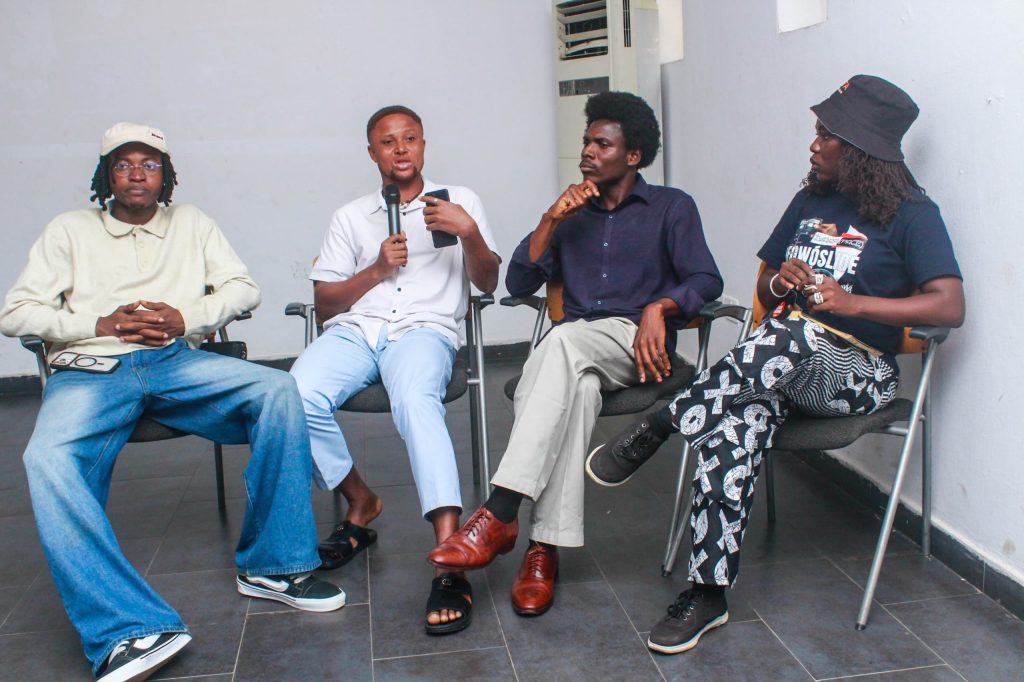
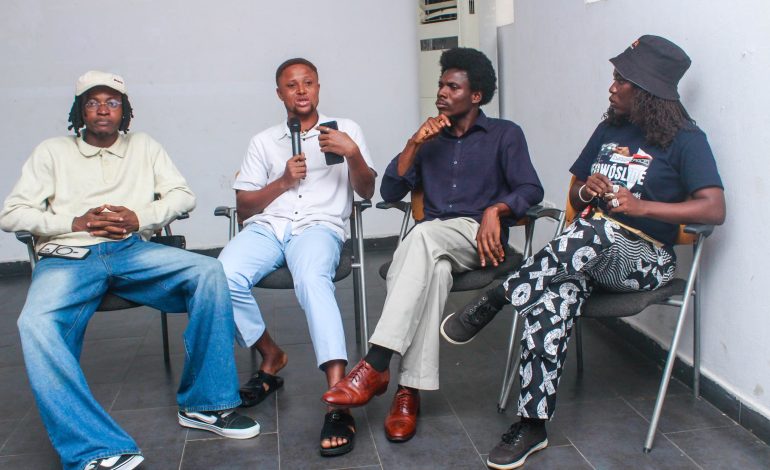
Sanjo Oluwafemi (left); Victor Adedapo; Kehinde Folorunsho and Agnes Johnson discussing Femi Osofisan’s The Best of Times as part of Lagos Book and Arts Festival’s Femi Osofisan Review Season at Freedom Park, Lagos PHOTO: OLUSEGUN OLALEYE