
Grammar of wounds: Reading James Eze’s ‘Unbind Me Now’ as poetry of healing

By Jeff Iwu
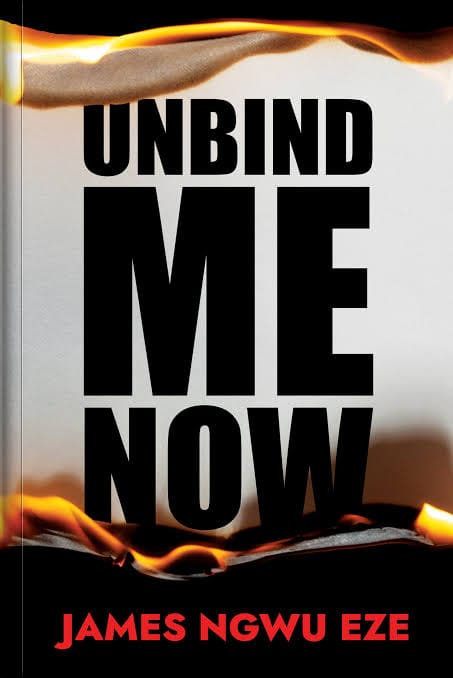
JAMES Eze’s steady evolution as a poet has been marked by both critical recognition and artistic growth. His debut collection, Dispossessed, won the Association of Nigerian Authors Poetry Prize in 2020 and was longlisted for The Nigeria Prize for Literature in 2022, while his second collection, Goosebumps, received critical acclaim for its sustained exploration of a single theme of universal resonance. Unbind Me Now, his third collection of poems (Masobe Books, Lagos; 2026) and another longlisted work for The Nigeria Prize for Literature, builds on those achievements while extending the range of his poetic vision. It reveals a poet whose concern reaches beyond the immediate realities of violence and social upheaval to the more quiet, more enduring wounds they leave behind. At first glance, Unbind Me Now belongs to the tradition of Nigerian protest poetry, confronting injustice, displacement, terrorism and political betrayal with lyrical urgency. Such a reading is certainly justified. But to leave the collection within that tradition is to overlook the emotional architecture that gives it its distinctive power. This is because beneath its political surface lies a sustained meditation on injury, memory and survival. Eze is less concerned with recounting historical events than with examining what those events do to the human body, the human mind and the moral imagination. The collection derives its greatest strength not simply from its political consciousness but from its compassionate attention to lives shaped by injury, memory and the search for restoration.
Read through the lens of Medical Humanities and Narrative Medicine, Unbind Me Now emerges as an anatomy of suffering. The poems keep returning to wounded bodies, fractured memories, interrupted voices and traumatised landscapes, suggesting that violence extends beyond physical destruction to reshape consciousness itself. Here, poetry assumes the work of diagnosis before presenting the possibility of healing. The poet becomes not only a witness but also a careful listener to pain. He translates experiences that often resist ordinary language into images capable of carrying their emotional weight. In Arthur Frank’s conception of the wounded storyteller, illness and suffering demand narratives through which damaged lives reclaim meaning. Eze’s poetry performs a similar task. His speakers do not deny pain; rather, they insist on telling it until silence itself becomes impossible. The title, Unbind Me Now, therefore functions not simply as an appeal for political liberation but as a plea for emotional release from histories that continue to imprison memory. This concern with suffering finds its fullest expression in the collection’s persistent use of bodily imagery.
Blood, wounds, breath, bones, tongues, throats, tears and flesh recur with remarkable consistency, creating what may be called a grammar of wounds. These are not decorative metaphors but the vocabulary through which the poet understands both history and humanity. The poems not only report violence; they also embody it. History writes itself on skin; memory settles in bones and grief lodges itself in the throat. As a result, the reader encounters not abstract political commentary but an intimate experience of pain. This poetic strategy becomes particularly evident in ‘Bullet Wounds.’ The title itself rejects abstraction. Instead of speaking generally about oppression, the poem focuses immediately on injury. Yet even here, the wound refuses to remain individual. The repeated appeal, ‘bind my bullet wounds, brother,’ followed by the equally moving plea to the sister, transforms healing into a communal responsibility rather than a private struggle. The emotional force of the poem lies in its refusal to isolate suffering. The poetic speaker invites others not just to observe pain but to touch it, to let ‘calloused hands remember tenderness’ and allow blood to become the medium through which empathy is restored. The wound thus becomes relational, exposing the ethical demand placed upon every society confronted with violence: either to participate in healing or become complicit in abandonment.
The same concern with invisible injury appears elsewhere in the collection. In one of its most memorable refrains, the poet declares that ‘our pain runs in rivulets—/ uncharted, unaccounted for’. These lines read almost like a clinical observation. Pain exists, but no record acknowledges it. It remains undocumented, untreated and socially ignored. Medical Humanities has long argued that institutional narratives frequently overlook subjective suffering, reducing people to statistics while neglecting emotional realities. In this collection, Eze’s challenges this neglect. His concern is not that people die but that their pain disappears into silence without adequate remembrance. The repeated insistence on naming grief becomes an act of resistance against historical erasure, and silence itself takes a central place within the symbolic economy of the collection. Ordinarily, silence suggests absence or surrender. Eze consistently overturns that expectation. His silence breathes, waits, gathers strength and eventually speaks. In the poem, ‘Silence,’ the poet asks, ‘how much is a verse?’ before insisting that ‘a poet’s silence is a breeding season’. This metaphor deserves careful attention. Silence here is like gestation, not emptiness. Like an unborn child developing beyond public sight, language matures within quietness before entering the world. The image resonates strongly with Medical Humanities, where healing rarely occurs as dramatic spectacle. Recovery often begins invisibly, beneath the surface of the body and mind.
Eze therefore transforms silence from repression into incubation. The unwritten poem already possesses life. That same transformation also appears in the poem, ‘Silent Thunder’. Here, the speaker refuses invitations to soften truth or trade conviction for comfort. He rejects ‘perfumed silence’ because he has ‘stepped over the body / of a child in the ruins of terror’, therefore, silence becomes ethically impossible. Witnessing atrocity imposes an obligation to speak, however dangerous speech may become. In the poem, the image of ‘live coal’ on the tongue recalls prophetic traditions in which speech burns because truth itself burns. Nevertheless, the concluding metaphor, ‘a silent thunder breathing in a bone,’ may be one of the finest images in the collection. Thunder usually announces itself through overwhelming sound. By making it silent, Eze imagines trauma as something that reverberates internally before becoming publicly audible. The storm has already begun long before listeners hear its report.
Similarly, in the poem, ‘The Voice of the Streets’, this movement from silence to testimony continues. Here, the poet does not celebrate poetry as aesthetic ornament; he locates its true home among itinerant traders, blacksmiths, labourers and forgotten communities. He writes, ‘My poetry belongs to the streets.’ He also describes himself as ‘a griot who is an audience to his own song.’ The poet’s authority therefore derives not from literary prestige but from proximity to suffering. The repeated identification with ordinary people prevents the collection from becoming rhetorical. It listens before it speaks. Even the concluding image of voices urging the poet ‘to possess my truths, / and sing their sorrows into shut ears’ encapsulates the ethical responsibility of testimony. Poetry becomes an instrument through which neglected pain acquires public hearing.
The poet’s treatment of memory is another point of attraction. In literature, trauma frequently observes that painful memory refuses orderly chronology. It returns unexpectedly. It repeats itself in images rather than explanations. Eze captures this phenomenon through the metaphors of unfinished journeys, lingering bloodstains, abandoned buildings and voices refusing disappearance. In the poem ‘We Remember’, memory becomes both burden and survival. The poetic voice refuses to forget because forgetting would constitute a second violence against those already wounded. Likewise, in the following poem, ‘When the Light Finds Us Again’, the survivors insist that they ‘shall not wait for history to remember us.’ Instead, they undertake the difficult labour of remembering themselves, transforming memory from passive inheritance into active resistance. The treatment of memory in this collection is inseparable from its treatment of hope. This is because, the poet understands that genuine healing does not consist in forgetting the wound but in learning to live truthfully with its memory. This movement from injury towards restoration gives Unbind Me Now its emotional rhythm. The poems continually travel between darkness and light, silence and speech, grief and endurance. Therefore, the collection does not idealise either suffering or resilience; healing remains difficult, incomplete and often fragile, but it is never abandoned as an ethical possibility. This is also depicted in the poem, ‘The Little Orange Flame’. It is perhaps one of the finest poems in the volume because it rejects spectacular visions of revolution in favour of more quiet forms of resistance. The poetic voice reminds us that ‘a revolution is not always / a roar of wildfire, / but sometimes / a little orange flame.’ The metaphor is deceptively simple. Fire usually appears in political poetry as an image of destruction or uncontrollable rage, but Eze domesticates the symbol without diminishing its power. His ‘little orange flame’ survives because it refuses excess. It burns with patience rather than fury. Within the logic of the collection, this flame appears like the human spirit that persists beneath trauma. It also looks like the slow process of recovery itself. Clinical healing rarely occurs through dramatic transformation. More often, it advances through small recoveries, fragile victories and stubborn hope. The orange flame therefore becomes one of the defining metaphors of the collection, especially as it reminds readers that resilience often appears in forms too modest for history to celebrate.
The title poem’s demand for unbinding echoes across the collection through recurring images of chains, prisons, constricted breath and wounded memory. However, liberation rarely arrives through triumphalist rhetoric. Instead, it emerges gradually, almost therapeutically and this movement is exemplified in the poem ‘My Chains Are Broken’. Freedom is imagined not simply as political victory but as bodily release. The fallen chains produce music, drums answer them, birds recover song and communal celebration restores fractured identity. Healing therefore involves both remembrance and renewed participation in cultural life. Music, dance and indigenous imagery function as restorative practices that reconnect individuals to communities fragmented by violence. Perhaps no image better captures Eze’s imaginative brilliance than the title of ‘Where Shall We Wash the River?’. This question is one that immediately unsettles familiar logic. Rivers traditionally cleanse those who enter them. In this poem, however, the river itself has become contaminated by genocide, hatred and moral collapse. ‘Now, where shall the world wash its conscience?’ the poet asks after describing violence as ‘a stain on white linen.’ The inversion is devastating. The source of purification now requires purification. By displacing cleansing from the individual onto the landscape itself, Eze suggests that atrocity damages not only victims but the moral ecology within which societies exist. The river becomes an external manifestation of collective psychological injury.
The same imaginative confidence appears in ‘When the Light Finds Us Again’. The poem acknowledges decades of injustice without allowing injustice to dictate the future. In the third stanza, the poetic voice declares, ‘We survived bullets anointed by pogroms.’ He also insists that ‘the fire within must rise at last.’ What matters here is the shift in agency. Earlier poems describe communities acted upon by violence. This poem imagines those same communities becoming agents of their own renewal. The light for which they wait gradually becomes the light they themselves must kindle. Once again, Eze’s language aligns well with the concerns of Narrative Medicine, where recovery depends not only upon external intervention but also upon the patient’s ability to reconstruct a meaningful story after catastrophe. The poems do not erase historical pain; they reframe it within narratives of endurance. Additionally, one admires the remarkable coherence of Eze’s symbolic universe.
Certain images recur with such consistency that they acquire cumulative significance across the collection. Images of fire, rivers, birds, chains, roads, blood, wind, trees, stones and light surface repeatedly, not as repetitive ornaments but as interconnected symbols through which different emotional states become intelligible. Fire alternately represents rage, purification, memory and hope. Rivers signify cleansing before becoming contaminated by genocide. Birds embody both freedom and exile, while trees register endurance, rootedness and communal memory. Light functions as moral clarity achieved after prolonged darkness. These images produce an internal conversation among the poems. They also give the collection a structural unity that many contemporary poetry collections lack. One poem often completes an image introduced several pages earlier, allowing readers to experience the book as an organic whole rather than an assortment of isolated lyrics.
Another important element of the collection is Eze’s command of metaphor. His strongest images arise naturally from emotional experience rather than from intellectual display. For instance, in the lines, ‘my mother is a pilgrim / in her own blood’, the poet uses only a few words to compresses questions of identity, race, ancestry and belonging into a memorable image that refuses simplistic interpretation. Similarly, in the poem, ‘Abandoned Building’, memory itself becomes architecture, while decay signifies not just physical neglect but cultural amnesia. Such metaphors succeed because they remain emotionally intelligible even while inviting multiple readings. The poet trusts images to think for themselves instead of explaining them into exhaustion. Also, the language throughout the collection deserves praise. Eze writes with lyrical confidence, the same time, avoiding unnecessary obscurity. His diction is accessible without becoming simplistic, allowing metaphor to emerge through ordinary words arranged with unusual precision. The rhythms take the form of oral performance, particularly in poems built upon repetition, invocation and refrain. One hears the influence of the griot tradition, biblical cadence and contemporary spoken-word performance without feeling that any single influence dominates the collection. This stylistic flexibility enables the poems to move comfortably between personal meditation, public lament, political testimony and cultural remembrance. However, the collection is not entirely without limitations; no book exists without any. There are moments one notices a tendency to revisit similar symbolic fields with such frequency that certain images begin to echo one another.
Images of blood, chains, silence, fire and wounds recur so persistently that a few poems occasionally feel less distinctive than they might otherwise have been. Readers moving through the collection in one sitting may sense an overlap in emotional texture, especially among poems addressing political violence. Nevertheless, this repetition also reflects the psychological reality of trauma itself. Traumatic memory does not progress in neat chronological order. It circles back upon recurring images, unresolved questions and unfinished grief. What may initially appear as imagistic repetition therefore becomes, on closer examination, a formal expression of the very condition the collection seeks to represent. The poems imitate the repetitive nature of wounded memory, where the same pain returns until it finds language capable of carrying its burden.
Another way the collection distinguishes itself is through its refusal to reduce human suffering to just political slogans. Although the poet presents contemporary Nigerian realities, depicting issues like terrorism, ethnic violence, state repression, displacement, social fragmentation and historical betrayal, the poems consistently recover individual humanity from beneath collective tragedy. A grieving mother, an injured brother, a forgotten child, an abandoned village or a frightened community never becomes an ordinary symbol for ideological argument. They remain human. This ethical restraint elevates the collection above much contemporary protest poetry, which sometimes sacrifices emotional complexity for rhetorical certainty. Eze allows grief to retain its ambiguity. His poetic voices question, mourn, doubt, hope and remember without pretending that poetry alone can repair history’s fractures. Perhaps the greatest achievement of Eze’s Unbind Me Now is the understanding of poetry itself. Throughout the collection, poetry is imagined not as decorative language, and not as intellectual exercise. It becomes an act of care. The poet listens before he speaks. He bears witness before he judges. He gathers scattered memories before attempting to heal them. In this sense, the collection exemplifies one of the central principles of Medical Humanities, which is: that attentive storytelling possesses restorative power because it acknowledges suffering without reducing it to diagnosis or statistics. Eze repeatedly reminds us that people survive not only because wounds eventually close but because stories preserve dignity when institutions fail to do so.
Furthermore, the title of the collection, Unbind Me Now, acquires its significance by the end of the collection. The plea is addressed not only to political authorities but also to memory, silence, grief and fear. It is the cry of individuals seeking release from histories that continue to tighten around their lives. However, the collection suggests that liberation begins with speech itself. To name pain is already to loosen its grip, and to remember together is already to resist erasure. To imagine hope, however tentative, is already to challenge despair.
In conclusion, Eze’s Unbind Me Now stands as one of the most accomplished Nigerian poetry collections of recent years. It is intellectually alert without becoming self-conscious, politically engaged without descending into propaganda. Also, it is emotionally affecting without being too emotional. More importantly, the collection enlarges a reader’s understanding of what contemporary Nigerian poetry can accomplish. This is because Eze transforms poetry into a space where history, memory, suffering and hope meet in difficult but necessary conversation. His poems ask readers to not just witness wounds but to learn the language of wounds, to recognise their persistence and, to participate in the slow work of healing. Therefore, apart from being a collection of protest poems, Unbind Me Now is also a poetry of healing, a grammar through which wounded lives recover voice, fractured memories reclaim meaning and broken histories begin, however cautiously, to imagine wholeness once again.
* Iwu, Nigerian scholar, literary critic, creative writer and educator, doctoral student in Literature at the University of Nigeria, Nsukka, with research interests in African literature, medical humanities, gender studies and creative writing, winner of Akachi Ezeigbo Prize for Literature 2024, was a finalist in the International Beeta Playwright Competition