The Nigeria Prize for Literature 2026… Meet the 11 poet laureates

By Editor
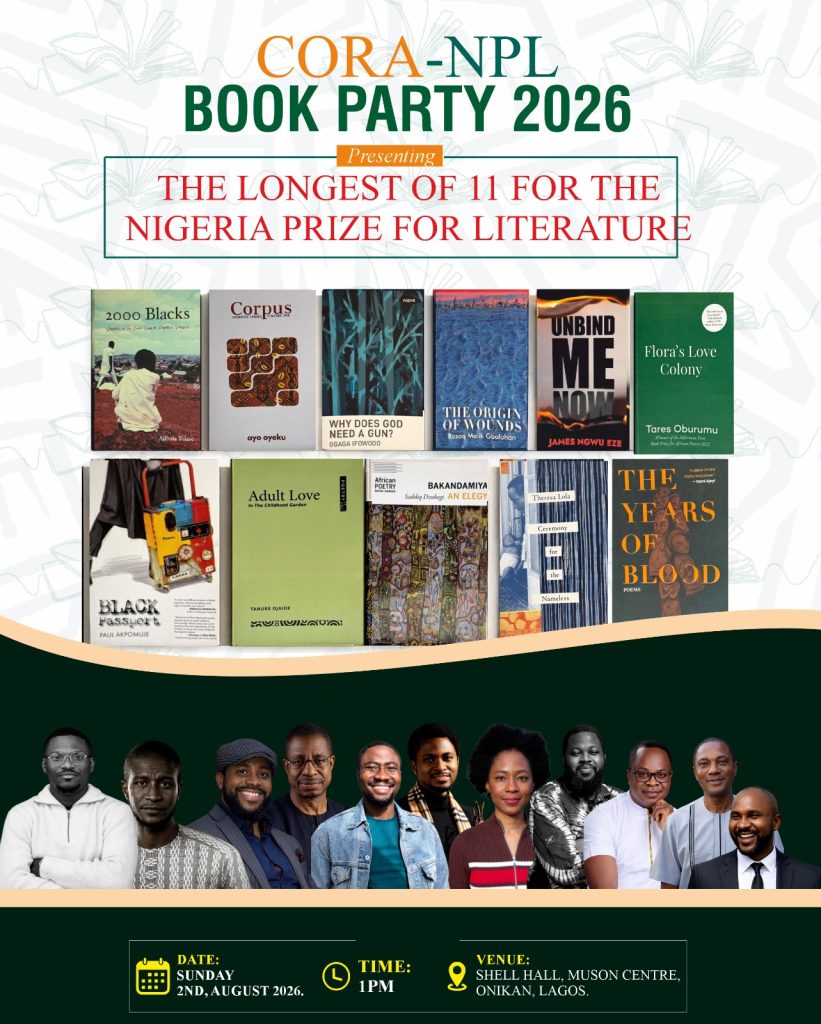
TOMORROW, Sunday, 2 August 2026 at MUSON Centre, Onikan, Lagos @1.00pm, the 18th CORA-NLNG will showcase the 11 poets on the longlist of The Nigeria Prize for Literature 2026, endowed and promoted by the NLNG worth USD$100,000. The Book Party will be moderated by the spoken word poet and poetry advocate, Juliet Nnaji, who will engage the poets on the big stage and enable audiences on-site and online encounter firsthand the minds that crafted the poetic pieces up for celebration.
Guests attending in-person or virtually would be opportune to meet face-to-face and virtually with the poets adjudged the very best of the 223 who submitted entries to the directorate of the Prize project launched in 2004 as the Community Service Relations (CSR) of the gas company. Virtual guests have been advised to join the event via zoom at Meeting ID: 89716268311 | Passcode: CORA2026. It will also be broadcast live on Facebook, YouTube and Instagram.
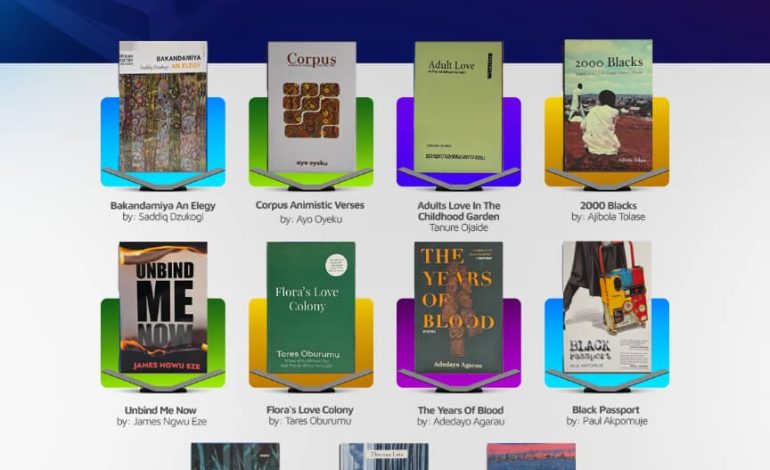
The genre in focus is poetry. The 11 longlisted finalists (in alphabetical order) are Adult Love in the Childhood Garden by Tanure Ojaide, Bakandamiya: An Elegy by Saddiq Dzukogi, Black Passport by Paul Akpomuje, 2000 Blacks by Ajibola Tolase, Ceremony for the Nameless by Theresa Lola, Corpus Animalistic Verses by Ayo Oyeku, Floral’s Love Colony by Tares Oburumu, The Origin of Wounds by Rasaq Malik Gbolahan, The Years of Blood by Adedayo Agarau, Unbind Me Now by James Ugwu Eze and Why Does God Need a Gun? by Ogaga Ifowodo.
The Book Party, a literary feast of ideas and life, celebrates the authors and their works for emerging as the very best in the country. It promises to be an afternoon of literary feasting, featuring conversations, performances, wining and dining. The Nigeria Prize for Literature was inaugurated in 2004 with USD$20,000 Prize money. Sponsored by NLNG, the prize money was later raised to USD$50,000 and now, it iisUSD$100,000 – the biggest of its kind in Africa.
The Nigeria Prize for Literature Book Party, a special iteration of the CORA Book Party launched in 1996 – was initiated after a review of the first five years of the esteemed Prize project. The idea is to create a platform through which the public gets to engage with the works considered the best of the usually, over 200 entries per edition of the NPL.
CORA is a group consisting of artistes, art enthusiasts, art promoters and art writers committed to the flowering of all the contemporary arts of the Nigerian, and African people. It has organised, every year since 1999, the Lagos Book & Art Festival (LABAF), critically described as ‘the biggest culture picnic on the African continent.’ The 28th edition holds November 16-22 with theme ‘The WorkOver Starts, Now.’
Adult Love In the Childhood Garden by Tanure Ojaide focuses on the poet’s childhood and youth. The poet says: “Many of those early experiences have relevance to my adult perceptions and, in fact, elicit comparisons of those days and these days, the traditional community and today’s not just modern but also global world. It is the advantage of age to compare, as happens here… My childhood and youth are replete with folklore; hence this collection begins with Aridon, my muse, and the falcon we call egodi whose yearly appearance is expected to affirm a sense of creative renewal. There are allusions to myths that made life then a congruence of the seen and unseen, the known and unknown, as well as the material and the spiritual… There is always a lot to learn from the past to make the present and the future more purposeful, stable, and comfortable…”
Poet, scholar and a Fellow in Writing of the University of Iowa, Tanure’s poetry has been translated into Chinese, Dutch, French, German, Spanish, Sanskrit, and Hindi. His awards include the Commonwealth Poetry Prize for the Africa Region (1987), the All-Africa Okigbo Prize for Poetry (1988, 1997), the BBC Arts and Africa Poetry Award (1988), and the Association of Nigerian Authors Poetry Award (1988, 1994, 2003, and 2011). His collection Sovereign Body was a runner-up for The Commonwealth Literature Prize for the Africa Region in 2005. His non-fiction, Drawing the Map of Heaven: An African Writer’s Experience of America, was a runner-up for the Penguin Prize for African Writing (2010). A co-winner of the Wole Soyinka Prize for Literature in Africa in 2018, he was given an honorary doctorate degree by Delta State University, Abraka, 2025. He is a fellow of the Nigerian Academy of Letters and the Association of Nigerian Authors. www.tanureojaide.com and FB: tanure ojaide.
Covering more than 500 years of cultural transformation, Saddiq Dzukogi’s Bakandamiya: An Elegy is a book-length epic poem set in northern Nigeria. The poem moves from passages of mythic power to elegant lyricism with remarkable skill, subverting the legend of Bayajidda, a prince from Baghdad whose arrival reshaped the outlook of the Hausas. Told in part from a shapeshifting Bori spirit’s point of view and in part through personal lyrics, part prayer and part praise song, Bakandamiya decries the loss of culture and spirituality due to colonization from both the West and the East. Even as it subverts myths and popular beliefs and addresses some of the events that led to the Nigerian civil war, it tackles the lingering question of nationhood. This work of lyric and elegiac longing, blends the personal with the mythical, expanding the griot tradition of Bakandamiya, a poetic form from northern Nigeria popularised by Mamman Shata.
Poet and scholar, Saddiq’s poems have appeared in major journals such as Poetry Magazine, Kenyon Review, Prairie Schooner, Narrative Magazine, Ploughshares, Guernica, Poetry London, The Cincinnati Review and Best American Experimental Writing anthology. In 2024, he received the Narrative Poetry Award for his poem “Egress.” Recipient of a Mississippi Arts Commission Poetry Fellowship, and winner of the Mississippi Institute of Arts and Letters Poetry Prize, he won the Wilbur Gaffney Poetry Prize and the Vreeland Poetry Prize a record two times. He is author of Your Crib, My Qibla (University of Nebraska Press, 2021), which won both the Derek Walcott Prize for Poetry and the Julie Suk Award; named one of Oprah Daily’s 29 Best Poetry Books of 2021 in America, and was a finalist for The Nigeria Prize for Literature 2022. His work has been recognised with fellowships from PEN America, the Nebraska Arts Council, and Cave Canem. IG: @SaddiqDzukogi, X: @SaddiqDzukogi, FB: Saddiq M Dzukogi.
Black Passport by Paul Akpomuje captures the everyday realities of Nigerian migrants navigating immigration offices, airports, waiting rooms, classrooms, foreign streets, and the nostalgia of home. The poems attend to the intimate textures of migration, the torturous anxiety of waiting, the negotiations of belonging, and the search for home in unfamiliar spaces. Exploring the tensions between movement and restriction, belonging and displacement, memory and reinvention, it examines how borders, passports, immigration systems, and racialised encounters shape the lives and identities of migrants while also revealing the possibilities that emerge within and beyond these constraints. Reflecting on what it means to travel while black and to carry histories, dreams, and memories across borders, the poems offer a meditation on migration as both a personal and collective experience. Through humour, wit, hope, love, joy, and spirituality, the poet tells stories of survival and possibility, illuminating the complexities of migrant life beyond narratives of struggle alone.
Poet, scholar and curator of community-based poetry events, Akpomuje’s creative and scholarly work explores visa stories, migration, identity, spirituality, social justice, and poetry as a form of witnessing and community engagement. His research examines migrant experiences and the intersections of anti-oppressive pedagogies and inclusive education. Founder of The Poetics of Migration, a creative project that brings poetry into dialogue with community stories to explore displacement, belonging, immigration paperwork, and the complexities of travelling while black, his poems have appeared in anthologies, literary publications, and art festivals. He is also the curator of Poetics of Love and Poetics of Climate Work and leads Poetry Behind Bars, a poetry initiative that supports incarcerated people in exploring purpose, rebirth, and wellbeing through creative expression. He is a fellow of the Revolutionary Demand for Happiness and previously taught at Obafemi Awolowo University, Ile-Ife. X: @AkpomujeP, FB: @paul.akpomuje and IG: @paulakpomuje.
2000 Blacks by Ajibola Tolase fashions a lyrical meditation on the fragility of memory, the afterlives of migration, and the mutable architectures of Black identity. Traversing Nigeria and the American Midwest with equal emotional acuity, these poems inhabit the interstices between homeland and exile, inheritance and reinvention, intimacy and estrangement. His supple, image-rich language interrogates the burdens of history while attending to the ordinary rituals through which love, grief, family, and desire are made legible. At once elegiac and exuberant, the collection resists fixed notions of belonging, instead revealing identity as a continual act of negotiation across geographies, generations, and languages. With formal dexterity and philosophical depth, 2000 Blacks enlarges contemporary conversations about race, displacement, and kinship, offering a poetics that is both intellectually rigorous and emotionally resonant.
POET and essayist, Tolase’s chapbook, Koola Lobitos, was featured in the New Generation African Poets chapbook box set published by the African Poetry Book Fund. His debut poetry collection, 2000 Blacks, received the 2024 Cave Canem Poetry Prize and the 2024 Florida Book Awards Gold Medal for Poetry. It was also a finalist for the 2025 Derek Walcott Prize for Poetry and the 2024 Julie Suk Award. A graduate of the Creative Writing Program at the University of Wisconsin–Madison, Tolase is a former Wallace Stegner Fellow at Stanford University, where he was mentored by Nobel laureate Louise Glück. He also served as the 2023–2024 Olive B. O’Connor Fellow in Poetry at Colgate University, where he was mentored by Pulitzer Prize–winning poet Peter Balakian. His work has been supported by a creative writing grant from the Elizabeth George Foundation. IG: @jibo_jhybo.
Ceremony for the Nameless by Theresa Lola is far-reaching and musical. Lola’s second collection of poetry explores the act of naming and its role in shaping our identities, our aspirations, what we carry and how we belong. She conjures and questions the realities of her dual Nigerian-British identity, traces the lineages of names, asks why some deserve to be named while others are treated as though invisible and explores the ways our journey through life might require us to cast off old expectations – both others’ and our own – just as at other times it can bring us back, strangely and unexpectedly, to where we first began. In lyrical, joyful and moving poems, Lola breaks down the complexities of the diasporic experience and the way it is woven through family life, history and memory. The collection is described as among the ranks of new wave of young female bards widening the appeal of poetry for a new generation.
Poet, author and artist, Lola’s interest in poetry was nurtured by the encouragement of a teacher and solidified during a school trip to a poetry festival in Lagos. In 2018, she was awarded the Brunel International African Poetry Prize and was, from 2019 to 2020, the Young People’s Laureate for London. In 2025, she won the Derek Walcott Prize for Poetry. Committed to creative education and expression, she received a grant in 2017 to run workshops for writers in Lagos. She has held poetry residencies at Wellcome Collection and Bethlem Museum of the Mind. In 2023 she was Communications Director for Obsidian Foundation, a programme supporting the artistic and professional growth of Black poets around the world. She holds a Masters in Creative Writing from University of Oxford. A poem from her debut poetry collection In Search of Equilibrium was added to the UK’s GCSE syllabus. X: @theresa_lola, IG: @theresa_lola and FB: theresalola
WHAT does it mean to inherit a destiny, to search for meaning, and to live beneath the shadow of death? In Corpus Animistic Verses by Ayo Oyeku, poetry becomes both pilgrimage and witness. It is rooted in Yoruba cosmology and animated by the rhythms of African memory. These poems journey through beginnings, identity, longing, migration, love, grief, and mortality with remarkable clarity and emotional depth. From the sacred wisdom of Odù to the quiet reckonings of everyday life, Corpus explores the invisible threads that bind the living to their ancestors, the individual to community, and the temporal to the eternal. Lyrical, contemplative, and profoundly human, Corpus is an invitation to inhabit life’s mysteries with courage, tenderness, and wonder. It is a collection that reminds us that while everybody returns to dust, each of us leaves behind a unique contribution worth remembering. We are here because others were.
Writer and literary advocate whose work explores memory, spirituality, identity, history, and the enduring search for meaning, Ayo, an Ebedi International Residency Fellow and Humanitarian Leadership Fellow, writes across poetry, fiction, and children’s literature, bringing a lyrical sensibility and philosophical depth to every genre. His poetry has appeared in notable literary journals and anthologies, including The Kalahari Review, Brittle Paper and Vinyl Poetry. His children’s books have received both national and international acclaim, including the Children’s Book Council Favourite Awards (Teacher and Librarian categories), the Notable Social Studies Trade Books Award, among others. His writing has earned recognition across multiple genres, including the Ezenwa Ohaeto Prize for Fiction, the Association of Nigerian Authors Prize, finalist placements for the Golden Baobab Prize and longlisted twice for The Nigeria Prize for Literature in 2024 and 2025. In 2016, his poem ‘Reeds on the Rivers’ was nominated for the Pushcart Prize. Corpus is his debut poetry collection. X: @ayo_oyeku, IG: ayo_oyeku and FB: Ayo Oyeku
Flora’s Love Colony by Tares Oburumu is a handbook of the history of Nigeria from the precolonial times to the present. The collection traces the history of the most populous black nation from the Berlin Conference of 1885, precolonial Nigeria, post-colonial to present day Nigeria. It vividly looks at some of the major events that shaped the cultural and social dynamics of the country, with emphasis on 1914, the year of the amalgamation of the protectorates into a single nation of tribes by Lord Frederick Lugard, and the Nigeria Civil War, which was a direct consequence of the events of post-in dependence Nigeria. Central to the amalgamation is the naming of the country by the wife of Lugard, Flora Shaw. It’s from this naming the book took its title. It explores the colonial influence the British have on both the cultural and the political dynamics of the country. This influence brings the question of identity, the internal crisis rocking the country.
Poet, essayist and playwright, Oburumu’s work explores history, the effects of colonialism on the African, identity, religion, and migration. Winner of the 2022 Sillerman Prize for African Poetry with his book Origins of the Syma Species, he is also two-time Pushcart Prize nominee, and winner of the GAP Poetry Prize. With seven published poetry chapbooks, Oburumu mentors over 1,000 young Nigerian poets, with his works having appeared in Connotation Press, Poetry Foundation, Icefloes International journal, Eunoia Review, ilora press, Loch Raven Review, Lunaris Review, Dawn Review, Bluepepper, Okiti Literary Journal, African Writer Magazine, Kalahari Review, Konya Shamsrumi, Juked International journal, The Agonist, Ngiga Review, Agbowo, NigeriaNewsDirect Poetry Column, Mersey Review, Arts Lounge Journal, The Muse, Sentinel Magazine, Praxis, YabaLeft Review, ANA review Bayelsa State chapter, Expound, Yellow House Library, Woven Tales Press, Afapinen, Open Country Magazine, Nantygreen, Zocalo, Afrocritik and Poetry Sango & elsewhere. FB: Tares Oburumu, X: Oburumu Tares and IG: tares oburumu
The Origin of Wounds by Rasaq Malik Gbolahan exhumes fragments of historical accounts that bring us face-to-face with the brutality of national and global wars. The collection addresses personal and global grief through the loss of homeland, the loss of beloveds, and the continuous search for a sanctuary. In poems that startle and astonish, the poet shows the excruciating lives of children in war-torn homelands, while also guiding readers through diaries of war notes and archives of forgotten wounds. In examining the wounds of displacement, of migrants, of ancestors on slave ships and dreams buried in the dark of war, Gbolahon reminds that we must pay attention to the wounds carried from the past to the present, and we must also do everything possible to save the children from a world fraught with monumental tragedies. The poet renders powerfully the experiences of the displaced, the migrants on boats leaving homeland to an imagined promised land.
Poet, performer and translator, Gbolahon’s poems have been published in journals such as Poetry, Ploughshares, Kenyon Review, The Nation and elsewhere. He is the author of poetry chapbooks, No Home In This Land (Akashic Books, 2018) and The Other Names of Grief (Konya Shamsrumi, 2021), as well as the co-editor of African Urban Echoes (Griots Lounge, 2025). He received Honourable Mention in 2015 Best of the Net for his poem ‘Elegy,’ published in One. In 2017, Rattle and Poet Lore nominated his poems for the Pushcart Prize. He was shortlisted for Brunel International African Poetry Prize in 2017 and was a finalist for Sillerman First Book for African Poets in 2018. He won the 2024 Anhinga Prize for Poetry for his manuscript, The Origin of Wounds (Anhinga Press, 2025) selected by Kaveh Bassiri. He is a cofounder of Àtẹ́lẹwọ́, a digital journal devoted to publishing literary work written in Yorùbá language. FB: Rasaq Malik Gbolahan, IG: rasaq_malik_gbolahan and X: rasaq_malik.
The Years of Blood by Adedayo Agarau’s collection returns to Ibadan between 1998 and the present, to a city where children disappear between football and evening prayer, shrines rise in unfinished buildings, and mothers learn to live with doors that open onto absence. Moving through ritual killings, money rituals, and abductions, Agarau’s debut asks how a family, a city, and a language carry what they have been forbidden to say plainly. Rather than reproduce crime as reportage, Agarau enters its dream logic. News fragments, prayers, incantations, and remembered scenes gather around the missing. The perpetrators remain indistinct, making the horror larger than a single criminal: an ideology in which belief, wealth, desperation, and power turn the body into a resource. Memory supplies the book’s structure. Images recur with altered meaning, voices move between child, witness, survivor and ghost, fractured sonnets, broken syntax, and inverted meters register the shock of what cannot be integrated.
Poet, editor and content designer, Agarau’s work draws on Yoruba cosmology, documentary witness and the enduring consequences of violence in southwestern Nigeria. He has written three chapbooks: The Origin of Name, selected for the African Poetry Book Fund’s New-Generation African Poets series, The Arrival of Rain, published by Vegetarian Alcoholic Press and For Boys Who Went, published in 2016 by Authorpedia. In 2020, he edited Memento: An Anthology of Contemporary Nigerian Poetry, which brought together a generation of younger Nigerian poets writing across the country and the diaspora. His debut full-length collection, The Years of Blood, was published by Fordham University Press in September 2025, with an African edition published by Masobe Books in 2026. The manuscript won the 2023–2024 Poetic Justice Institute Editors Prize for a BIPOC Writer, and was later named one of the New York Public Library’s 25 Best New Poetry Books of 2026. X: adedayoagarau, adedayoagarau and FB: adedayo agarau.
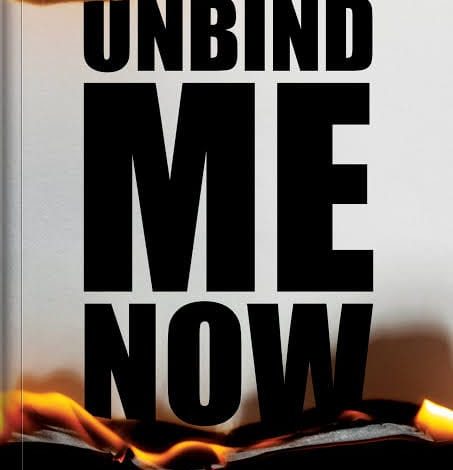
Unbind Me Now by James Eze is a book of outrage. The collection raises a strident voice on our vanishing certainties with a searing exploration of walls on the brink of collapse, the increasing loss of humanity through identity and belongingness and the persistent threats that might lead to a collective ecological grief. And in a world of receding certainties, it silently whispers, in between spaces, a reminder that we must never forget the scars of COVID-19. Consistent with its theme of outrage, the collection deploys the fire motif extensively to name, interrogate, and redirect our gaze to the issues that burn our time. It is broken into five segments with each section delivering verses in smoke, starting with the incendiary flames of the “burning bush” in the opening segment and tapering off with the elegiac homage “to a grieving earth.” The collection turns a private grief into a communal mourning with a shattering sense of loss.
Poet, journalist, cultural organiser and a communications strategist, Eze’s first poetry collection dispossesse won the Association of Nigerian Authors (ANA) Poetry Prize in 2020. It was also long-listed for The Nigeria Prize for Literature in 2022. As a solo act, he released two extended plays, Open Secret and Exhale, exploring the themes of a better world and the journey within. He curated and co-founded Return 2 Idoto, a poetry festival in honour of Christopher Okigbo and A Flutter in the Woods, an annual evening of poetry and music in Awka, Anambra State. He also co-curated the Fidelity International Creative Writing Workshop in Lagos and Abuja. In 2022, he founded the Udala Nation project, a collective that seeks new audiences for poetry through music. In 2025, he chaired the planning committee for Things Fall Apart Day, a cultural celebration commemorating Chinua Achebe’s classic novel and its impact on the society. FB: James Eze, IG: james_eze, X: @jameseze4000 & TikTok: @jameseze_.
Why Does God Need a Gun? by Ogaga Ifowodo have poems that constitute ‘From the Forest of a Million Demons’ and the second section are drawn from the horrors of the terrorist wars waged by Islamic fundamentalists, more generally known through the group nicknamed Boko Haram (Book is Forbidden) for their peculiar aversion to formal education. The scroll of their crimes as the guardians of God would stretch round the entire African continent and beyond. In choosing to make the sad but inspiring case of Leah Sharibu the heart of his poetic ruminations, Ifowodo’s intention is to beam light on an image in the hope of illuminating the entire canvas of murder and mayhem. The forest assumes the dual status of prison and mirror, a gruesome stage where the claim of divine authority is turned by the victim, a sapling, against the bearded guardians of God. The rest of the poems, even the merely meditative or amusing, ponder from varying standpoints the fraught question of creeds and the (in)credulous.
Lawyer, poet, writer and activist, Ifowodo has previously published five collections: Homeland and Other Poems (winner of the 1993 ANA poetry prize), Madiba (winner of the 2003 ANA/Cadbury poetry prize) and The Oil Lamp (winner of the 2005 ANA/Gabriel Okara poetry prize). A Good Mourning and Augusta’s Poodle were shortlisted and longlisted, respectively, for The Nigeria Prize for Literature. Why Does God Need a Gun? is his sixth volume. He has also published the scholarly work, History, Trauma, and Healing in Postcolonial Narratives (New York: Palgrave Macmillan, 2013). He is a recipient of the Barbara Goldsmith Freedom-to-Write Award of the American PEN Centre, the Free Word award of the Netherlands-based Poets of All Nations, an honorary member of the PEN Centres of USA, Canada and Germany, and a fellow of the Iowa Writing Programme. He was Assistant Professor of English at Texas State University until 2014 when he returned to Nigeria. He is also a columnist. https://www.facebook.com/ogaga.ifowodo.
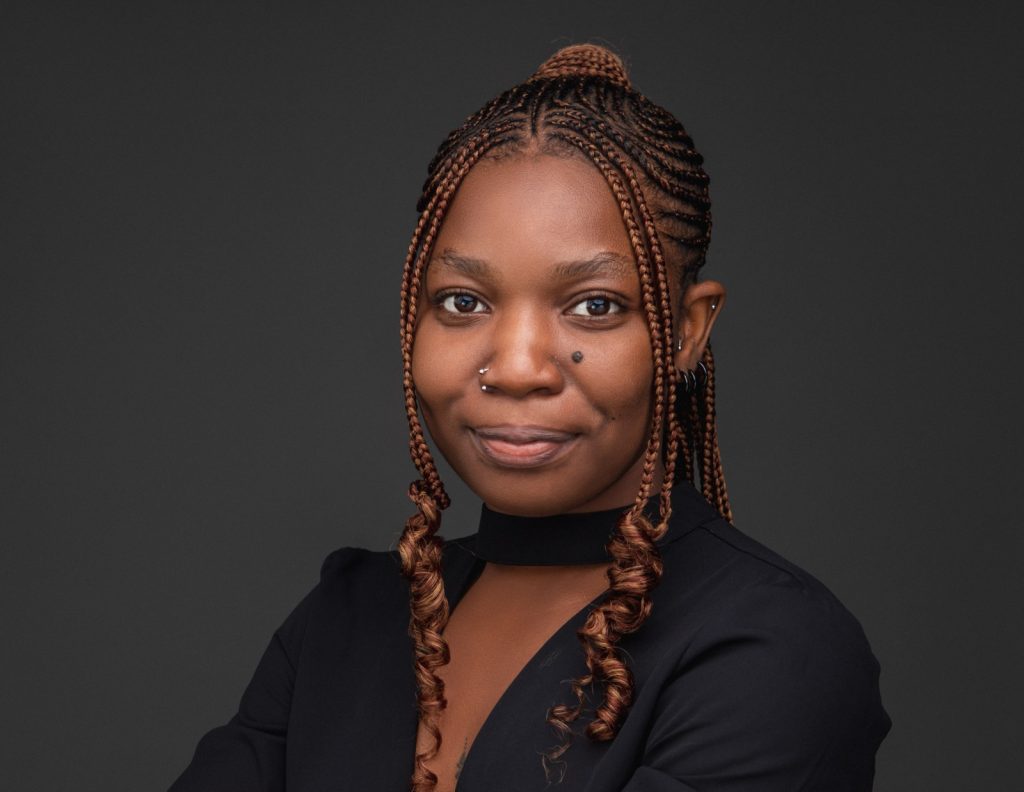
Juliet Nnaji
Moderating CORA-NLNG Book Party 2026
WRITER, spoken word poet and storyteller, Juliet Nnaji is a regular feature in most of Lagos literary events, especially performance poetry circuits. Her poetry has served as a bridge between cultures through the WO2WA (West Oakland to West Africa) Renshi Poetry Exchange, between West Oakland, California, and Lagos, Nigeria. She won the 2022 Vweta Chadwick Poetry Prize, becoming the inaugural Voice of ASHA. Since then, she has performed at festivals such as Lagos International Poetry Festival (LIPFEST) and Lagos Book & Art Festival (LABAF), and shared stages with luminaries like Wole Soyinka, interlocuting alongside Tade Ipadeola in a celebration of poetry. She has also been a regular feature at the annual World Poetry Day staged every year in March to mark the UNESCO-declared feats of poetry to celebrate the importance poetry to humanity. She is the founder and Creative Director of Mic & Mind, a close-knit open mic and creative gathering that makes room for creatives to share their work in an intimate setting. It’s a platform through which she is building a creative community that holds people, including herself, long enough for their work to grow. Her essays have appeared in The Republic, More to Her Story, Black Ballad UK, Brittle Paper, among others. Watch her full video on YouTube – https://lnkd.in/d8CA5HNN.