Nigeria’s education crisis is no longer about enrolment, it’s about system capacity

By Editor
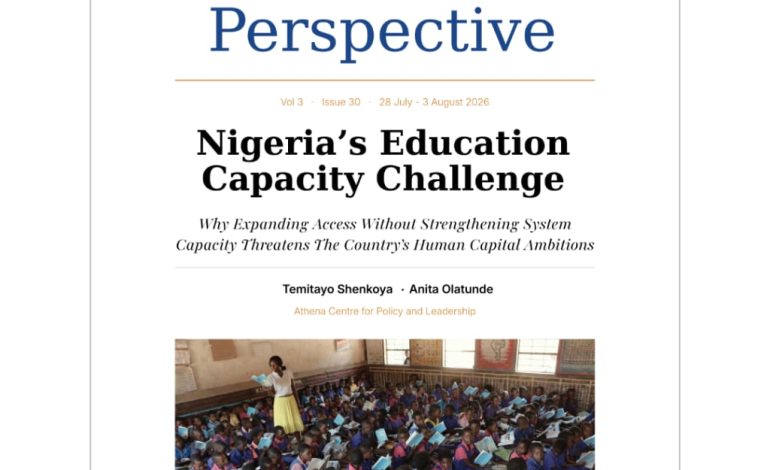
NIGERIA’S greatest education challenge is no longer getting children into school. It is building an education system with the institutional, instructional, and governance capacity to convert rising enrolment into better learning outcomes and stronger human capital. That is the central finding of a new policy publication by the Athena Centre for Policy and Leadership, ‘Nigeria’s Education Capacity Crisis: Closing the Gap Between Enrolment Growth and System Capacity,’ authored by Professor Temitayo Shenkoya and Anita Olatunde.
The study finds that Nigeria has expanded access to education at a scale unprecedented in its history, but investment in classrooms, teachers, infrastructure, school leadership, and governance systems has not kept pace with demand. The result is a system that is increasingly overcrowded, under-resourced, and unable to consistently deliver quality learning outcomes.
The key findings show that 40.1 million learners were enrolled in Nigeria’s public basic and secondary education system in the 2024/2025 academic year, across 107,042 public schools, approximately 60 students share a single classroom, and about 66 students share one toilet, indicating severe overcrowding and major sanitation deficits and that Nigeria allocated just 0.3% of GDP to public education in 2025, significantly below levels in many peer African countries.
According to the authors, these figures point to a structural capacity crisis, not a temporary funding shortfall that shows that governance, and not enrolment, is the real challenge. The report argues that education system performance depends not only on physical infrastructure but on institutional capability, teacher deployment, instructional quality, integrated data systems, accountability, and coordination across all levels of government. It identifies fragmented planning, weak execution, limited use of education data, and poor institutional coordination as the major constraints on performance.
“Nigeria’s education challenge is no longer defined solely by access; it is increasingly one of system capacity,” the authors state.
The report proposes a reform agenda built around the Digital Nigeria Education Management Information System (DNEMIS) that recommends Integrated State Education Management Information Systems linked to DNEMIS, multi-year investment in classrooms, teachers, and digital infrastructure, evidence-based teacher deployment and strengthened instructional quality and school leadership, annual infrastructure and learning-performance scorecards, targeted support for vulnerable learners and clearer coordination among the Federal Ministry of Education, state governments, SUBEBs, TESCOMs, and Local Government Education Authorities. The authors argue that education investment should increasingly be driven by verified data and measurable learning outcomes, rather than enrolment growth alone.
Drawing on the experiences of Botswana, South Africa, and Namibia, the report contends that stronger education outcomes require institutions capable of continuous planning, performance management, and accountability.
“Success will no longer be measured simply by how many children enrol or how many classrooms are built,” the authors write. “It will be measured by whether governments at every level can use evidence to improve teaching, strengthen school leadership, and ensure that every child learns.”
The report concludes that closing Nigeria’s education capacity gap is not simply an education sector objective — it is a human capital, economic growth, and national competitiveness imperative.