Ifowodo says poetry must confront religious intolerance, fanaticism

By Godwin Okondo
POET and lawyer Ogaga Ifowodo has said his latest collection, Why Does God Need a Gun?, is an exploration of religious intolerance, fundamentalism and the consequences of human beings’ beliefs about God and one another. He argued that it always amzed him that a mere creature would take upon himself to defend the divine, as religious extremists do by taking up arms in defence of whatever supreme being they subscribe to. His poetry collection is therefore designed to expose this hollowness of man’s puny attempt to defend God, who is believed to be almighty.
Ifowodo, whose collection is one of the three shortlisted works for the 2026 Nigeria Prize for Literature, said the book evolved from his long-standing engagement with questions of good and evil, freedom, faith and the human tendency to deny others the right to exist because they believe differently.
The poet explained that the collection’s first section, “From the Forest of a Million Demons”, centres on Leah Sharibu, the schoolgirl abducted by Boko Haram who became a symbol of resistance after reportedly refusing to renounce her faith. According to him, the collection seeks to restore agency to those whose voices have been suppressed, using poetry to celebrate Sharibu’s testimony, womanhood and courage.
“The truly free spirit must be given agency, must be given subjectivity, must be made to speak, must be made to speak in a book,” he said.
The collection subsequently moves beyond Nigeria to the Middle East, engaging with the Salman Rushdie controversy and broader questions of religious fanaticism. It also examines spirituality and differing ways of apprehending the divine, including traditional African perspectives.
Ifowodo said the book was initially conceived under the working title Creeds and the Incredulous, before becoming The (In)credulous, a title intended to accommodate both “the incredulous” and “the credulous”. He said the central concern is how people’s beliefs can become a basis for intolerance towards those who worship or understand God differently.
The poet, however, stressed that although the collection carries strong social and philosophical concerns, he considers artistic craft more important than the message.
“Craft is the first thing,” Ifowodo said, explaining that “the message is secondary,” because issues such as war, intolerance, love and grief have existed throughout human history. What distinguishes art is how the writer treats them.
He said the collection took roughly two and a half years to move from notes and impulses into poems, although the ideas behind it had developed over a longer period. The first impulse, he disclosed, came from the opening question of the collection: “What is your creed?”
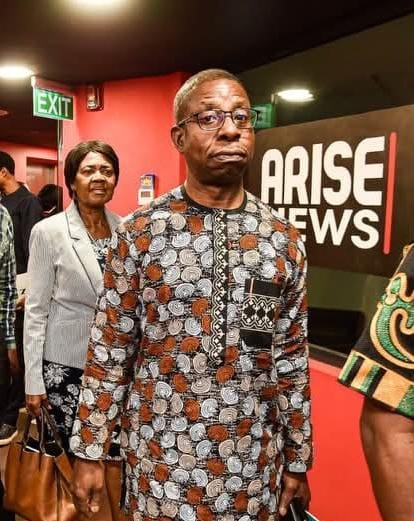
Dr. Ogaga Ifowodo
Ifowodo also described the writer’s major challenge as finding the right words, images and metaphors to adequately represent an idea. “A writer has to be her best critic,” he said, adding that he is “unsparing” and “unsentimental” about his own work.
The poet, who trained and worked as a lawyer before pursuing literature and obtaining an MFA, said he has no intention of allowing literary recognition to interrupt his writing. He disclosed that he already has three works in progress and has begun taking notes for another collection.
On the USD$100,000 Nigeria Prize for Literature, Ifowodo said winning would provide significant financial relief for writers, but disclosed that he would also use part of the money to establish a literary prize at his alma mater, Federal Government College, Warri, Delta State.
He recalled writing his first poem while in secondary school after being encouraged by another student to enter a school arts competition. The poem won first prize, an experience he described as an important early influence on his literary journey.
Ifowodo also expressed reservations about the growing influence of artificial intelligence in creative work, arguing that creativity is fundamentally connected to human complexity and experience.
For him, literature remains an intensely human activity because art depends not only on information but also on empathy, feeling and the complexity of human responses.