The Nigeria Prize for Literature and the plethora of opinions

By Ndidi Chiazor-Enenmor
IT is that time of the year again when voices of dissent rise to a crescendo over a literature prize that is regarded as the biggest in Africa. Let me delve into this quickly. There’s no need to beat about the bush. The Nigeria Prize for Literature has added colour and vibrancy to the literary scene in Nigeria, more than anything else has done in the past two decades and counting. If you disagree, please point out to me what else has. Since the Cadbury prizes were rested, I can’t think of any other prize that has made Nigerian writers churn out as much creative works as they have been doing in the past two decades. I have been in the scene long enough to make this claim authoritatively.
Our society is one that pays little or no attention to writers. Many corporate organisations in Nigeria would rather put their money in sponsorship of musical concerts, football tournaments, and many other things that appear more glamorous. We have seen banks sponsor dance events. I recall the Celebrity Takes Two Dance programme sponsored by one of our commercial banks some years ago. I was amazed at the quantum of money this particular bank sank into that dancing competition. We have the Maltina Dancetheaon. We have companies sponsoring Big Brother Naija. The list goes on. They consider these programmes as a priority in their Corporate Social Responsibility. We are not crucifying them. Our libraries lack books, and the government and corporate bodies don’t care enough.
But here, we have the Nigeria Liquefied Natural Gas (NLNG), sponsoring a literature prize consistently for over two decades, and some writers and pretend writers want to crucify them. Daily, more critics are joining the bandwagon. Haba! Pretend writers, I say, because some of the loud critics have not written or published a pamphlet. But everybody wants to adorn the garb of a writer. Everyone wants to talk. Everyone wants to suggest something to NLNG and the Advisory Board. While some are questioning the composition of the judges, others are picking on the amount of money spent on the Grand Award Night. Some others are shouting at the rooftops about the winner-takes-all. Haba! Fellow Nigerians. E don do. E don do!
We know that things can be done better, differently, yes. We know that there are areas for improvement, yes. But does that justify the glut of criticisms? No, no. Some have even gone to the ridiculous extent of asking that the prize be cancelled. Why call for cancellation of the prize when you don’t have a replacement for it? Is it not absurd? So, if the prize is cancelled, what would be the gain of the critics? And what will they criticise next? A no prize literary space? What would be the gain of Nigerian writers? What will be the fate of the CORA-NLNG Book Party? That book party is one of the yearly rendezvous where the remaining writers left in Nigeria meet up. A lot of writers have left the shores of this country. The book industry is not so boisterous. The NLNG gives writers something to look forward to every year, and some people are asking that it be cancelled. Is it not a sinister suggestion?
Can’t the critics of The Nigeria Prize for Literature channel their angst against the writers (and publishers) who go into oblivion once they clinch the prize? Fish them out, and call them out. Anote Ajeluorou has done this before. We need more voices in that regard. Many writers whose books made the longlist and shortlist of the prize have vanished from the scene. The winning and shortlisted books are nowhere to be found. The most painful is that even some previous winners of the prize have gone into oblivion. How sad. Is it NLNG that should be printing and marketing the books for those authors and publishers? The answer is no. But our dear critics have even made the ridiculous suggestion that NLNG should be responsible for the availability of the winning books in their blind vituperations. The Igbos will ask, ‘agam aṅụrụ gị nwanyi, tụọrọ gị ute?’ Will I marry a wife for you and also lay the mat for you to sleep with your wife?
It is time to moderate and shift blames.
Why can’t the critics channel their attention to the Faculties of Arts of our universities and ask them to recommend the winning books (the available ones) to their students? They can use them for their courses. This will generate good income for the author and publisher. Certainly, it is not the NLNG that should do this.
For the children’s category, can’t the critics compel the (federal) Universal Basic Education Board (UBEC) and State Universal Basic Education Boards (SUBEB) to get the shortlisted and winning books into the reading lists of our primary and secondary schools? Some of the books being used in our schools are terribly substandard, to say the least.
I agree that the two finalists should be given something by the organisers, but if they choose not to do so, must we crucify them with needless criticisms? My book, A Hero’s Welcome, made the longlist in 2019, and in 2024, I made it to the shortlist of three with A Father’s Pride. I understand that hollow feeling of getting that far and close and going home empty-handed, but I had to remind myself that The Nigeria Prize for Literature does not define me, as a writer. It does not define my writing success. Any writer worth their salt should come to that realisation. I do not also believe that a winner of the prize should be under any obligation to share the prize money. That is not the only parameter to define the kindness of a writer. I know that Romeo Oriogun (Nomad) and the other two poets in 2023 had an agreement to give out that sum by whoever wins among them. I doff my hat for them. Romeo respected the agreement. I doff my hat for him.
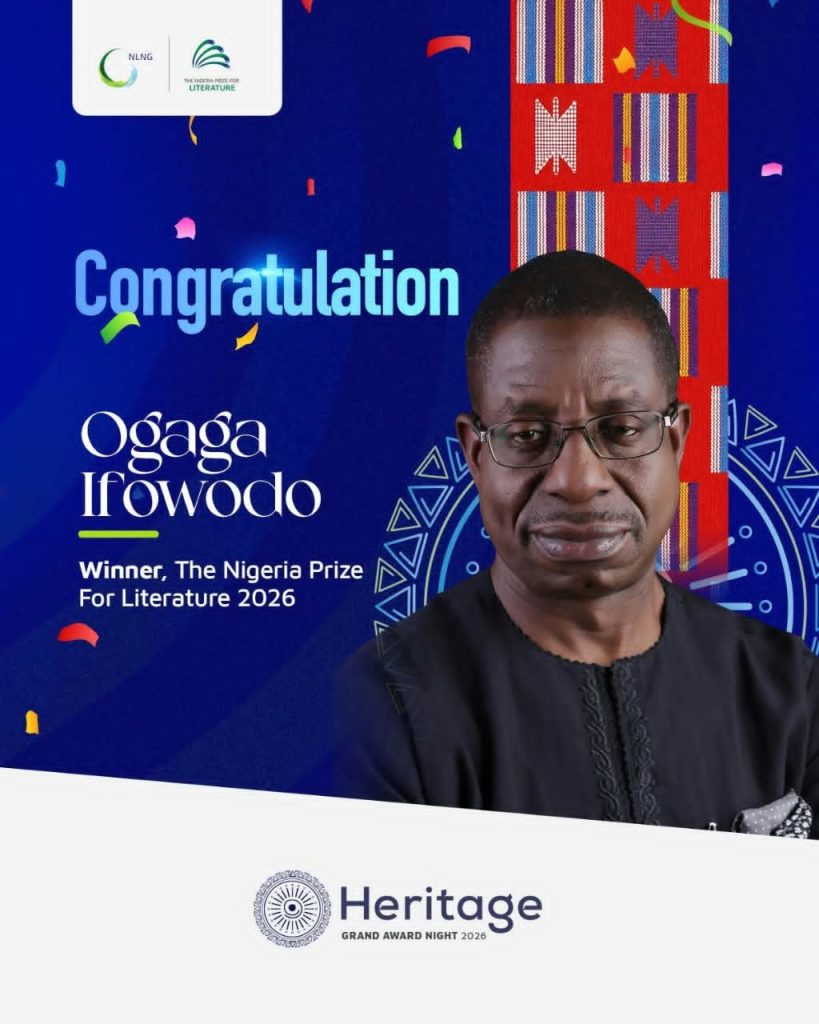
Dr. Ogaga Ifowodo
As a way of giving back to society in my capacity as a writer, I donate copies of my books to children from low-income communities. I do this on a consistent basis. Those who know me personally can attest to this. I run workshops for upcoming writers on a consistent basis. So, if I had won the prize in 2024 and decided not to publicly declare who and who benefitted from the largesse, would you say that I am not generous? Many times, I choose to keep my acts of random kindness private because I do not do them for public acclaim. God is the one who rewards, and He has the bigger shovel.
I have made modest success out of my writing career. It’s been a beautiful journey against all odds. I will continue to improve myself because there is still so much to do. I have won other prizes and the most important thing for me is that my books do not go out of print. That is where I fault many writers, especially those who print a few copies of their books just to submit for a prize. That’s not writing. That is kalo-kalo.
Again, to the critics who badger NLNG, how many of you have called out the Anambra State Government for reneging on its commitment to the Chinua Achebe Literature Prize. I won the 2025 edition of the prize with my book, See Morocco See Spain. After many months of stony silence from Anambra State, the National Executive of the Association of Nigeria Authors had to pay the one million naira prize money to me from ANA purse. Previous winners of the prize also experienced long delays before they got their money. Thankfully, United Nigeria Airlines has now taken over the sponsorship of the prize. Did our vociferous critics go sleep then or that prize doesn’t matter to them? Such selective criticism is foolishness.
The NLNG, a gas company, deserves accolades for its role in supporting Nigerian literature. They don’t deserve this charade of condemnation. I have been privileged to attend several international book fairs, and I marvel at the support governments of other nations give their book industries. But in Nigeria, the story is different. I have visited public libraries in several cities in Canada, the United States of America, and the United Kingdom. I have been to the National Arts Theatre in Ghana as well as some of their public libraries. What I have seen makes me want to shed tears concerning the state of our public libraries. Let us channel our collective energy towards asking our government to do more for the book industry and for education in general. The critics should please let NLNG breathe. We should not kill the Nigerian literary goose that is laying the golden egg. Before you write again to condemn, close your eyes for a moment and imagine how dull the Nigeria literary space would be if the NLNG pulls out of it.
A word is enough for the wise!
See you at Accra if you’d be at Pa Gya 2026 festival! I will be there, courtesy Goethe Institut, Ghana.
* Chiazor-Enenmor’s children’s books have appeared on the longlist (2019) and shortlist (2024)