Images, poetry, conversation at Yemisi Shyllon Museum of Art, Lagos

By Glory Damilola Folami
“TO be or not to be—that is the question…” So muses Shakespeare’s tragic hero, Hamlet, in his soliloquy as he grapples with the burdens of existence and the uncertainties of being. Yet, while Hamlet appears to lament the burdens that accompany the very art of living, the Yemisi Shyllon Museum of Art, Pan-Atlantic University (PAU), Ibeju-Lekki, Lagos, seems to approach the question from an entirely different angle, celebrating the very wonders of existence in its new exhibition, What Is Given, which took place on Wednesday, 15 October 2026.
Featuring the works of Omolola Coker (Nigeria), Emmanuel Ellis (Ghana), Vincent Frimpong (Ghana), and Edward Prah (Ghana), winners of the Nigerian-Ghanaian Myma Art Prize Contest, the exhibition invites viewers to reflect on what it means to inherit, to receive, and in turn, to give back. Through painting, photography, sculpture, and installation, the four artists draw on materials and forms ranging from adire and batik to family photographs, second-hand objects, and symbolic impressions, exploring the ways in which history, memory, heritage, and cultural identity find expression in the things we make, keep, and pass on.
But beyond these material and cultural inheritances lies a more intimate question: how much of who we are, and how we understand the world around us, is shaped by what came before us? ‘What Is Given’ seems to suggest that being is never quite separate from these inheritances; we come into a world already rich with histories, meanings, and experiences that shape our understanding of ourselves and our place in it. Yet we are not merely vessels for what has been handed down. We interpret, alter, and sometimes question what we receive, adding our own stories to the ones that precede us. And perhaps this is what it means to leave a legacy: to have lived, to have been shaped by the world, and to have offered something of ourselves in return.
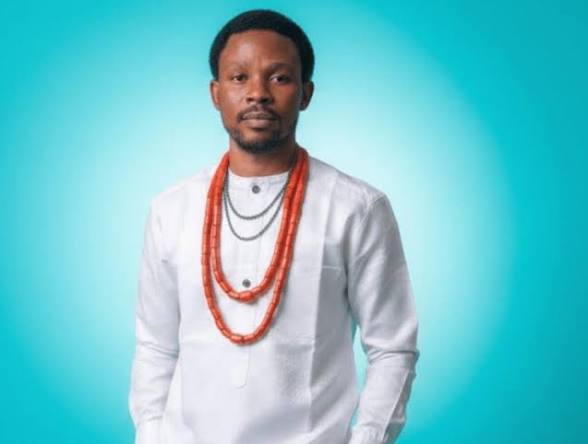
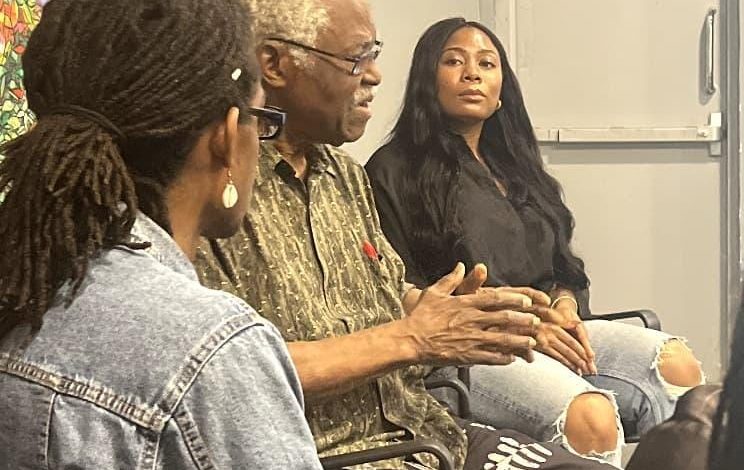
If the preliminary exhibition was a meditation on what we inherit and the ways in which these inheritances shape our becoming, the symposium that followed titled ‘What Is Given: When Poetry Becomes Art – Poetry, Art and the Exchange between Image and Word’ — was an ode to the wonder of being itself. Bringing together distinguished poet Professor Mark Nwagwu, author of Curved Fortunes and Petals Please, and Omolola Coker, one of the winners of the Myma Art Prize Contest, the panel offered an opportunity to reflect on existence through the distinct but complementary lenses of poetry and visual art. Their conversation returned to a question as old as human consciousness itself: what does it mean to be? To exist? Not merely as a mass, occupying space in the world and passing through the motions of living, but to be conscious of our existence, to wonder at it, and to find ways of giving expression to its many complexities.
Perhaps there is something remarkable about our capacity to turn the ordinary materials of our lives into vessels of meaning: a word arranged into a poem, an image rendered on a canvas, a memory preserved in a photograph. Or even things as mundane as a fleeting conversation, a familiar gesture, a moment of acute disappointment, or the quiet rituals of everyday life. In all these acts, we find the possibility of making meaning out of the seemingly insignificant, giving form to the ineffable, and expressing something of what it means to be human; something of our experience is made visible, something of our being offered to the world.
When asked what inspires him as a poet, Professor Nwagwu responded simply and humbly: “I am a human being, an ordinary human being to begin with.” On the surface, this might seem an underwhelming response, perhaps even a curious departure from the question itself. Yet, there is more to this statement than meets the eye. To plumb its depths is to confront the inadequacy of the categories through which we attempt to make sense of one another, and perhaps, too, the limitations of our attempts to capture a life at any single point in time.
As the conversation unfolded, the meaning of his words began to take shape in the many dimensions of the life he shared with the audience. Here was a poet who also happens to be Professor Emeritus of Cell and Molecular Biology at the University of Ibadan, a man whose intellectual pursuits span the seemingly disparate worlds of scientific inquiry and literary expression. Yet, beyond these titles, the octogenarian revealed a more personal side of himself: a man who enjoys a good beer and appreciates beauty in its many forms. These details might seem inconsequential taken in isolation, but together they offer a glimpse of a person who cannot be fully understood through any single description. And perhaps there is something else to consider here: that who we are is never entirely confined to the present. We are, in many ways, the accumulation of what we have lived through, the sum of experiences that have shaped our understanding of the world, even as we remain open to the possibilities of who we might yet become.
To call Professor Nwagwu a poet is to say something true about him, but not everything; the same holds for his identity as a scientist. Neither title, nor the two combined, can account for the entirety of his being, for the person he was before these identities took shape, the person he is now, and the person he continues to become. We are constantly moving between these different dimensions of time, carrying the past into the present while making room for a future that has yet to reveal itself. There are, after all, so many things that make us who we are; some grand and others seemingly ordinary, that no collection of titles or labels can adequately contain the whole of a person. Perhaps, then, Professor Nwagwu’s response invites us to look beyond the familiar markers by which we define ourselves and others, and to recognise the ongoing, unfinished nature of being human. To begin with the admission of being human is not to say very little about oneself, but to acknowledge the many things one has been, the many things one is, and the many things one might yet become.
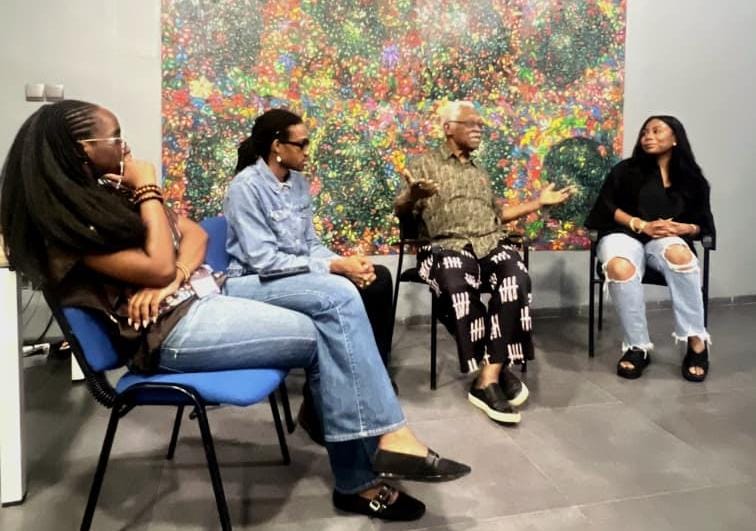
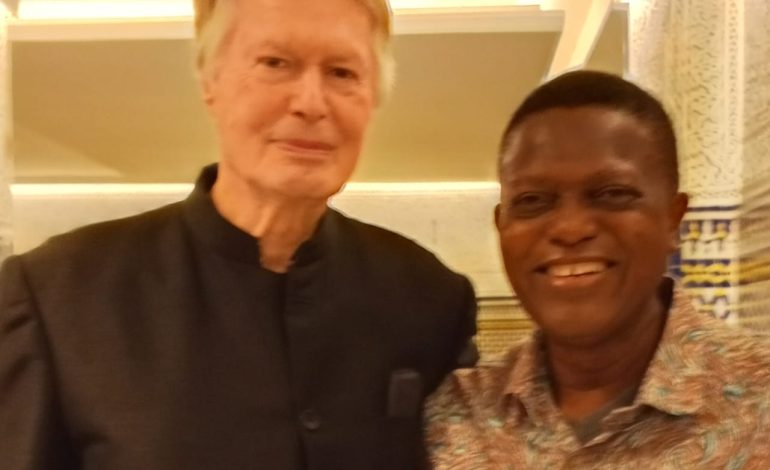
Omolola Coker (right); Prof. Mark Nwagwu and two other guests at the event
Coker would go on to corroborate Professor Nwagwu’s remarks when asked the same question, offering a perspective that brought the conversation back to the relationship between art and the experience of being human. “Art itself is an expression of what you experience, whether it is something you’re digging up from your past or you’re just confronting in that moment or something you’re currently going through, and the only way you can get through that moment is letting it out,” she remarked. In her response lies an understanding of art as something that emerges from the ongoing business of living, from the memories we carry, the realities we grapple with, and the experiences we have yet to make sense of. The artist, in this sense, becomes a conduit, a channel through which something within us finds its way into the world. Sometimes, it is a feeling too overwhelming to contain, a memory that refuses to settle into the past, or an experience for which ordinary language offers no adequate expression. At other times, it is simply the quiet insistence of something that needs to be said, seen, or felt. Whatever its source, art offers these experiences a form through which they can be encountered, not only by the artist but also by others who may recognise something of themselves in the work.
Yet, art does more than give expression to the experiences of the individual; it also preserves something of the time in which it was created. Every work carries, in some measure, the imprint of its moment: the anxieties, aspirations, sensibilities, and circumstances that shaped its making. Even when an artist draws from the past or reaches towards an imagined future, the work bears traces of the present in which it came into being. A poem, a painting, or a photograph may begin as a deeply personal response to an experience, but over time, it can become a record of something larger, offering later audiences a glimpse into how people lived, felt, and understood their world at a particular point in history. In this way, art becomes a marker of time, holding moments that might otherwise recede into memory and allowing them to be encountered long after they have passed.
Perhaps this is where the connection between Coker’s remarks and Professor Nwagwu’s becomes most apparent. If being human means inhabiting the shifting terrain of memory, experience, and possibility, then art becomes one of the ways we give expression to that movement. We draw from what has been, make sense of what is, and sometimes reach towards what is yet to come, transforming the materials of our lives into something that can outlast the moment of its making. What begins as an artist’s attempt to give form to an experience may eventually become a window into an entire moment in time, allowing those who encounter the work in the future to glimpse something of a world they never inhabited and perhaps recognise something of themselves in it. Art thus becomes both an expression of our passage through time and a means of resisting its erasures, a way of making the fleeting endure.
The conversation continued with further reflections on the relationship between lived experience and artistic expression, before drawing to a close with a photo session that brought the speakers and audience together in a moment of shared experience. Yet, if the symposium had offered an opportunity to consider art through words, what followed invited the audience to encounter it more directly. The gathering proceeded to the exhibition, where Coker took the audience through her works, offering insights into the processes behind their creation and the experiences, ideas, and inspirations that informed them. As she spoke about her artistic choices, the media used—adire and batik—and the thoughts that found expression in her work, the pieces became more than images and objects to be admired; they became entry points into the memories, questions, and personal encounters from which they had emerged. The audience was invited to look beyond what was immediately visible on the canvas and consider the intentions, decisions, and lived experiences that had shaped each work. In this way, Coker’s guided tour extended the earlier conversation, bringing its reflections on being, memory, and the passage of time into closer contact with the art itself. What had been explored in the abstract through poetry and discussion now found a more tangible expression in the works before them, offering a glimpse into how an artist gathers fragments of experience and transforms them into something that can be shared with others.
Perhaps, in the end, this is what What Is Given leaves us to consider: that existence is as much about what we receive as it is about what we choose to make of it. We inherit histories, memories, and ways of seeing the world, but we also gather experiences of our own, carrying them through time and finding, in one way or another, the means to give them expression.
Through poetry and visual art, Professor Nwagwu and Coker offered glimpses into this deeply human impulse to make sense of our lives, to give form to what might otherwise remain unspoken, and to leave something of ourselves behind. Their reflections also remind us that we are never quite finished becoming; the past continues to shape us, the present offers new ways of understanding ourselves, and the future holds possibilities we cannot yet imagine. Art, in this sense, becomes both a testament to our passage through time and a gift to those who come after us, preserving something of what it meant to be here, to have felt, to have wondered, and to have lived.
Maybe the question that lingers after the exhibition is not simply what we have been given, but what we will make of it, what we will add to it, and what, in the fullness of time, we will leave for others to discover.
* Folami, a book editor, aspiring writer, avid reader with a keen interest in fantasy, classic fiction, drama, satire, African and historical fiction, enjoys exploring ways stories reflect culture, identity, and the human experience through thoughtful literary criticism