Deborah Uzoma’s children’s poetry, ‘My Father’s House and Other Poems’: A review

By Christabel Onyema
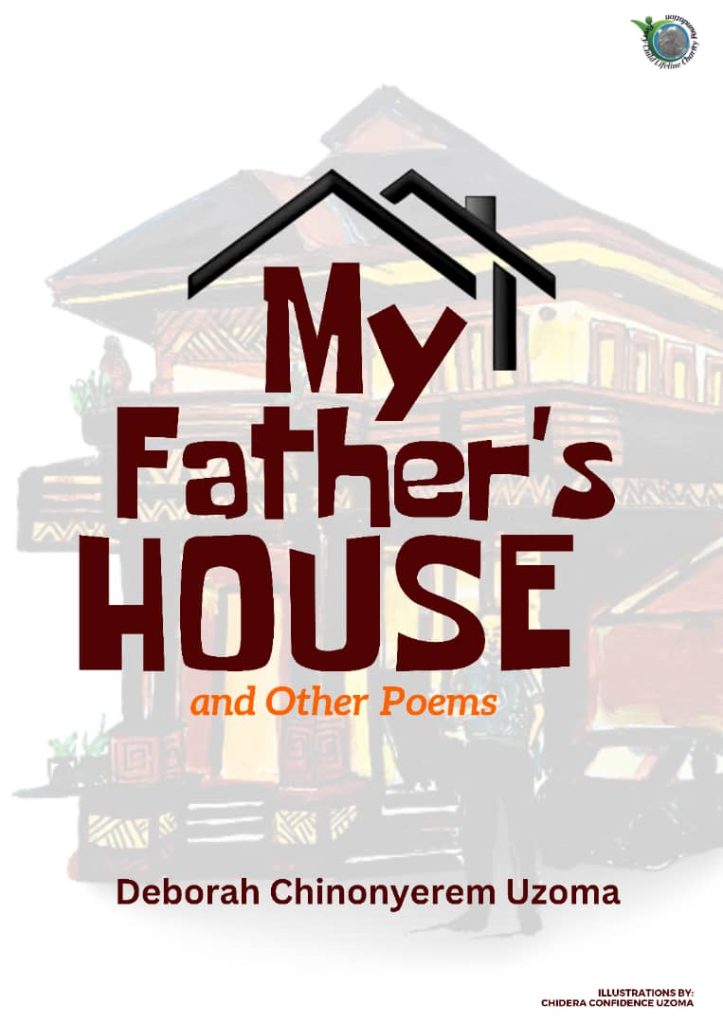
MY Father’s House and Other Poems (Purple Shelves Literary Services; 2024) is Deborah Chinonyerem Uzoma’s debut children’s literature. The poems in the collection cover such topics that have to do with cultural values and virtues for children which will help them grow up and be useful to their families and societies. It is a teaching tool for children from the crèche to primary school, which will guide them to live responsibly as members of the family the society at large. Her primary audience are particularly children in the nursery and lower primary schools. The language use is simple and comprehensible to children at these levels, they do not require explanations as there are pictures/illustration against each title.
There are 30 poems in the collection with varying themes (central ideas) ranging from act of appreciation, greeting, certain etiquette, developing reading habits, the importance of family and education. Uzoma’s collection of poetry is made up of short rhythmical poems that children could memorize and even recite daily to guide them to become responsible members of the society as they grow into adolescence. It introduces children at the pre-primary stage to the poetry genre of literature. The poems deal with everyday topics and experiences familiar to children, they contain fantastical elements that captivate young children, some of them evoke joy or excitement while others contain certain elements that will help the child connect with his/her experiences in the real world.
The poems in the collection cover such topics like fruits and their importance (‘Sweet pawpaw’), showing appreciation in ‘Thank you’ and ‘My new slippers’, where the poet stated some of the reasons that will make a child to wear slippers instead of walking barefooted. There are also teachings on how to brush the teeth in ‘The way to brush my teeth’. Greeting one’s parent and elderly ones around in ‘Good morning.’ The need to believe in yourself in Believe’.’ How to hold a pencil in ‘The way I hold my pencil.’ Encouragement to read their books in ‘Reading my books,’ teaching them to appreciate God for providing them with food in ‘Before I eat.’ The importance of a good name in ‘My name’ patriotism or devotion/love for their country in ‘I love my country’.
Other themes include, appreciating their mother’s and father’s handwork in ‘The woman I love to see’ and ‘My father’s house,’ respectively. Encouraging diligence in ‘The cleaner in our house’ and Importance of rest and sleep in ‘Bedtime.’
The poems in the collection are wonderful tools for fostering literacy skills, sparking imagination and engaging young minds. The descriptive language employed by the poet creates vivid mental pictures for the children, while the rhythmic structures/lines will help the child connect with the poems’ flow and also in explication of meaning.
The few simile used in the poems will help the children visualize and understand some of the topics in more tangible ways, for example in ‘I want to get of right’. ‘….like chocolate bars on my tongue.’ The poet’s style is unique as she employs unique graphological skills. The arrangement of the poems on the pages of the book with eye-catching pictures is appropriate for children and aids in children development. Also, there are variations in the appearance of the stanzas and lines to draw the reader’s attention.
There are use of repetition of words, phrases or clauses, rhymes, alliteration and assonance as well as parallel constructions to foreground the importance or significance of the lines – when a child repeats a word or clauses several times the meaning is internalized immediately. There are also use of exclamation marks (a phonological feature) to arouse excitement in some of the poems, which are characteristics of children’s poetry. There are long lines followed by shorter lines in some stanzas, while some have equal lines; as we know, children love variety.
Like I said earlier, MY Father’s House and Other Poems explores everyday topics and experiences relatable to children. The language use is straightforward with simple or short lines, avoiding complex vocabulary that makes it easier for children to understand and appreciate. The collection will make an interesting read to children and is suitable for children at the pre-primary and lower primary levels. I strongly recommend it and wish the state primary school board will recommend it too.
* Prof. Onyema teaches English at Federal University, Otuoke, Bayelsa State