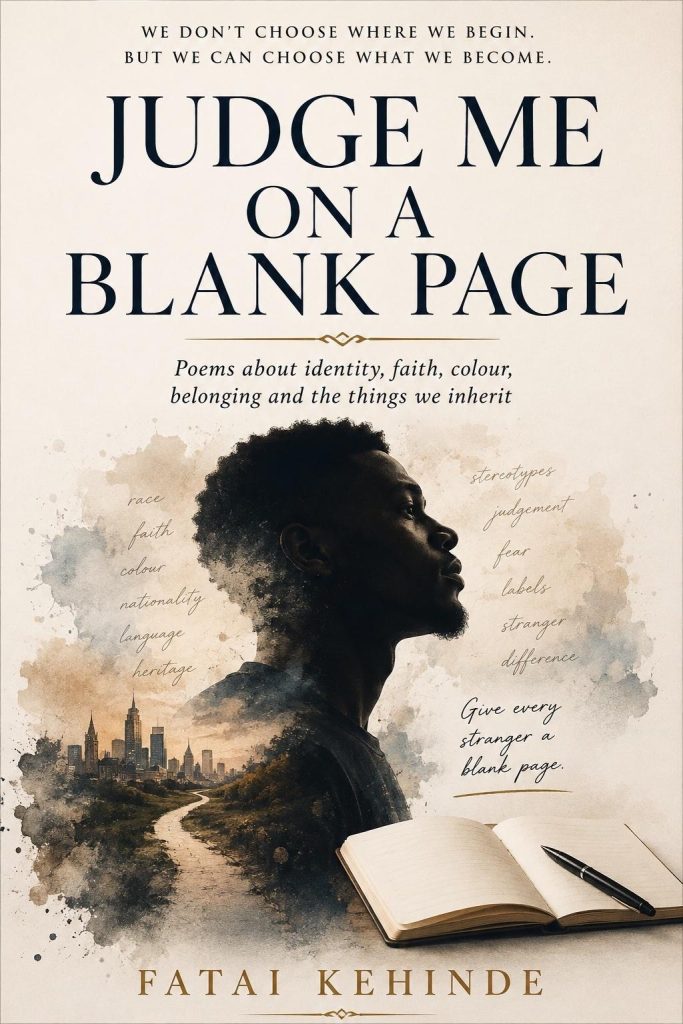
A case for my accusers: A review of Kehinde Fatai’s ‘Judge Me on a Blank Page’

By Freedom Olarenwaju
I happen to have an affinity for philosophy. For some reason I cannot quite explain, it tickles some part of my brain in a particularly satisfying way. Be it African, Western or Eastern, I find myself slipping straight into “the zone” whenever I’m tinkering with ideas of this nature. As such, I tend to think of poetry as a form of philosophy. Only, rather than the high and lofty philosophy of the cerebral kind—with its brain-numbing expositions and whatnot—it’s a sort of philosophy distilled into an art form.
Be that as it may, for someone who’s particularly fond of philosophy, I simply cannot seem to get the hang of poetry. To me, poetry is an enigma: it eludes me. With its cloaked and subtle meanings (especially those); its undulating forms and hard-to-pin-down metres; its catchy rhymes and soul-embedded rhythms; its intricate techniques (don’t even get me started on figures of speech) that lend it a certain musicality…and so on and so forth. There is, in poetry, a curious alchemy of thought, language, sound, and form that I find both fascinating and utterly confounding. For all my affinity for ideas, I struggle with the very thing poetry asks of its reader: meaning. I can neither seem to pry open the hidden meanings behind its cloaked words nor bring myself to impose an interpretation of my own, for who am I to attach meanings to words and thoughts that are not mine? And so, I remain caught in that peculiar limbo—knowing there is something to be understood, yet unable to reach it. It is as though the very things that make poetry beautiful—the layers, the ambiguity, the music—are precisely what keep its meaning just beyond my reach.
In my experience, people tend to react in one of two ways towards qualities (and skills) they wish they possessed but do not. They either resent and deride the very quality they observe—sometimes even scorn it with contempt, because they are cowards—or they put it on a pedestal and admire it, much as one might admire a work of art or the stars in the heavens above us. Well, because I consider myself a cultured person—and not a coward—my interaction with poetry belongs firmly to the latter camp.
So, imagine my genuine surprise—and self-imposed apprehension—when I was handed a poetry collection to review. I mean, what do I know about poetry? One can hardly write about a subject with which one isn’t conversant. Regardless, I took the bull by the horns and started reading Kehinde Fatai’s Judge Me on a Blank Page… and I must say I was thoroughly underwhelmed—at first glance, that is. So, what did I do? I closed the book, went about doing other things, then came back to it. And I’m glad I did.
Now, I might not be conversant with poetry, but if there is one thing that is my forte, it’s identifying a good story—and at the core of a good story is structure. In the same way that rhythm is the heartbeat of a poem, structure is the backbone of a plot, as are its story beats. Reading through Fatai’s work, I began to discern what felt remarkably like a three-act story structure. The full-length collection is divided into eight parts, which, to my mind, unfold across three broad acts: Parts I and II constitute Act I—the Exposition/Set-Up and Rising Action; Parts III, IV, and V form Act II—the Confrontation, Conflict, and Climax; while Parts VI, VII, and VIII comprise the final act, Act III—the Falling Action and Resolution.
I must say, I was rather giddy when I caught a glimpse of the aforementioned pattern. It was something of an “Aha!” moment for me. Alongside this structural pattern, I was also able to identify the tone and form of the poems in the collection. Throughout the work—which is written entirely in free verse—Fatai adopts a conversational tone. He seems to be engaged in a one-on-one dialogue with someone, or perhaps with a group of people: chiefly, his accusers, those who find him lacking—or wanting—in some regard. In one sense, he is conversing with them; in another, he is appealing to them.
It’s as though he has unwittingly found himself before this Vehmic tribunal, and now, he must plead his case before judges who have already found him guilty before the proceedings have even begun. This interplay between dialogue and appeal lends the collection a certain dynamism, heightening the tension that runs through it. Consequently, that very dynamism and tension serve to harmonise the collection as a whole, binding its disparate poems into a coherent and unified work.
Well, that’s enough about structure and tone. Another striking aspect of the poetry collection is the range of themes explored and embedded within it. Right off the bat, the overarching themes of this work are identity and belonging.
Hmm…identity. Come to think of it, identity is a rather thought-inducing word. Considering our present era and cultural climate—both on global and national scales—a great deal comes to mind when one begins to contemplate identity. In his work, Fatai probes into identity and belonging as they pertain to race, nationality, borders and religion.
“Before I had a name, I had a country,” Judge Me on a Blank Page begins. That poem, “The Accident of Birth,” marks the genesis of the collection, its melancholic musings reverberating throughout until they culminate in a profound sequence towards the end:
“
…
Yet somehow, years later, the things I never chose became evidence people used to decide who I was.
Maybe we should be careful with the things we call identity.
Some of them began before we had a voice.
“
The poem is a list of potential predeterminants that eventually shape one’s identity. Thus, “The Accident of Birth” introduces us to the collection’s logic: that much of what comes to constitute our identities is determined for us before we are even capable of choosing—our birthplace, nationality, race, religion, and the circumstances into which we are born. We inherit these markers before we possess the agency to accept, reject, or even question them. Yet, as the collection unfolds, Fatai interrogates the curious paradox of being judged by identities we never chose, asking, in essence, how much of who we are can truly be said to belong to us.
Additionally, a sense of miasmic melancholia permeates the written poems, as the poet wearily interrogates these “supposed” predetermined actualities that govern the lives and dealings of human beings even before they are born. Yet this melancholia is not static; it develops alongside the collection’s thematic progression. In Act I, it emerges as the melancholy of inheritance: indoctrination, prejudice, hatred, and inheritance confront the individual with the unsettling realisation that much of what comes to constitute his identity has been imposed upon him before he possesses the agency to question or reject it. But inheritance here operates in both directions: we inherit not only identities, histories, and circumstances, but also the prejudices through which we are taught to perceive the “Other.” Thus, the individual may inherit both the burden of being othered and the learned impulse to ‘other’ someone else. The sadness here is rooted in powerlessness—the recognition that one can be judged by things one never chose, while also being shaped by assumptions one never consciously elected to hold.
Act II then transforms this melancholy from an existential unease into lived consequence. Through its exploration of racism, injustice, and immigration, the collection demonstrates what happens when inherited identities and prejudices acquire social and political consequences: what was once merely imposed becomes something suffered. The melancholy consequently deepens into alienation, exclusion, and the bitter awareness of being made to bear the consequences of identities constructed by others. By Act III, however, the melancholia assumes a more reflective and ultimately redemptive character. Through acceptance, restorative justice, and transformation, the speaker begins to reckon with what has been imposed upon him and, crucially, with what he might choose to make of it. The past cannot simply be undone, but neither must it remain determinative. Thus, across the three acts, the collection’s melancholia moves from inheritance to consequence to reckoning: Act I mourns what was imposed; Act II suffers what was imposed; and Act III wrestles with what to do with what was imposed.
What’s interesting to note is that, at the end of Acts I and III, a title appears twice, acting as a motif: “What Ends with Me.” I took it for granted to be the same poem; however, they are two different poems sharing the same title. This stylistic choice seems deliberate, not merely as a structural device but also as a means of emphasis. By giving two different poems the same title—and placing them at the close of two separate acts—Fatai draws particular attention to the phrase itself, compelling the reader to return to it and consider its significance anew.
At the close of Act I, “What Ends with Me” reads almost like a tentative declaration of resistance: a desire to prevent the prejudices, hatreds, and inherited burdens that have shaped the speaker from being passed on:
“
If hatred travelled through generations to reach me, let it stop here.
If fear was placed inside my hands, I will not pass it on.
If someone taught me to distrust a stranger, I will meet the stranger first.
If somebody told me a whole people were bad, I will look for the person.
…
“
By the time the same title reappears at the close of Act III, however, it carries the accumulated weight of everything that has preceded it. What was initially a question of inheritance has become a question of agency: what, having been handed down to us, do we choose to perpetuate, and what do we choose to end?
“
…
Because somewhere between inheritance and identity there is a choice.
And I want that choice to be mine.
…
“
The repetition therefore becomes emphatic in itself. It underscores the collection’s preoccupation with the transmission of identity, prejudice, and inherited burdens, while marking the speaker’s gradual movement from being shaped by what he has inherited to deciding what will—or will not—continue through him.
With the collection’s strengths duly acknowledged, it is only fair to turn to its weaknesses. For all its thematic richness, Judge Me on a Blank Page suffers from a shortage of linguistic ambition and technique. This is not to suggest that poetry must be bound by elaborate rhyme schemes, fixed metres, or an abundance of rhetorical devices to be considered good poetry. Free verse, after all, derives part of its appeal from its freedom from such formal constraints. But freedom from metre and rhyme does not necessarily entail freedom from poetic musicality: in other words, an absence of rhythm.
In this regard, the collection sometimes feels restrained in its manipulation of language and sound. There’s relatively little sustained use of techniques such as enjambment, assonance, alliteration, or other forms of sonic patterning that might lend the poems greater musical texture. Nor does each poem—with the exception of “Guilty by Resemblance”—always seem to develop a distinctive internal rhythm of its own. There are instances of anaphora, particularly in the repetition of words or phrases at the beginning of lines, and these occasionally provide emphasis and momentum. Beyond this, however, the poems tend to rely heavily on their conversational quality rather than on the musical possibilities of language itself.
This becomes particularly noticeable because the collection deals with ideas that are, at times, weighty and philosophically charged. One might therefore expect the language to rise to the occasion—to surprise, unsettle, or linger in the ear as much as the ideas linger in the mind. Instead, some poems read more like carefully arranged reflections broken into lines than like language consciously transformed into poetry. The distinction is subtle but important: the collection often has something to say, but it does not always make the language through which it says it do enough of the work.
Consequently, while the thematic architecture of the collection is considerably stronger than its linguistic architecture, a greater attention to sound, cadence, imagery, and formal variation could have given the individual poems a more distinctive identity. In a collection so deeply concerned with questions of identity, this is perhaps its most curious limitation: the poems have much to say about what makes us distinct, yet some of them could themselves have benefited from a more distinctive poetic identity.
Having considered both its strengths and shortcomings, Judge Me on a Blank Page not only strikes me as a collection whose ideas are stronger than its technique, but also as a thoughtful and thematically cohesive work whose intellectual ambition gives it considerable merit. Fatai’s greatest strength lies in the architecture of his thought: beneath the free verse and conversational tone is a carefully discernible progression—from the identities we inherit, to the prejudices and injustices that those identities can engender, and finally to the possibility of acceptance, justice, and transformation. Although Fatai may not always exploit the full musical and formal possibilities of poetry, he succeeds in creating a sustained meditation on identity, belonging, inheritance, prejudice, injustice and the possibility of breaking the chains of what we inherit.
That, I think, is what I found most compelling about the collection. Beneath its individual poems lies a larger question: how much of who we are is truly ours to claim? We are born into countries we did not choose, races we did not select, religions we may inherit, histories we had no hand in making, and prejudices we may be taught before we are old enough to recognise them as such. Yet, somewhere along the line, inheritance gives way to agency. We must eventually decide what to accept, what to reject, and—most importantly—what ends with us.
That question gives the collection its lasting relevance. Fatai is not merely concerned with identity as a label, but with identity as a burden, an inheritance, and ultimately a responsibility. In this sense, the repetition of “What Ends with Me” becomes more than a clever structural device; it is perhaps the most fitting question with which he could leave his reader. It transforms the collection’s preoccupation with what we inherit into a meditation on what we choose to perpetuate.
So, would I recommend Judge Me on a Blank Page? Yes—but not necessarily because it’s a technically flawless collection. I would recommend it because it’s a thoughtful one: a collection that has something to say and, more importantly, something worth thinking about long after the final page has been turned.
And perhaps that’s where I, the reluctant poetry reader, find my own point of connection with the collection. I began by wondering what right I had to interpret words that were not mine. But perhaps that was the wrong question. Poetry, after all, does not merely ask to be understood; it asks to be encountered. Its meanings may begin with the poet, but they do not necessarily end there. In reading Judge Me on a Blank Page, I may not have completely solved the enigma that is poetry—and, truth be told, I am not sure I ever will. But I have come to appreciate that perhaps the point is not always to unravel every hidden meaning, but to allow the questions to linger long enough for them to become our own.
As for me, I began reading this book wondering what business I had reviewing poetry in the first place. I’m still not entirely certain that I have figured poetry out. But perhaps that is beside the point. If nothing else, Fatai has managed to do something rather unexpected: he made a reluctant poetry reader stop, look twice, and think. And for a book that asks us to reconsider the identities and judgments we take for granted, that is not an insignificant achievement. For a collection concerned so deeply with the things we inherit, the identities imposed upon us, and the judgments that precede our voices, perhaps the most fitting question to leave with the reader is also the simplest: what, ultimately, do we choose to make of what we have been given? Fatai does not offer an easy answer. Instead, he leaves us with something more valuable—a reason to keep asking.
Reviewer’s Bio
Glory Folami is a book editor, writer, and avid reader with a keen interest in literature, particularly fantasy, classic fiction, drama, satire, African and historical fiction. She enjoys exploring ways stories reflect culture, identity, and the human experience through thoughtful literary criticism.