Three poets, three visions as Eze, Ifowodo, Oburumu race for The Nigeria Prize for Literature 2026 trophy

By Godwin Okondo
THREE poets from different generations and with markedly different literary journeys are now at the centre of attention as the Nigeria Prize for Literature 2026 enters its final stage. James Ngwu Eze, Dr. Ogaga Ifowodo and Tares Oburumu emerged as the three finalists for the prestigious USD$100,000 prize, following the selection of their poetry collections — Unbind Me Now, Why Does God Need a Gun? and Flora’s Love Colony, respectively — from an initial 223 submissions.
The three collections offer strikingly different poetic responses to the realities of contemporary Nigeria and the wider African experience. Yet, beneath their differences are common concerns about violence, identity, history, injustice, political failure and the search for redemption.
The Advisory Board described Eze’s Unbind Me Now, as a work written in fluid and aesthetically captivating language that “decries the sociopolitical dysfunction of the nation and the world at large”, while interrogating the human condition and seeking a path towards redemption. Ifowodo’s Why Does God Need a Gun?, she said, depicts religious and political violence in Nigeria through rich allegory, while Oburumu’s Flora’s Love Colony examines the enduring consequences of colonialism and its effects on identity and society.
For Eze, the journey to the final three is another chapter in a literary career that has moved between poetry, journalism, music, cultural organisation and communications. Born in Enugu, Eze is a poet, journalist, cultural manager and communications strategist. He was the pioneer literary editor of Sunday Sun and has worked in corporate communications. He is also the inaugural chairman of the Things Fall Apart Festival hosted by the Centre for Memories, and has been involved in initiatives aimed at creating new audiences and platforms for poetry.
His debut collection, dispossessed, won the Association of Nigerian Authors (ANA) Poetry Prize 2020 and was subsequently longlisted for The Nigeria Prize for Literature in 2022. His other collection, Goosebumps, enjoyed critical acclaimed before Unbind Me Now brought him back into contention for Africa’s biggest literary prize.
But Eze’s latest collection is far removed from poetry as mere aesthetic decoration. Unbind Me Now is a confrontation with a world he sees as fractured by violence, injustice and moral failure. The collection moves through political violence, ancestral memory, exile, pandemic silence and ecological destruction. Its poems are described as being forged in “fire, grief, and moral urgency.”
Eze himself has described the collection as emerging from “extreme displeasure” and a desire to speak for the voiceless. He has argued that poetry cannot remain passive in the face of injustice, thus giving the work an unmistakable quality of protest and moral intervention. In that sense, Unbind Me Now asks readers not simply to observe the crises around them but to confront them. Its central message is one of awakening — a call to remember, question, resist oppression and refuse the silence that allows injustice to endure.
Ifowodo brings to the competition a literary career deeply intertwined with Nigeria’s history of political repression and the struggle for human rights. Born in 1966 in Oleh, Delta State, Ifowodo is a lawyer, poet, writer, activist and columnist. He studied law at the University of Benin, Benin City, and was called to the Nigerian Bar in 1991. He later obtained an MFA in poetry and a PhD in English from Cornell University in the United States. He also taught poetry and literature at Texas State University.
His literary career has already produced several major recognitions. His first poetry collection, Homeland and Other Poems, won ANA Poetry Prize 1993, Madiba won ANA/Cadbury Poetry Prize 2003 while The Oil Lamp won ANA/Gabriel Okara Poetry Prize 2005. His collection A Good Mourning was previously shortlisted alongside Prof. Tanure Ojaide for The Nigeria Prize for Literature in 2018. That year, Ikeogu Oke won with The Heresiad.
His commitment to human rights has also been central to his public life. As a rights activist with the Civil Liberties Organisation, he worked on documenting human rights violations in Nigeria. In 1997, he was arrested after returning from a Commonwealth summit where he had advocated stronger sanctions against the military dictatorship of Sani Abacha. He was detained without charge until his release in 1998. That same year, he received the PEN/Barbara Goldsmith Freedom to Write Award.
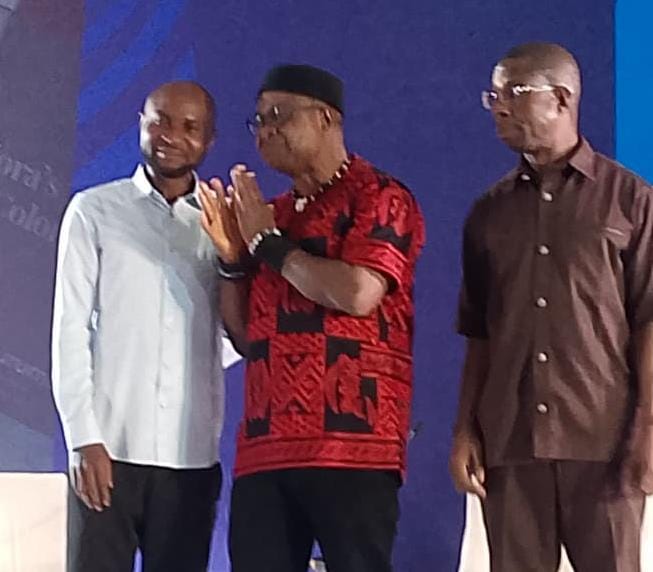
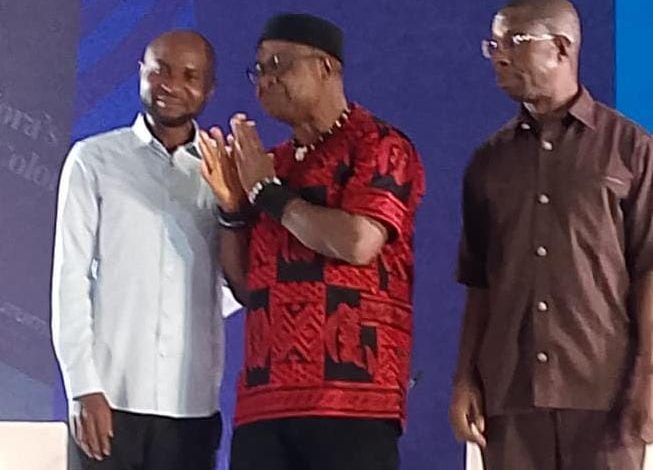
Tares Oburumu (left); James ngwu Eze and Dr. Ogaga Ifowodo after the CORA-NPL Book Party
It is therefore hardly surprising that the question at the centre of his sixth poetry collection is one about violence, faith and the contradictions inherent in religious beliefs. Why Does God Need a Gun? takes its title from a question posed by the poet-persona in the long poem ‘From the Forest of a Million Demons (Leah Sharibu Lifts the Veil),’ which forms the spine of the collection. Ifowodo has described the book as a reflection in verse on what he calls “Creeds and the Incredulous.”
The collection turns its attention to religious extremism and political violence, particularly the horrors associated with terrorism and the victims caught in its brutality. Rather than offering easy answers, Ifowodo’s poetry challenges the reader to confront the disturbing contradiction at the heart of religious violence: how can violence be committed in the name of a God supposedly associated with peace, love, morality and salvation?
Ifowodo’s poetry consequently becomes not only an indictment of those committing violence but also an examination of faith itself. Its message is a challenge to conscience — a demand that readers question the ideologies that allow human beings to justify cruelty to fellow humans in the name of religion.
Oburumu, the third finalist, comes from a markedly different but equally compelling literary background. A poet, essayist and playwright, Oburumu’s work is concerned with history, identity, religion, migration and the consequences of colonialism on the African experience. He lives in Yenagoa, in the Niger Delta, and has built a reputation as one of the distinctive voices of contemporary Nigerian poetry.
His first full-length collection, Origins of the Syma Species, won the Sillerman First Book Prize for African Poets 2022. The collection draws heavily from his upbringing in Syma, a neglected oil-producing region of the Niger Delta, and explores ancestry, family, single parenthood, love, religion and political realities.
With Flora’s Love Colony, however, Oburumu expands his gaze from personal and regional memory to the larger historical relationship between Africa and the forces that shaped its modern identity. The collection looks at the legacy of colonialism and imperial influence, touching on subjects including the Berlin Conference, amalgamation, Biafra, colonial naming, national memory, political failure, war, identity and cultural displacement.
The title itself is deliberately ironic. ‘Love’ becomes a vehicle through which the poet interrogates the romanticised relationship between Africa and the forces of foreign domination. The poems examine how the legacy of colonial intervention continues to manifest in contemporary political, economic, cultural and social realities.
One reading of the collection sees it as a meditation on the tension between freedom and exploitation, asking whether the end of formal colonial rule necessarily meant the end of colonial influence. Its concerns extend from historical memory to present-day questions of ethnic identity, political failure and Africa’s struggle to determine its own future.
The three finalists therefore arrive at the same literary destination from different directions. Eze looks at a world burning around him and turns anger into resistance. Ifowodo interrogates the intersection of faith and violence, asking uncomfortable questions about humanity’s capacity to invoke God while inflicting suffering. Oburumu digs into history, exposing the lingering roots of colonialism in the present. Together, their works offer a striking portrait of contemporary Nigerian poetry — one that is increasingly unwilling to separate art from society, but grafted deeply into it like Siamese twins.
Their emergence from 223 submissions makes the final contest even more compelling. The 11-title longlist announced earlier in August included established and emerging voices, but the final selection has produced a contest between three poets whose works engage with some of the most enduring questions confronting Nigeria and Africa.
The announcement of the winner, expected on 9 October 2026, will determine who takes home the USD$100,000 prize, but the anticipation extends beyond the money. Each of the three books has already demonstrated the power of poetry to preserve memory, confront injustice, interrogate history and force society to look at itself.
Whether the prize ultimately goes to Eze’s fiery call for liberation for Unbind Me Now, Ifowodo’s searing interrogation of violence and faith for Why Does God Need a Gun?, or Oburumu’s excavation of colonial history and identity for Flora’s Love Colony, The Nigeria Prize for Literature 2026 has already produced a shortlist capable of keeping readers, writers and literary enthusiasts guessing until the final verdict. And when the envelope is finally opened, the question will not only be who won the USD$100,000? It will also be about which of these three visions of Nigeria — resistance, reckoning or historical remembrance — has spoken most powerfully to the judges and to our time?