15 centuries of communal history, culture documented in Adesanya’s ‘A Handbook of Sagamu’

By Godwin Okondo
A new book, A Handbook of Sagamu, authored by filmmaker, writer and former lecturer, Ọmọ’ba Deji Adesanya, has been described as an important documentation of the history, culture, politics, economy and social development of Sagamu, Ogun State. The book was unveiled and publicly presented on Thursday, August 27, 2026, at the Centenary Hall, Ewusi Street, Sagamu, with traditional rulers, community leaders, professionals and residents in attendance.
Speaking at the event, the father and chairman of the day, Asiwaju S.K. Onafowokan, commended Adesanya for undertaking what he described as a significant historical project capable of preserving the heritage of the ancient town for present and future generations. He said a community that fails to understand its history risked losing its sense of direction, noting that the book provides valuable insight into the origins of Sagamu, the sacrifices of its forebears and the evolution of the community.
According to Onafowokan, the publication is the product of extensive research and would be useful to young people, people in diaspora, researchers and others interested in understanding the roots, cultural landscape and social development of Sagamu.
“This publication is as a result of a brilliant research,” Onafowokan said. “The book tells us where we came from, the sacrifices of our forebears and the journey that has brought us to the Sagamu we have today.”
Onafowokan further urged schools, universities, libraries and homes to acquire the book, saying it would contribute to preserving Sagamu’s history and culture while inspiring future generations, investors and visitors to appreciate the community.
The Royal Father of the Day, HRM Oba (Dr.) Babatunde Ajayi, Akárìgbò and Paramount Ruler of Remo Land, also praised Adesanya for documenting the history and environment of Sagamu. He described the author’s effort as a valuable contribution to the community, saying it was important for Sagamu to have people who would undertake research and compile its history for future generations.
“It is good for us to have someone like Deji Adesanya in the family, who looked at Sagamu and its environment, and tried to make research and compile this book, which we are launching today,” he said.
The chief launcher, Hon. S. I. O. Kalejaiye, also commended the author, describing the compilation of the extensive information on Sagamu as a major undertaking.
“We have to commend the writer because for someone to stand and put such voluminous information about Sagamu for present and future generations, which we can now improve on in future, it’s not child’s play,” he said.
For Adesanya, the book is the outcome of an idea that had evolved over several years, explaining that the idea first occurred to him around 1999 after he came across a newspaper publication on Who is Who of Kwara. Although he initially considered producing a similar publication on prominent people in Sagamu, he later abandoned the idea after finding it too narrow.
His interest was revived after his mother gave him a book on the history of Ikenne. The publication inspired him to develop a more comprehensive work on Sagamu, combining history with the town’s economy, politics, traditional institutions, education, health, culture, food, festivals and profiles of prominent indigenes.
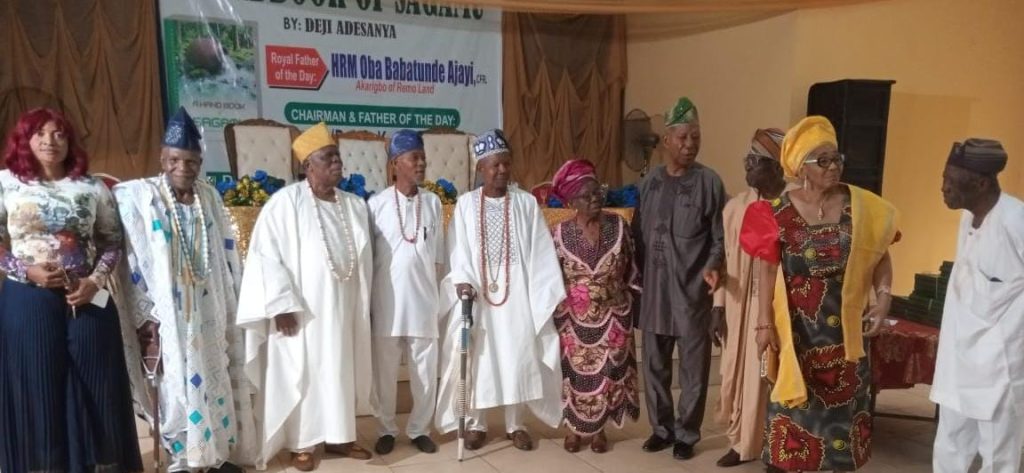
Chairman, Asiwaju S. K. Onafowokan and the author, Deji Adesanya (middle) and other guests at the book launch event on Thursday, 27 August 2026… in Sagamu
“I already had an idea of the history of Sagamu, so why not expand it?” Adesanya recalled. He said his research also examined the traditional system of governance in Sagamu, particularly the role of the Oba-in-Council before and after colonial rule.
According to him, while the modern local government system places political authority in elected officials, traditional institutions continue to play important roles in community life, particularly in dispute resolution.
Adesanya also highlighted Sagamu’s historical importance in the kola nut trade, noting that the town was once a major centre for kola nut trade in West Africa, with produce from the area eventually finding its way to markets outside Nigeria.
Beyond history and commerce, he said the book examines issues affecting the development of the community, including education and environmental challenges. One of the issues he highlighted was the impact of industrial activities on Sagamu’s kola nut industry. He recalled that dust from limestone processing had, at a time, affected kola nut trees and contributed to the decline of kola nut farming in the area.
He also raised concerns about the effect of industrial pollution on workers, noting that environmental and health concerns had eventually led to the introduction of equipment aimed at reducing the amount of dust released into the atmosphere.
Adesanya said his experience as a lecturer also influenced his views on education, particularly the language of instruction in Nigerian schools. He argued that children often learn more effectively when taught in languages they understand, rather than being forced to process concepts through English before understanding them.
Reflecting on what he wants young people of Sagamu to take away from the book, Adesanya said knowledge of one’s roots was essential to developing a sense of identity and responsibility.
“It is important that you know where you come from, so that when you leave that environment and people ask you about where you come from, you must be able to answer correctly,” he said.
He added that knowing one’s heritage should not merely inspire pride but should also encourage individuals to consider what they could contribute to the development of their community.
Adesanya also expressed hope that A Handbook of Sagamu would stimulate conversations about the town’s past, present and future.
“I have looked at the whole gamut, from economics to politics, and from what people have said, it has already started provoking interest in so many ways,” he said. “You have generated a conversation.”
The author is an award-winning scriptwriter, film producer and director who studied filmmaking at Cambrian College of Art and Technology, Sudbury, Ontario, Canada, and Brooks Institute, Santa Barbara, California, United States.
He began his career in cinematography at the Television Service of Oyo State, now BCOS-TV, Ibadan, and worked on documentaries and international sporting events in countries including Germany, Egypt, Kenya and Senegal.
In 1986, he co-founded A-Productions with his brother and, in 1988, co-wrote and directed his debut feature film, Vigilante. He subsequently produced Ose Şàngó (Sango’s Wand), which won the maiden Hubert Ogunde Foundation Award for Best Film of the Year.
His 2010 documentary, Uncommon Service, won the AFRICAST Award for Best Documentary Film among television broadcast stations across Africa.
Adesanya was a pioneer lecturer and former Head of Department of Film and Television Production at PEFTI Film Institute, Lagos, before retiring in 2020. He has also served as a resource person in Film and Multimedia Production for the National Board for Technical Education since 2007.
Through A Handbook of Sagamu, Adesanya has brought together the historical and contemporary dimensions of the community in a single volume, with the hope that the work will serve as a reference point for residents, researchers, institutions and generations yet unborn.