Beyond cultural entertainment, drumming has educational, therapeutic, professional value, says Adeniji

By Anote Ajeluorou
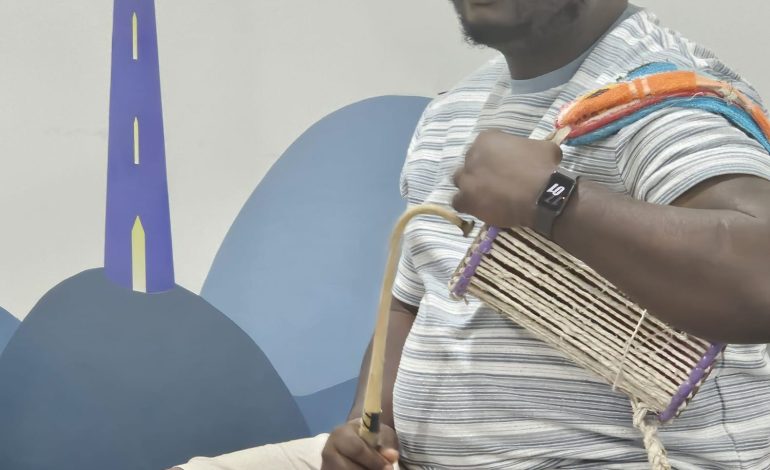
Hammed Adeniji has a uniquely fascinating mix of interests. He speaks the language of drums, just as he thrives in the world of mental health advocacy. In this interview, he speaks about what drumming means to him, the inseparable lines that connect arts and the mind, as well as how a proper understanding of promoting wellness through creative performance can drive positive global health and general well-being
You have certifications in health and social care. Still, you are thriving in the creative performance space. How did this venture into the arts come about?
I am an indigene of Ijebu Imusin in Ogun State. I grew up in a close-knit family of six with our parents. I have a National Diploma, Higher National Diploma, as well as a Bachelor of Technology degree, all in Estate Management. However, in recent years, I have nurtured interest in mental health advocacy and have certifications and expertise in health and social care. Growing up, I engaged in several extracurricular activities growing up as did most Nigerian kids. This, I believe, prompted me to join the Ijebu Students’ Association during my undergraduate studies, and I also served in many capacities, including as president of the association. The Ijebu Students’ Association promotes cultures of the Ijebu people among students on campus. I can say it is from here that my love for culture, tradition through the arts grew. While in Nigeria, I was a member of the prestigious Footprints of David Art Academy and Guild of Nigerian Dancers (GOND), both in Lagos, for several years. Now in the United Kingdom (UK), I am a member of the Nganga Performing Arts and Mobile Theatre, a cultural subsidiary of the C3 Centre for Creativity and Culture that is based in Wales.
You are passionate about mental health care and advocacy. How do you think being a creative fits into this perspective?
Personally, both have never really been separate. I have always understood mental health as a feeling, and I relish the relief that comes after a good session behind the drum, with the audience breathing together when the rhythm locks in. Being a creative gives me a universal language for understanding things I may not have words for. So, mental health advocacy is just naming out loud what the drum has always been doing quietly.
Does this mean positive mental health and wellness can be achieved through creative arts, such as drumming?
Absolutely! Drumming has the unique ability to engage both the body and soul, which helps in reducing stress. As I have observed from the crowd, any time I’m on stage, drumming not only has the ability to reduce stress, but also improves a person’s mood. It helps to strengthens social connections too.
Through creative lens, drumming looks like a favourite for you. How did you discover your passion for drumming?
My passion began at a young age through my cultural roots. I was fascinated by the way the talking drum could imitate human speech and communicate emotions. I realised early that this instrument is more than entertainment, and the more I learned, the more I realised that drumming was not just an instrument but a voice for our history, a tradition, our identity, and a calling.
How do you get creative inspiration; that is, what influences the drumming signature for a particular performance?
Inspiration comes from everyday life, past experiences. What is presently happening in the society influences my signature. The mood of the crowd or calibre of the audience also helps in the type/rhythm of drumming signature I perform. I get inspiration generally by listening to the classical Yoruba music of people like Haruna Ishola, Yusuf Olatunji, etc.
Now that you have had the opportunity to take drumming beyond the confines of ‘familiar’ interpretations available in Nigeria, what do you think makes your skill unique in the UK?
My technical ability sets me apart here in the UK, as I bring the full cultural weight of the instrument with me. The talking drum isn’t just percussion; it’s a language, literally. In the UK, where audiences are often encountering it for the first time, I’m not just performing rhythm, I’m translating a tradition. And because I’ve had to adapt by blending it with sounds and contexts that didn’t exist for me back home, I’ve developed a kind of fluency in code-switching between the traditional and the contemporary. That fusion, done with respect for the roots, is what makes it distinct.
What has been the greatest challenge you have encountered in relation to drumming as an art form?
One of the biggest challenges has been changing people’s perception of traditional drumming. Some see it only as cultural entertainment, but it is also an art form with educational, therapeutic, and professional value. Another challenge has been preserving authenticity while adapting to new environments. These challenges have motivated me to keep learning, improving, and advocating for African arts.
What do you think African art forms, such as drumming, dancing, and playing traditional instruments have to offer in the UK space?
African art forms bring diversity, history, creativity, and community. They introduce new perspectives while celebrating cultural identity. Beyond performance, they promote inclusion, cultural understanding, education, and well-being. They enrich the UK’s multicultural society by creating opportunities for dialogue and shared experiences through the arts.
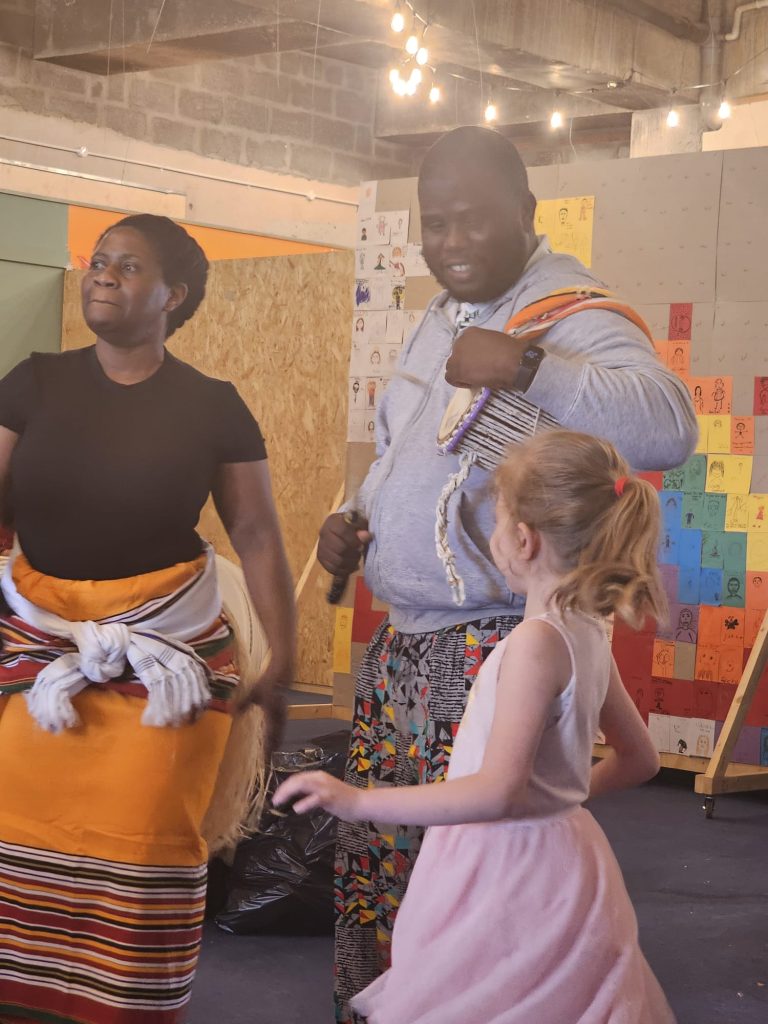
An English child and an adult dancing to Hammed Adeniji’s drumming performance
There is something uniquely interesting about your creative performance side. You are Yoruba; you handle the talking drum, yet you shine even in Igbo cultural performances, especially in an English setting. How have you been able to create a balance in navigating these different worlds?
I believe respect is the foundation. I have intentionally taken time to learn about different cultures, traditions, and the meaning behind their music. Although my roots are Yoruba, I see African culture as something that unites rather than divides us. When I perform in Igbo settings or multicultural events as you just highlighted, it is what is expected of a creative. As an African creative in the UK, my main focus is to showcase the beauty of the African culture. Music has taught me that diversity is strength.
The theme for the 2025 World Mental Health Day was ‘Mental Access to Services-Mental Health in Catastrophes and Emergencies.’ With your expertise, how do you think creative performance can combine effectively with healthcare within this context?
During crises, people often experience fear, anxiety, grief, and uncertainty. Creative performance can provide comfort, emotional expression, and hope when words are not enough. Community drumming sessions, music therapy, storytelling, and cultural performances can help reduce stress, rebuild social connections, and support emotional recovery. While all these complement, and should not replace professional mental health care, the arts can play an important role in ensuring holistic healing.
Mental wellness drives a sustainable world. Based on your experience and beyond emergency contexts, in what ways do you think individuals and institutions can promote mental wellness through the arts?
We need to integrate the arts into everyday life. Schools can include creative arts in education; workplaces can organise wellness activities through music and creativity; communities can host cultural events that encourage participation rather than just observation. Healthcare providers can also collaborate with artists to develop programmes that support emotional well-being. Investing in the arts is also an investment in healthier and happier communities.
In a world that is fast evolving, what would be your advice for creatives on balancing passion and profession?
Protect the joy. It is easy to let a passion become purely transactional once it starts paying bills and every gig becomes about output, and you can lose the very thing that made you want to do this in the first place. My advice is to build discipline and structure around your craft. Diversify how you earn so no single performance carries the full weight of your survival because that will take pressure off the art itself. And stay rooted in why you started. Trends will keep shifting; your ‘why’ is what keeps you steady through all of it.
Balancing extraordinary creativity, rhythmic percussion, and therapeutic value: A review of Hammed Adeniji
NEARLY anyone can lay claim to beating a drum if they get the chance to. However, traditional drums speak a distinct language that only a handful of people can creatively interpret with assured understanding. And that is the language Hammed Adeniji speaks. He beats the drums with a dexterity that pulses with fused passion, bringing to life a satisfying blend of cultural potency and therapeutic vibrancy.
For Adeniji, drumming is not just a tool that represents tradition, to be handled at will. His experience as a mental health professional, as well as his multi-ethnic representation at performances, brings a unique sense of urgency to performance. With Adeniji, the drums take on an exceptional voice, carving an identity that pulsates with historical, cultural, educational, and all-round wellness value.
* Ajeluorou is a renowned Arts and Culture Critic, and a celebrated journalist in Arts, Culture, Lifestyle and Entertainment with many publications to his name, including Igho Goes to Farm (children’s book), Libations for Africa (poetry), Brides of Infidels (a novella) and Moonbeam (Ed – short stories)