Voices behind the verses: 11 poets reflect on memory, identity and the power of poetry

By Godwin Okondo
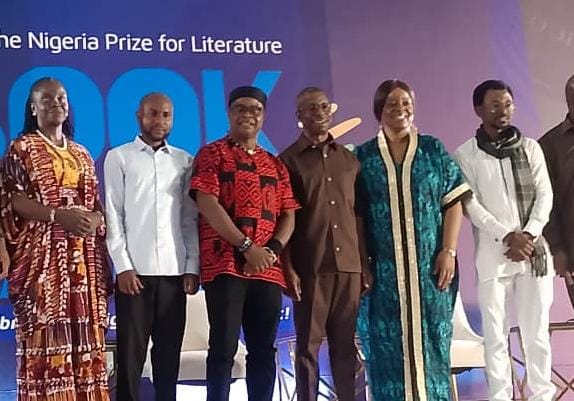
THE voices behind the 11 poetry collections longlisted for The Nigeria Prize for Literature 2026 came alive in Lagos recently, as authors opened up about the personal histories and convictions that shaped their works. At the Book Party, organized by the Committee for Relevant Art (CORA) and NLNG, the longlisted poets discussed the creative journeys behind their works, with budding poet and poetry advocate, Juliet Nnaji moderating the session. Beyond individual inspirations, the conversation culminated in a powerful reflection on how the prize has reshaped the nation’s literary ecosystem over the past two decades.
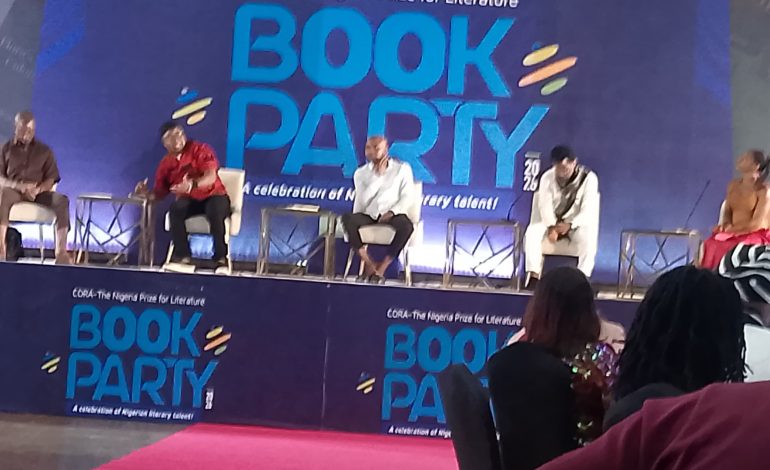
While four of the writers – Dr. Ogaga Ifowodo, James Ngwu Eze, Tares Oburumu and Ayo Oyeku – were physically present, seven – Prof. Tanure Ojaide, Paul Akpomuje, Adebayo Agarau, Rasaq Malik Gbolahan, Ajibola Tolase, Theresa Lola and Saddiq Dzukogi – joined Book Party virtually.
On the motivation behind Flora’s Love Colony, Tares Oburumu explained that his collection was borne out of studying Nigeria’s colonial history and encountering Flora Shaw, adding, “If Flora was the girlfriend of Lugard, then we are all illegal children of Nigeria, because she was the one who gave us the name,” he recalled jokingly, saying that a fellow poet, Dr. Ogaga Ifowodo had informd him that Shaw was Lugard’s girlfriend, as they were never married. “From what I read about her, she gave us that name out of love for a country, for a people.”
Looking at his journey and what the moment represents, Oburumu said, “My poetry journey has been a long, tough one. I’ve been writing poetry for the past 15 years, and I think the very first 10 years were very tough for me… Finding your name on the longlist is something beyond me. I find joy and I’m thinking that with this, I have a very long way to go.”
And how would winning the prize affect his literary career? Oburumu reflected on his difficult childhood in the Niger Delta thus: “During my primary school days, we used to paddle canoes to school and there were no books. I remember vividly, it was at the age of 15 that I got to read my first book… My long dream has been to build a library for primary school pupils; so, I would be full of joy if I’m able to build a library for primary school children.”
Reflecting on the prize’s wider ecosystem, Oburumu, who had earlier won a poetry prize, noted, “When I first sent my manuscript for publication, the publisher said Nigerians don’t read poetry and poetry doesn’t sell… I think these two events have given meaning to poetry and how it’s been perceived here in Nigeria.”
On what compelled him to devote his work Leah Sharibu, Dr. Ogaga Ifowodo (Why Does God Need a Gun?) pointed straight to religious hypocrisy and violence. “God, the Almighty, the creator… yet, somehow, some beings, molded out of mere clay believe that they have to protect God,” he said, highlighting the chilling question posed by the poet persona: “Why does God need a gun?”
Connecting the theme to broader struggles against oppression, Ifowodo added, “A mere girl of 14 or 15 is offered freedom if she would renounce her faith and convert to Islam, and she had the courage to say, ‘no!’ That is worthy of celebration a thousand times over.”
Ifowodo is not new to this stage of the prize, having been longlisted thrice in a row. “Three times in a row, what I have done can be deemed worthy of being highlighted among the 11 best out of hundreds of entries,” hesaid. “That in itself gives me some kind of satisfaction. But as they say, third time is a charm. This time, I hope I go back to the shortlist and then go all the way.”
Regarding what he would do if he wins, Ifowodo recalled his earliest attempt at writing poetry at Federal Government College, Warri that won his school house first prize: “I would want to establish an annual poetry prize at Federal Government College, Warri.”
On the prize’s broader impact, Ifowodo observed quite poignantly, “It has made more Nigerians write poetry. We can tell by the sheer number of entries every year. The Nigeria Prize for Literature has to be commended for this intervention in our creative and literary culture.”
Tanure Ojaide (Adult Love: In the Childhood Garden) reflected on his long literary journey since winning a prize in 1987 and being longlisted for this prize, saying, “I look at this as normal in my career at this stage. I’ve been writing poetry for a very long time, and won many prizes, but at this time, each period of my life gives me the sort of poetry I should write.”
Explaining his motivation, Ojaide said, “This collection has to do with the small things while I was living in the village in the Niger Delta… things like (one’s) relationship with nature, water, animals, and such things in my adult life now guide me and set values which affirm humanity. Whether you are in politics or anything, in the end, it’s how we behave as human beings that matter.”
If he wins, the veteran poet plans to invest in the poetry craft that has given him fame over the years: “This would make me do more things on a broader level. Real teaching of writing is not done. I want to spend some money, if possible, to make people practice writing and encourage writing programmes and workshops.”
Whiule reflecting on Nigeria literary landscape and how NLNG-sponsored prize has helped shapeit, Ojaide said, “I think Nigerian poetry has changed a lot. The prize has generated a lot of interest in people to write more.”
Saddiq Dzukogi (Bakandamiya: An Elegy) explained that his motivation began with a doctoral challenge in 2020, when “my mentor, who is also my editor, asked why we haven’t had an epic from an African poet in a while, and I said I would do it without thinking about it.”
He specifically targeted humanizing historical narratives and challenging certain myths: “When I was reading a particular historian about the Hausa people, and he said they were people without myth. Instead of reacting angrily, I set out to change that and say we have got myth and poetry and we are humans too.”
On what being longlisted for poetry for the second time in a row represents, Dzukogi said, “It’s an affirmation to be here with contemporaries, friends and forebears. It’s a huge honour. When I started writing, I just wanted to write poems and express myself, and everything else is extra.”
And how would winning affect his career and life? Dzukogi, whose father is also a poet, joked that he had displaced him, adding, “I was talking to my dad, and he said the prize is a lot of money, and I said it’s a lot for one person. I told him if I get to be a winner, part of my acceptance speech would be NLNG to split it (prize money – his poet friend Romeo Oriogun in 2022 gifted him and Suedie Agema USD$10,000 each as fellow shortlistees). I think the only thing I will do right now that I thought of: my mum hasn’t seen me in close to a decade. So, I’m going to make sure she misses me in comfort. So, I’ll spend a huge sum of money on mum.”
Highlighting NLNG’s role in shaping Nigerian poetry, Dzukogi stated, “Not a lot of people value the written word, and the NLNG put a lot into it, and it’s evident in the number of poets springing out of Nigeria everyday.”
Theresa Lola (Ceremony for the Nameless) also shared what the moment represented for her as apoet, saying, “It’s a huge honour to be on this list. For me, it affirms what I’m doing because I started writing when I was young and a teacher encouraged me. I had no sense of what it meant to be a writer as a profession, but when I graduated from the university in accounting, I took that bold step that I was going to pursue writing, and that was over a decade ago.”
“I was intrigued by the importance and significance of names in Nigerian culture,” she furtehr shared her motivations for this work. “When I moved to the UK, everyone still calls me Olufunmilola in my family, but other students struggle to pronounce the name. It started as a personal enquiry into how names shape our destiny and future.”
Regarding how winning would affect her writing career, Lola emphasized, “Prizes are part of the heartbeat of what keeps the community going. This prize wouldn’t just be a win for me, but for publishers who continue to invest in our works, and readers to continue to pay attention to poetry.”
She also reflected on the literary ecosystem, adding, “This prize has been important in allowing and encouraging writers to continue to uphold excellence in our work and also to remain diligence in being a writer.”
Paul Akpomuje (Black Passport) admitted to being “very lucky and fortunate to be among such great poets. It’s huge because I have not been doing so much of poetry over the last few years.” He recalled how he started taking poetry seriously after winning a 2007 university contest in Ile-Ife judged by Prof. Gbemisola Adeoti, who inscribed on a copy of Naked Souls that he was a budding poet.
Akpomuje recalled his motivations also, saying, “I was just trying to tell migration stories. I’m a migration scholar. I wanted to document my own experience of migration and diasporic life and how complicated it is.”
On the impact winning the prize would have on him, he joked, “If it’s about the money, my wife probably has plans for it already. So, I’m probably going to defer to her, but personally, I want to do a lot of work on poetry.”
Evaluating Nigeria’s literary scene, Akpomuje noted, “I think the role of the NLNG is immense. I think the NLNG is a huge motivation, a driving proof for writers to bring out their creative juice. Sometimes, that juice flows more with incentives.”
Also explaining the force behind hsi collection, Corpus Animistic Verses, Ayo Oyeku said, “If you look at our religion, animism is layered in everything we are doing, from the myth, to culture, to belief. So, I decided to pick a powerful and old religion, and I picked the Ifa religion and did a thorough research on it.”
He reflected on his journey from holding a degree in Physics and quitting his corporate job in 2016 just to write, saying, “I didn’t have a job for a year, and I kept on writing. It now became like my second scheme.”
ON how winning would affect his career, Oyeku answered with humour: “The best decision cannot be made when emotions are heightened. So, give me the money first. I’ll soak it in, then decide what to do with it later. We are grateful to The Nigeria Prize for Literature and all the minds that came together to make this happen. The windfall which you share with us every year is a lot. It has inspired us a lot to come out.”
Ajibola Tolase (2000 Blacks) reflected on his motivation, and said, “It’s a question of why? Why do we do the things we do? Why is race a thing? I’ve lived in two different continents, and I’ve lived with the aftermath of colonialism, and currently I live in a society that’s deep in racism.
“It’s very exciting to have readership. My book was published abroad; so, it’s kind of different audience here, but to also have a book that Nigerians can relate with also makes me feel good.”
As for how winning would impact his career, Tolase noted, “I hope it doesn’t change anything about the writing. I hope that what it does is improve readers and gather more readers towards poetry.”
Evaluating the broader literary landscape, Tolase added, “The writing has evolved more than ever. We have a lot of writers working in the genre, which is exciting. It’s always nice to see that our work is supported by the NLNG.”
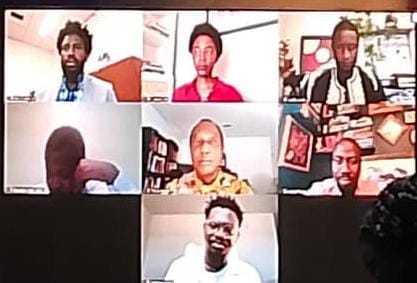
Paul Akpomuje (top left); Theresa Lola; Saddiq Dzukogi; Rasaq Gbolahan; Prof. Tanure Ojaide; Ajibola Tolase and Adebayo Agarau participating online
Rasak Malik Gbolahan (The Origin of Wounds) explained his motivation thus, “I was thinking about the wounds. If we think about Nigerian history, the past and the present, how do we locate the wounds? Also, if we think about the current happenings, we can’t heal the wounds if we don’t know the genesis of it.”
On what the poetic journey represents, Gbolahan said, “For me, the first reaction is gratitude, because it’s been a long journey and I’m glad I’m here today. Back then, I started posting my poems on Facebook in 2010, and I was a student at the University of Ibadan. I feel seen, heard, recognized, and acknowledged.”
What would winning mean for his wiriting career? Gbolahan said, “One of the things I would like to do is create platforms, probably like a literary journal. Also, going to schools to talk about poetry, buying books for students and everything.”
Gbolahan compared the prize to sports, when he said, “In sports, we do have Ballon d’Or. So, in Nigeria, NLNG is equivalent to that in Literature.”
James Ngwu Eze (Unbind Me Now) shared his politically ocnscious motivations that border on revolutionary fervour when he wrote his collection, “It’s a desire to set an agenda for my country in a very perilous time. I think that we are at a moment in our growth and development as a country where silence is dangerous. My motivation is to rouse the lion in Nigeria and Nigerians.”
He also reflect on being longlisted for the second time in a row, when he said, “If I ever had any doubts about the quality of my poetry, and my mission as a writer, being called a second time to be part of this amazing treatment of writers in this country, has erased all doubts.”
Should be wins on 9 October 2026, Eze promised to sustain the literary festivals he’d been involved in such as Return to Idoto, where poets visit the hometown of Christopher Okigbo: “So if I should win, I would plough it back to sustaining this tradition.”
Reflecting on the prize’s societal impact, Eze concluded, “Once the longlist is announced every year, the attention of the conscious population of Nigerians focuses on writing and writers for that period of time. I really can’t think of anything more important than that.”
When asked what compelled him to write his collection, The Years of Blood, Adedayo Agarau pointed to his upbringing: “It’s a lived experience of me growing up in Oyo state, Ibadan. I think that in today’s Nigeria, it’s also the reality of how we go to bed and wake up with fear, and kidnapping is something that we don’t talk about.”
Leaving the country provided him with the breakthrough, he said: “Leaving Nigeria, getting on the flight to the US, it felt like my body started allowing me to express these things. So, I started writing the poems the moment the flight took off.
“First, I am very honoured to be longlisted with people whom I either have read growing up or people I started writing with. Starting from Facebook and getting here is a full circle for me. It means the world.”
On how winning would affect his career, Agarau said he sustain his work with The Unserious Collective and the Alole Agarau Prize: “I always thought that poetry has poured so much into me. I’ve always in my life just poured back as much as it has poured into me. I’ll probably travel, take some time off work and go see the world.”
Reflecting on the digital generation and the prize, Agarau concluded, “You can start from Facebook and win the biggest poetry prize in Africa, and that matters because it continues to shape the way that people look forward to writing and making something out of their own writing.”
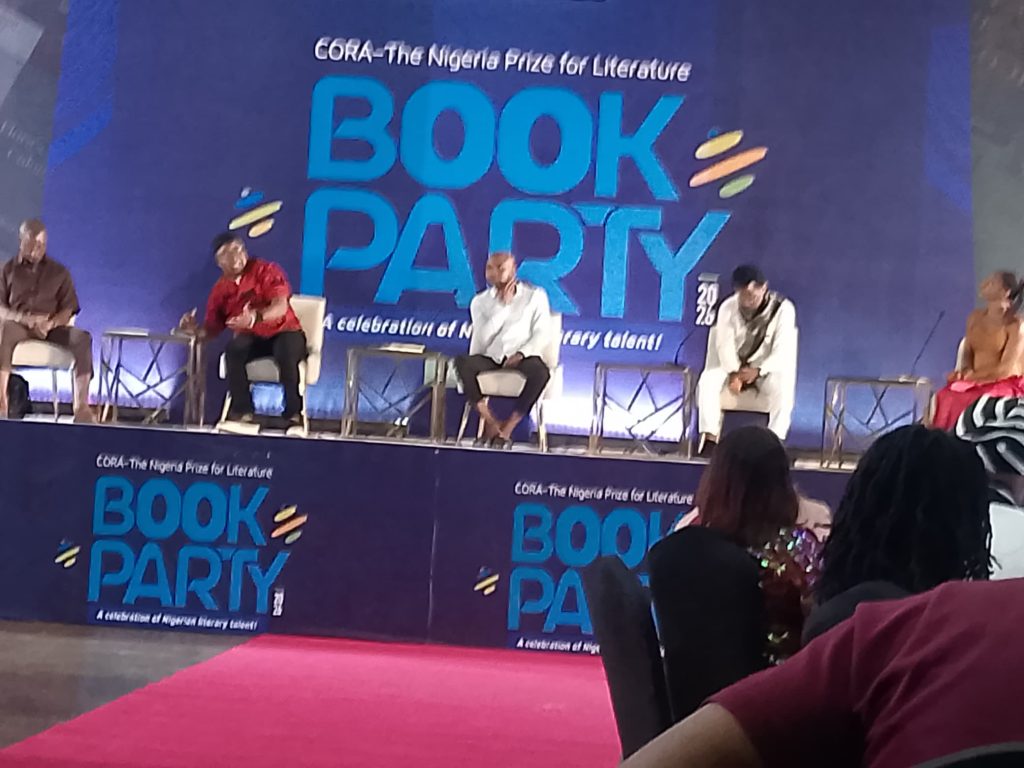
Dr. Ogaga Ifowodo (left); James Ngwu Eze; Tares Oburumu, Ayo Oyeku and Juliet Nnaji moderating