
Real, surreal and sundry Solfeggio: Chidozie’s poetry of memory and music

By John Chizoba Vincent
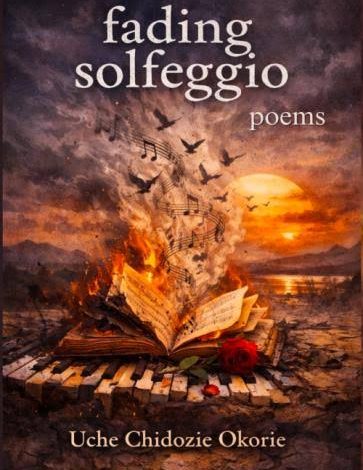
FADING Solfeggio (Literary Dungeon Publishers, Enugu; 2026) by Uche Chidozie is a bold and reflective debut that situates itself at the intersection of music, memory, and social consciousness. Drawing from the solfeggio system of musical notation, the collection which is divided into seven sections, builds a central metaphor around the idea of fading sound and memories which suggests not just the loss of melody, but the erasure of identity, culture, and moral clarity in contemporary society. At its core, the collection reads like a quiet but persistent lament, a poetic attempt to document a world gradually losing its rhythm and morals. Yet, beyond its mournful tones, the book is also an act of resistance by the Author himself, insisting on remembering, naming, and interrogating what is slipping away.
What sets Fading Solfeggio apart is its fusion of musical consciousness with sociopolitical and economical awareness. The metaphor of fading society or notes is not decorative; it is structural, thematic, and philosophical. Here the author, Chidozie extends this idea across poems that engage with personal vulnerability, generational confusion, loss, environmental degradation, migration, and digital alienation. The result is a collection that feels both intimate and expansive.
Another defining strength of the collection is the poet’s courage to confront uncomfortable realities. Rather than retreat into purely aesthetic poetry, he leans into critique of society, of self, and even of the creative process itself. This gives the collection urgency and relevance. Additionally, the language of the poems often carries a rhythmic quality that echoes its musical inspiration, reinforcing the thematic concern with sound and silence.
Several poems stand out as thematic anchors within the collection. “Introvert” functions as an opening statement, presenting a poetic voice that is inward-looking yet painfully aware of its surroundings. It establishes vulnerability as a central mode of expression.
In “The Worst Poem,” the author interrogates the act of writing itself, portraying poetry as a site of struggle, Pains, agony, rejection, and survival. This meta-poetic reflection adds depth to the book thereby revealing the tension between creation and inadequacy. “Stupidity” shifts toward satire, critiquing intellectual arrogance and societal contradictions with sharp irony.
Environmental concerns emerge powerfully in poems like “Ada,” where nature is depicted as both victim and witness to human exploitation. Meanwhile, technologically themed poems such as “iPhone” expose modern dependency on devices, portraying them as objects of obsession that replace genuine human connection.
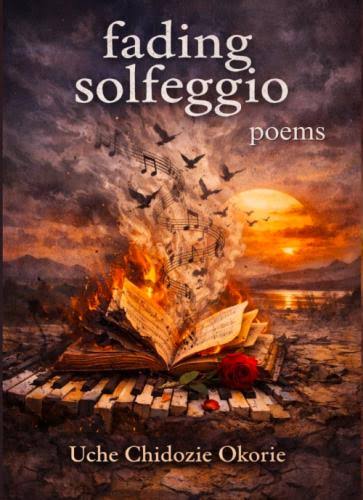
Migration and displacement are explored in “Coming to America,” which highlights both the allure and disillusionment of the immigrant experience. At the centre of it all lies the title poem, “Fading Solfeggio,” which synthesizes the collection’s concerns into a poignant meditation on cultural and existential loss.
The collection is deliberately structured into thematic movements, creating a sense of progression rather than randomness. It begins with introspective and personal poems, grounding the reader in the poet’s inner world before expanding outward into broader societal issues.
Sections such as “Dementia,” “Space Stations,” and “Countries of Particular Concern” mark shifts in focus from psychological fragmentation to technological critique and geopolitical reflection. These transitions are not abrupt but cumulative, allowing themes to build upon one another.
The final movement of the collection introduces a subtle shift toward resolution, culminating in poems like “Sweet Smelling Sacrifice,” which suggest the possibility of renewal or transcendence. This careful arrangement gives the book a narrative arc, mirroring the movement from clarity to fragmentation and, finally, to a fragile form of hope.
Chidozie’s voice is introspective, restless, and unflinchingly honest. He writes with a sense of urgency, yet avoids melodrama, often allowing imagery and rhythm to carry emotional weight. The voice oscillates between vulnerability and confrontation at times withdrawn and reflective, at other times sharp and accusatory.
There is also a noticeable self-awareness in the voice, particularly in poems that examine the role of the poet. This reflexivity adds complexity, making the collection not just an observation of the world, but also an interrogation of the act of observing.
The collection’s greatest strength lies in its thematic ambition and coherence. The idea of fading applied across multiple dimensions creates a unifying thread that holds the poems together. The integration of musical metaphors are particularly effective, enriching both form and meaning.
Chidozie’s engagement with contemporary issues gives the work relevance, while his emotional honesty ensures that it remains grounded. The variety of tones ranging from lyrical to satirical adds dynamism, preventing the collection from becoming monotonous.
Despite its strengths, Fading Solfeggio is not without flaws. Some poems lean toward density and abstraction, requiring significant effort from the reader to unpack meaning. While this complexity can be rewarding, it may also create moments of disconnection.
There are also instances of uneven smoothness, where certain poems feel less polished or structurally cohesive. Additionally, the frequent shifts in tone, though intentional, can occasionally disrupt the overall flow, making the reading experience feel slightly fragmented.
You should read Fading Solfeggio if you are interested in poetry that is thought-provoking, socially engaged, and formally inventive. It is particularly suited for readers who appreciate layered meaning and are willing to engage deeply with complex themes.
However, those who prefer straightforward, narrative driven poetry or consistently lyrical compositions may find the collection challenging. Its density and shifting tones demand patience and active interpretation to understand its full drives and emotions.
In conclusion, Fading Solfeggio is a compelling and ambitious debut that captures the dissonance of contemporary existence. Through its sustained metaphor, thematic richness, and multifaceted voice, Uche Okorie Chidozie offers a collection that is as unsettling as it is insightful. It may not always be easy to read, but it rewards those who listen closely like a fading note that lingers long after the sound has disappeared.
* Vincent, a Nigerian filmmaker, screenwriter, cinematographer and film director, can be reached on X @Jchizobavincent and on IG @Jchizobavincent