Nigerian booksellers rewrote the future at book fair 2026

By Olufemi Timothy Ogunyejo
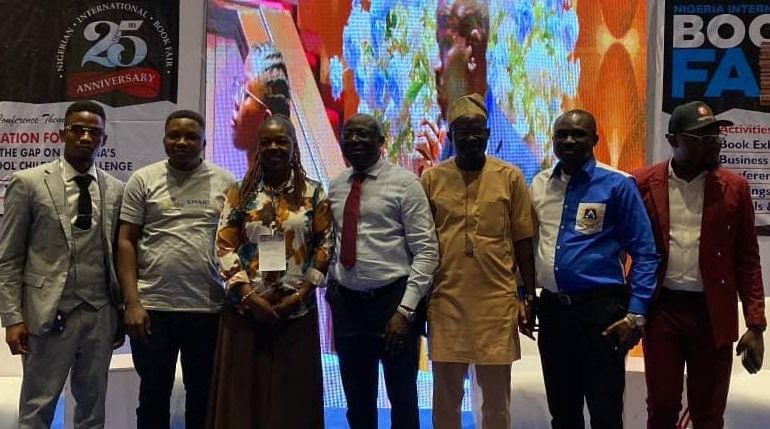
AS the morning sun stretched its golden rays across the vibrant city of Lagos, the atmosphere inside Cinema Hall 2 of the Wole Soyinka Centre for Culture and Creative Arts (formerly the National Theatre), carried the solemn excitement of history in motion. It was the final day of the silver jubilee edition of the Nigeria International Book Fair 2026, yet the energy in the hall suggested not an ending, but a rebirth.
Like a phoenix rising from sheets of printed pages and glowing digital screens, the Booksellers Association of Nigeria chose not merely to celebrate books, but to confront the future with courage, intelligence and innovation. There was profound symbolism in the choice of venue. The National Theatre itself stands like a monumental cathedral of Nigerian arts and culture, a sacred sanctuary where stories, ideas, music, drama and scholarship have for decades found expression.
To host a conversation about the future of books and knowledge inside a cultural monument now named after Wole Soyinka was to connect Nigeria’s literary heritage with its unfolding digital future. Indeed, the walls of the hall appeared to breathe history. They carried the invisible echoes of playwrights, poets, dramatists, scholars and cultural revolutionaries who have shaped Nigeria’s intellectual consciousness. It was therefore fitting that booksellers, the custodians and distributors of knowledge, gathered within such symbolic walls to discuss innovation, digital transformation and the survival of literary culture in a rapidly changing world.
And hovering spiritually above the entire gathering was the towering influence of Wole Soyinka himself, Africa’s first Nobel laureate in Literature and global literary colossus whose works transformed storytelling into resistance, culture into philosophy, and literature into national conscience. Soyinka’s literary journey remains a beacon to writers, publishers, booksellers and promoters of literature across generations.
Through his plays, essays and activism, he demonstrated that books are not mere objects of commerce; they are instruments of civilization and mirrors of society and weapons against ignorance.
For booksellers gathered in that hall, the symbolism was unmistakable: every book sold is a seed planted in the soil of national consciousness. As the renowned American author Maya Angelou once noted, “A word is a thing of power.” In that regard, booksellers become merchants of enlightenment, quietly shaping minds and futures through the circulation of ideas.
Under the compelling theme, ‘Technology, Social Media and Digitalization: Notes for Booksellers,’ the session unfolded like an intellectual orchestra conducted with precision and vision by Dapo Fisayo, whose leadership revealed a man deeply aware that the survival of bookselling in the 21st Century depends not on nostalgia, but on adaptation.
While many still romanticize the smell of old pages and wooden bookshelves, Fisayo chose a different path, one that bridges tradition with technology and places Nigerian booksellers firmly on the digital highway of global commerce.
Indeed, as the famous management thinker Peter Drucker once observed, “The greatest danger in times of turbulence is not the turbulence itself, but to act with yesterday’s logic.” That quote seemed to hover invisibly above the gathering like a prophetic inscription.
The hall itself resembled a parliament of ideas. From grey-haired veterans of the Nigerian publishing industry to energetic Gen-Z literary entrepreneurs clutching tablets and smartphones, every generation in the book ecosystem found representation.
Publishers, distributors, educators, librarians, authors, students and digital innovators occupied the venue like tributaries flowing into one intellectual river. It was a symbolic meeting of analogue memory and digital destiny.
The session, chaired by the veteran Mr. Dayo Alabi, opened with remarkable warmth and professional grace. Then came the keynote address delivered by the co-founder of Rovingheights Bookstore chain, Mr. Adedotun Eyinade, whose presentation pierced through the silence of complacency with the sharpness of a surgeon’s scalpel. He spoke not merely as a businessman, but as a visionary cartographer mapping the future terrain of African bookselling.
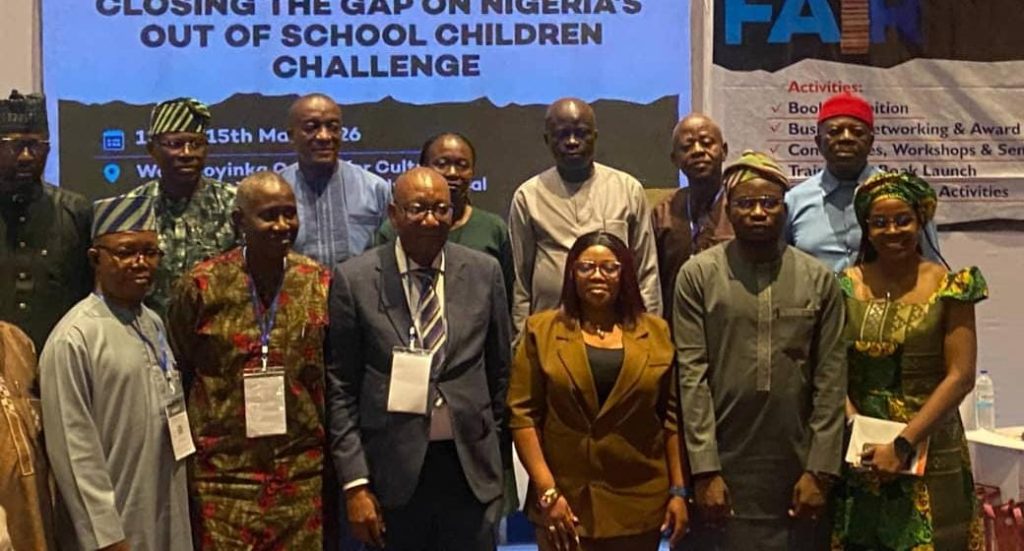
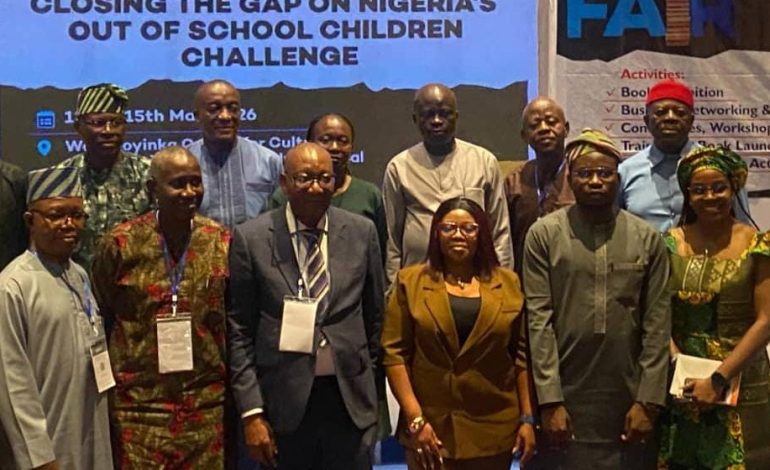
A cross-section of dignitaries in the Nigerian publishers and booksellers world at the event
With graphs, market realities, audience behaviour patterns and social media analytics, Eyinade demonstrated how digital platforms have become the new market squares of modern civilization. The analysis was neither speculative nor ornamental; it was scientific, empirical and unapologetically factual. He dissected the changing reading habits of younger audiences with the precision of a laboratory researcher, explaining how visibility algorithms, online engagement metrics and digital consumer behaviour now shape the commercial success of books.
“Books that are invisible online,” he implied in essence, “risk becoming invisible in society.”
The audience listened with rapt attention. Then the panel session began, and the atmosphere transformed from ordinary discussion into a gladiatorial arena of ideas.
Guided masterfully by moderator and master compere CM Okonkwo, questions flew across like arrows seeking intellectual targets. Yet each panelist received them with composure, clarity and scholarly confidence.
Kola Olaitan spoke with the practical wisdom of a field commander who understands the realities of bookselling from the trenches. His submissions on customer retention, online branding and reader engagement were enriched with practical examples and measurable outcomes. Every statement carried the firmness of lived experience.
Dapo Fisayo, calm yet profoundly analytical, repeatedly returned the conversation to one central truth: that technology is no longer optional for booksellers. In his view, digitisation is not an enemy of books; it is the bridge that will carry books into future generations. His words sounded like both warning and prophecy.
Like the ancient African proverb which says, “The river that forgets its source will soon dry up,” Fisayo reminded stakeholders that while the Nigerian book industry must embrace modern tools, it must also preserve the cultural and educational values that books represent.
Meanwhile, Comfort Chenge illuminated the discussion with thoughtful contributions on publishing sustainability and the role of social media visibility in expanding readership. Her interventions carried elegance and depth, proving that modern publishing is increasingly becoming a fusion of creativity, marketing and technological intelligence.
The contributions of Jemiyotan Brikkins added youthful dynamism to the discourse. She articulated how younger readers interact with literary content through digital platforms and why booksellers must reposition themselves where contemporary audiences now spend their time: online.
Each response from the panelists was met with rolling applause that echoed across the hall like waves striking the Atlantic coastline. At moments, the audience erupted into thunderous appreciation, not merely because answers were intelligent, but because they were honest, timely and transformative. It was clear that many present saw themselves reflected in the realities being discussed.
The atmosphere became electric. One could almost feel the old walls of conventional bookselling trembling gently before the unstoppable winds of innovation. Throughout the engagement, the symbolism of the event remained powerful. The book, once confined to shelves, was now being metaphorically released into cyberspace like a bird discovering its wings.
Nigerian booksellers were no longer being asked merely to sell books; they were being challenged to become digital navigators, content curators, online marketers and cultural ambassadors in a rapidly evolving knowledge economy.
Beyond commerce, however, the strategic importance of the Booksellers Association of Nigeria to national development cannot be overstated. Booksellers remain one of the strongest arteries through which education flows into society. They are silent architects of literacy, nation-building and intellectual advancement.
Every textbook delivered to a child, every literary work placed into curious hands, every academic material supplied to institutions contributes directly to human capital development and national productivity.
In many ways, booksellers are the invisible engineers of democracy and development. For a nation that seeks progress, innovation and enlightenment, the role of booksellers is as strategic as that of teachers, policymakers and scholars. A society that neglects its book ecosystem risks weakening the intellectual foundation upon which sustainable development rests.
It is therefore impossible not to applaud the leadership of Dapo Fisayo and the executives of the association for steering the body with foresight, adaptability and uncommon dedication at such a critical period in the evolution of Nigerian publishing and bookselling. Their commitment to training members, embracing innovation and sustaining relevance in a digitally disruptive age reflects leadership rooted not merely in administration, but in vision.
The organisers of the Nigerian International Book Fair 2026 equally deserve immense commendation for curating a gathering that transcended ordinary exhibitions and evolved into a continental intellectual festival. Their efforts transformed the fair into a marketplace of ideas, a sanctuary of learning and a bridge connecting generations of literary stakeholders.
Across the three-day celebration, conversations consistently revolved around literacy development, educational advancement, collaboration and innovation. Yet the BAN session stood out distinctively because it confronted perhaps the most urgent question facing the Nigerian book ecosystem today: how to survive and thrive in a digital century!
The closing moments carried emotional significance. It was not simply the end of another conference. It felt like the turning of a historic page in Nigeria’s literary journey. And perhaps the words of Nelson Mandela best captured the spirit of the occasion: “Education is the most powerful weapon which you can use to change the world.”
Inside Cinema Hall 2 of the Wole Soyinka Centre for Culture and Creative Arts, the custodians of books had gathered not merely to preserve that weapon, but to sharpen and modernize it for the battles of tomorrow.