
At 2.14% of GDP, Nigeria sits below UNESCO public education benchmark, Chidoka tells alumni in Enugu


By Editor
THE 70th anniversary keynote at Ekulu Primary School afforded the Chancellor of Athena Centre a moment to call for a national reckoning, and charged alumni to lead measurable renewal across Nigeria’s public institutions. Nigeria’s consolidated public investment in education stands at 2.14 per cent of Gross Domestic Product in 2026, placing the country below the UNESCO benchmark of 4 to 6 per cent for developing nations and behind selected African peers in the centre’s comparator set, the Athena Centre for Policy and Leadership said on Friday.
The finding was presented by the centre’s Chancellor, Chief Osita Chidoka, in a keynote address at the 70th Anniversary Gala of the Ekulu Primary School Alumni Association (EPSAA) in Enugu on Friday, 30 May 2026. Titled “Ekulu at 70: How One School Tells the Nigerian Story of Decline and the Duty of Renewal,” the address traced the trajectory of a single Enugu public school as a window onto four decades of Nigerian institutional decay and the conditions for its renewal.
The 2.14 per cent figure is drawn from an Athena Centre consolidation of federal ministry spending, the Universal Basic Education Commission (UBEC) statutory transfer, the Tertiary Education Trust Fund (TETFund) intervention pool, and the combined education budgets of all 36 states and the Federal Capital Territory. The total, approximately ₦9.49 trillion (about $6.27 billion), is set against a 2026 nominal GDP of ₦442.8 trillion as published by the National Bureau of Statistics. By comparison, South Africa spends 6.7 per cent of GDP on education, Brazil 5.6 per cent, Kenya 4.8 per cent, India 4.1 per cent and Ghana 3.4 per cent.
“Nigeria is not in the middle of the developing world on this measure. It is below its floor. We have been treating this as a routine budget conversation for too long. The figure is in fact a national emergency, and the country must now stop pretending otherwise,” said Chidoka.
Within this national picture, the Centre identified a small but determined group of subnational governments that have begun to lead. Anambra State has committed 46.9 per cent of its 2026 budget to education, the highest share in the federation. Enugu has committed 32.2 per cent, alongside the rollout of 260 Smart Green Schools across every political ward. Kano State is undertaking one of the largest teacher recruitment drives in the country. Together with Lagos, Kaduna, Katsina and Abia, these six anchor states will spend approximately ₦1.80 trillion on public education in 2026.
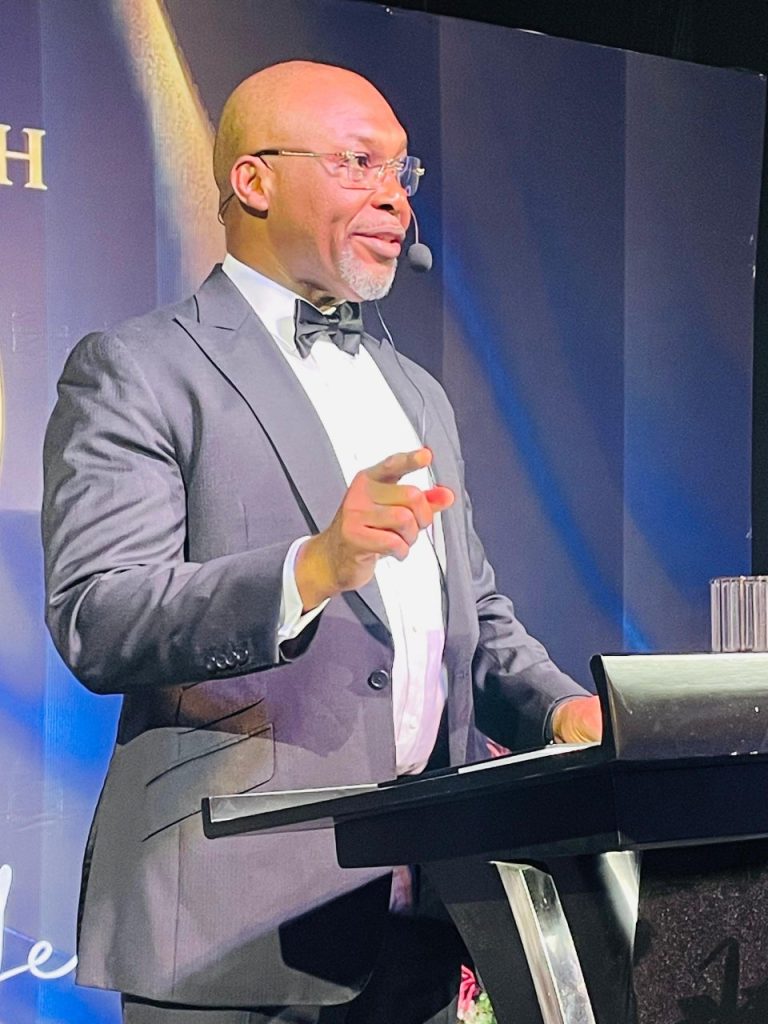
Chief Osita Chidoka
Lagos State, while spending more on education in absolute terms than most states combined, has allocated only 5.6 per cent of its 2026 budget to the sector. The Centre noted that, in dollar terms, Enugu State’s 2026 education budget is now approximately twice that of Lagos, a reversal of the position in the year 2000 when Lagos spent roughly six and a half times what Enugu did. The Centre described this as evidence that, in Nigerian public education, volume is not the same as priority and wealth is not the same as will.
“The reform of Nigerian public education is no longer waiting to be born. It is being led, not from Abuja, not from Lagos, but from a handful of states that have made the decision the centres of power have not yet made. The federal apparatus is moving. Anambra and Enugu are moving. The alumni associations of our public schools must now move with them, and ahead of them,” he said.
The Centre’s analysis traced the present condition to the period between 1986 and 1999, which the keynote described as Nigeria’s “years of the locust.” Over those thirteen years, the salary of a full Nigerian professor fell, in dollar terms, from about $1,000 a month in 1985 to $137 a month in 1997. Lagos State per-pupil spending fell from $281 to $22 in real terms between 1980 and 1990. The annual operating budget per student at Ahmadu Bello University, which had been on a par with that of the University of the Witwatersrand in South Africa in 1980, has since fallen to a ratio of approximately one to twenty-eight in Wits’s favour.
The chancellor argued that the deeper failure lies not in the locust years themselves but in the twenty-seven years of civilian rule since 1999, during which, in his words, “we accepted the empty field as the new harvest.”
In closing, the Chancellor issued a three-part charge to the Ekulu Primary School Alumni Association, framed as the alumni body’s contribution to a renewal effort already underway at the federal and state levels. The first proposed commitment, to be discharged within twelve months, is the construction of an Ekulu Learning Dashboard that captures literacy, numeracy, attendance, common entrance results, teacher availability, and infrastructure, updated termly and visible to every alumnus. The second, to be discharged within twenty-four months, is the establishment of a Teacher Development and Recognition Fund, paired with a remedial literacy and numeracy programme for pupils falling behind in Primary 3 and 4. The third, to be discharged within thirty-six months, is a partnership with the Nigerian Research and Education Network (NgREN) and its Connecting Nigerian Education (CONE) programme to bring Ekulu into the national digital learning infrastructure.
“Let’s Get It Done is not charity. It is repayment. It is a clarion call from a generation that received much, to a generation now standing in the same classrooms, asking only what was once routinely given,” Chidoka said.
The Athena Centre’s full data analysis, including the per-pupil collapse in Lagos and the Eastern recovery, the international comparator set, and the case studies of Poland, Vietnam, and China, is set out in the keynote address and accompanying report, available on athenacentre.org, according to the Media and Communications Officer, Athena Centre for Policy & Leadership, Mr. Paul Liam.
The Athena Centre for Policy and Leadership is a Nigerian policy-to-systems institution operating four institutes covering governance, education, health, and an election observatory. The Centre’s work translates evidence into measurable governance outcomes.