‘Children of Blood and Bone’: A reflection on cultural authorship, translation, reciprocity

By Qudus Onikeku
WHEN the trailer for Children of Blood and Bone was released, I watched it with excitement. I had read Tomi Adeyemi’s novel years earlier and admired its ambition. Here was a young writer reaching into the vast storehouse of Yorùbá imagination and assembling something unmistakably new: Orïsha, maji, diviners, kings, spirits, rebellion, oppression and power. It was culture being refined into the realm of fantasy, not ethnography, and that distinction matters. Fantasy by its nature is free to borrow, invent, distort, exaggerate and transform reality. Otherwise we reduce art to anthropology.
Yet anyone familiar with Yorùbá worlds can recognise some of the seeds from which this particular forest has grown. Hollywood has now discovered that forest. It looks magnificent. Still, one question refused to leave me. Where are the gardeners, the planters, and those who tend to the soil? That question emerged from a simple conviction. Culture is not content. It is an ecology. Stories do not exist in isolation, waiting to be licensed and adapted. They grow inside languages, rituals, landscapes, philosophies, gestures and communities. They grow inside people. To adapt a story is therefore never simply to adapt a plot. It is to translate an entire world. That, more than the film itself, is what interests me. How worlds travel. And who is invited to travel with them.
Beyond representation
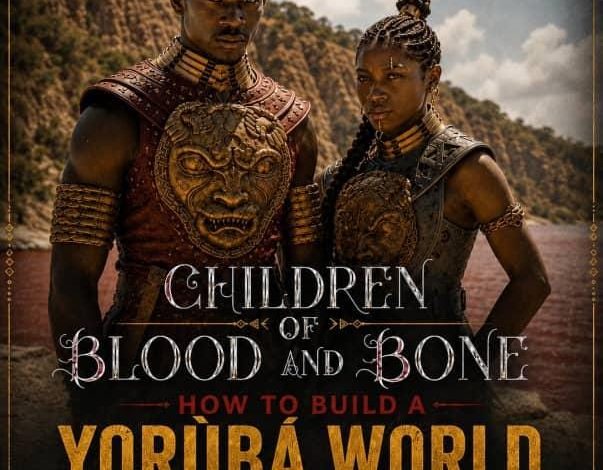
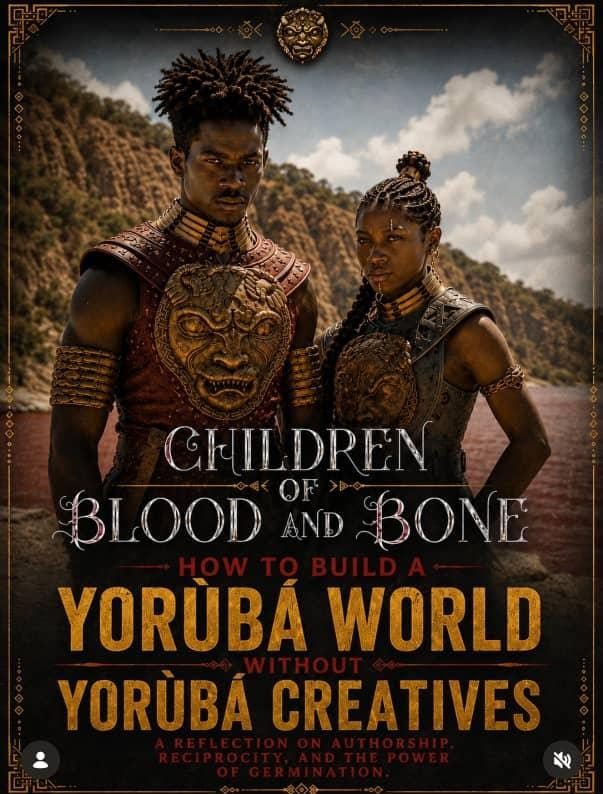
WHEN I raised a version of this provocation in an Instagram post titled “How to build a Yorùbá World without Yorùbá creatives”. The reactions were revealing. Some agreed immediately. Others dismissed the argument altogether. Hollywood bought the rights. Hollywood raised the money. Hollywood therefore had every right to make whatever Hollywood thinks will make profit. Others pointed to the Black filmmakers involved. Others to African actors. Some reminded me that practitioners of Ifá had participated in shaping the production. They argued that Yorùbá culture had travelled so widely that Nigerians could no longer claim exclusive authority over it. Even Tomi had to study Yorùbá mythology in Brazil.
The said post went quite viral, so I received comments from very diverse groups. The conversation made me realise that my original question was imprecise. I am not asking whether Yorùbá names appear somewhere in the credits. Nor am I proposing an ethnic census of a film crew. The real question is simpler: Who participated in translating this world? Translation is never neutral. Someone decides how architecture should look. How bodies should move. How power should be dressed. How divinity should be imagined. How language should sound. How memory becomes image. Those decisions are never merely technical. They are acts of interpretation.
The epic is co-screenplayed and directed by Gina Prince-Bythewood, one of the most accomplished Black filmmakers working today, with her most current oeuvre being Woman King. The production designer, Hannah Beachler, is an academy award winning Black American designer whose work includes Black Panther, Sinners, Creed, Black is King, etc; Charlese Antoinette is one of the most respected costume designers in Hollywood. This is therefore, not an argument about talent. The question is whether artistic excellence alone settles the more difficult question of cultural relationship. I do not believe it does. Where then did cultural authority actually sit? Who helped determine the thousand small decisions through which a fictional world acquires its cultural texture?
Then Tomi Adeyemi began speaking publicly about her relationship to the adaptation. Here, we should be careful. She has described the production as one of the most painful experiences of her life. She has spoken of leaving the set hyperventilating and sobbing, of panic attacks and physical distress, while choosing not to disclose the full story. That boundary deserves respect. Her experience cannot become evidence for an argument she herself has not made. We simply do not know enough.
Yet her situation unsettles one assumption many of us carry about authorship. Adeyemi was not a novelist who sold her book and disappeared. She remained attached to the adaptation as both screenwriter and executive producer, and still she emerged profoundly estranged from the finished work. Her experience proves nothing, but it raises a question worth asking. What does authorship mean when proximity to a project does not necessarily translate into authority over what that project becomes?
I keep returning to one image.
A woman plants a seed.
The seed becomes valuable.
A powerful machine arrives to cultivate it.
Somewhere between the seed and the harvest, the woman who planted it can no longer bear to look at the fruit.
The old machinery
ABOUT twenty years ago I first encountered Edward Said’s Orientalism. What fascinated me about his argument was the familiarity of it, despite his premise being the Orient. Said was interested in more than misrepresentation. His concern was the relationship between knowledge and power, the extraordinary ability of powerful institutions to describe other people so completely that their description eventually became more authoritative than the people’s description of themselves. One could admire a civilization while denying its authority. Love the art while remaining indifferent to the artist. Desire the world while rendering its inhabitants unnecessary.
That machinery has not disappeared, it has evolved. Today the person interpreting Africa need not be white. The director may be Black. The actors may be African. The consultant may practise an African religion. Representation has diversified. Just as extraction has diversified too. This is not to suggest that race no longer matters. It is to suggest that representation alone cannot answer deeper questions about cultural power. Who carries knowledge? Who translates it? Who decides? Who benefits? Who bears the consequences? These are questions about authorship.
One response appeared beneath my post more than any other; Whoever pays has the final say. Within the logic of capital, the argument makes perfect sense. Films cost hundreds of millions of dollars. Investors assume enormous risks. Creative decisions cannot be made by committee. Someone must ultimately decide. All true. But culture introduces another dimension. Money can purchase adaptation rights. It can finance production. It can hire an extraordinary cast and crew. It can own intellectual property. But it cannot do one thing. Money cannot retroactively become the ancestor of what it purchased.
Before the cheque arrived, something already existed. A language. A cosmology. An aesthetic. Ways of understanding beauty, destiny, death and power. People carried these worlds long before they became commercially valuable. Indeed, if money alone were enough, why borrow a culture at all? Invent one. Invent the gods. Invent the language. Invent the architecture. Invent the rituals. Invent the mythology. The very act of borrowing acknowledges a value that existed before the investment.
Once we recognise that, another kind of authority quietly enters the room. Cultures have custodians. There is legal ownership. There is artistic freedom. There is economic power. And there is cultural custodianship. These are not the same thing. The word custodianship deserves attention. What makes anyone custodian of a culture? Certainly not through birth. A Yorùbá surname does not make one an authority on Yorùbá civilization. Nor does bloodline confer knowledge of architecture, language, dance, textiles, philosophy, political history or ritual. Birth is not omniscience. Neither is initiation. Neither is admiration. Cultural authority is earned through knowledge, practice, study, relationship and accountability.
This is precisely why custodianship should never be mistaken for ownership. No people own imagination. And this is why Yorùbá sages usually say, “Yorùbá bọ, Yorùbá sọpe”, before saying any wise proverb, it literally means “Yorùbá returns, Yorùbá says”. Cultures have always travelled. They borrow, translate, forget, remember and return transformed. Custodianship is something quieter. It is proximity to consequence. That proximity matters. A production designer eventually leaves the project. A child may spend a lifetime encountering the version of their civilization that film helped place in the world’s imagination. Interpretation is available to everyone, but the right to respond belongs to those who continue living inside what has been interpreted. That, to me, is custodianship.
The generous river and its source
ONE response to my post appeared repeatedly. Some of the creatives involved in the film, I was told, are practitioners of Ifá. Surely that grants them cultural legitimacy. The argument deserves respect, but it remains incomplete. Few civilizations have demonstrated the remarkable generosity of Yorùbá spiritual thought. The Òrìṣàs crossed the Atlantic under unimaginable violence. They learnt Portuguese, Spanish, French and English. They entered Catholic churches wearing the names of saints. They found new rhythms in Cuba. New philosophies in Brazil. New expressions across the Americas.
These traditions are not echoes. They are living civilizations in their own right. Their custodians possess real authority too. There may well be a priestess in Salvador whose understanding of particular Òrìṣà traditions exceeds that of many people living in Lagos today. None of this is difficult to acknowledge. But spirituality and culture are neighbours. They visit one another constantly. They are not the same house. Initiation into Ifá does not automatically confer mastery of Yorùbá architecture, or language, or movement, or aesthetics, or material culture, or the countless gestures through which a people recognise themselves. Just as being born Yorùbá confers none of these automatically. What matters is not identity. It is situated knowledge.
The same principle helps us think about another argument. Some suggested that Brazil or Cuba now possess greater authority over Yorùbá spirituality than contemporary Nigeria. I think this imagines a competition where none is required. The Yorùbá world now has multiple legitimate centres of knowledge. Ilé-Ifẹ̀ is the single source that carries one history. Ọ̀yọ́ carries its evolution. Kétou another. Ajaṣe another. Ọ̀yọ́tunji another. Havana another. Salvador another. Trinidad another. Centuries of separation have produced different continuities. Different artistic vocabularies. Different ritual grammars. Different memories.
Diasporic traditions do not require Nigeria’s permission to be legitimate. Nor does their legitimacy require Yorùbáland to become relevant. A river travelling thousands of kilometres does not invalidate its source. Nor does the source own every form the river takes downstream. Both truths can coexist. Perhaps the most exciting cultural work of this century will emerge not from arguing over authenticity, but from allowing these different currents to encounter one another again, away from the muffling grip of capitalism.
Culture is ecology
HERE lies the deeper misunderstanding. Capital encounters culture as content. A story. A song. A dance. A myth. Something to acquire, package, license and distribute. Yorùbá culture behaves differently. It is not content. It is ecology. Content can be acquired. Ecology must be sustained. Content has owners. Ecology has relationships. Content travels. Ecology remembers.
You can purchase the rights to a novel. Finance its adaptation. Own the resulting film. But the cultural ecology from which that imagination germinated always remains larger than the transaction. This is why adaptation is never merely adaptation. It is translation. Every translation transforms, omits, and reveals simultaneously. The question then is no longer: Who owns the story? It is: who participates in translating the world from which the story emerged?
This is partly why conversations around Afrobeats interest me. Not because I believe the genre is dying. Cultures rarely die because they travel. They survive because they mutate. Afrobeats itself emerged from endless encounters: highlife, afrobeat, juju, fuji, hip-hop, R&B, dancehall, house music, gospel, electronic music, street culture and whatever young producers invented last Tuesday.
Purity is not the point. The question is regeneration. Something unruly grows in Lagos, Accra and across African and diasporic cities. Producers experiment. Languages collide. Someone invents a dance on a street. Another person uploads it. DJs test songs at two in the morning. Slang mutates. Nobody completely understands what is happening. Then the world notices. Capital arrives. Capital is very good at scaling things. But scaling requires legibility.
The machine begins identifying what travels best, what streams longest, what repeats easily, what can be reproduced. This is not inherently evil. It is what markets do. The danger begins when optimization replaces germination. When an ecosystem that is valued precisely because nobody fully controls it is being reorganised around the needs of those best equipped to sell it. The fruit becomes larger, no doubt, but the soil most certainly become poorer.
There is a principle called ‘the power of germination’. It posits that nothing germinates alone. Every masterpiece grows from an ecology. Behind every celebrated novelist stand generations of storytellers. Behind every musician stand producers, dancers, club owners, neighbourhoods, slang makers, and audiences. Behind every mythology stand people who carried those worlds long before they became commercially desirable. Capital sees the fruit. Culture remembers the soil. That, for me, is the question. Not whether capitalism should bother about cultural authenticity. But whether success continues regenerating the ecosystem and nourishing the ecology from which it grows.
On reciprocity
THERE is one final discomfort beneath this conversation. It is harder to name because it feels closer to home. Nigerian writers are celebrated. Our musicians fill arenas. Our designers shape global fashion. Our food, films and slang travel effortlessly across borders. There is an enormous appetite for what Nigerians produce. Yet there is also a contradiction worth naming. Nigerian creativity travels with extraordinary ease. Nigerians themselves often do not. Nigerian confidence is read as arrogance. Ambition becomes aggression. Resourcefulness becomes suspicion.
I do not wish to reduce the complex experiences of Nigerians across the world to a single story of exclusion and xenophobia. Nor are Nigerians innocent participants in the world. Nigerians can be loud, competitive, chauvinistic, classist, difficult neighbours and participants in other hierarchies. No nationality possesses moral innocence. But the contradiction remains. Sometimes it feels as though the Nigerian becomes easiest to love once separated from what the Nigerian produces. And suddenly what began as a conversation about a fantasy film starts resembling something much older. We love your world. Must you come with it?
This is why representation no longer feels like a sufficient ambition. Representation asks, Who is visible? Authorship asks, Who decides? Reciprocity asks, What returns? If an industry benefits from a living culture, what flows back toward the ecology from which that culture emerged? If a mythology becomes globally valuable, does the community that has carried it for centuries become stronger? If a language inspires a screenplay, does that language gain new life? If artists, choreographers, historians and craftspeople make possible the imagination from which a film draws, do they remain peripheral once the cameras arrive?
This does not mean surrendering artistic control to a cultural committee. Nor does it mean every Yorùbá-inspired film must be approved by Yorùbá people. Reciprocity is simpler; build meaningful pathways through which knowledge can participate in creation. Hire people with authority, not merely symbolic proximity. Create research partnerships. Commission artists. Work with archives. Build apprenticeships. Spend locally. Credit sources. Create opportunities for knowledge to travel in both directions.
And understand that collaboration does not diminish imagination. It often deepens it. “But where do we find these resource people?” some asked. There was a time when one could perhaps plead difficulty. That argument is increasingly untenable. The knowledge ecosystem exists. There are universities, museums, archives, traditional institutions, scholars, artists, designers, craftspeople, filmmakers, choreographers, linguists, content creators, historians, priests and community practitioners. There are institutions in Nigeria and throughout the diaspora whose entire purpose is to make cultural knowledge available for contemporary encounter.
The J. Randle Centre for Yorùbá Culture and History is one such institution among many. Its existence is itself an argument that the distance between historical knowledge and contemporary imagination can be deliberately bridged. The problem today is increasingly less the absence of knowledge than the willingness to build relationships with those who hold it.
The conclusion
SO, can one build a Yorùbá world without Yorùbá creatives? Of course. Hollywood can. Brazil can. Japan can. A brilliant child in Helsinki may discover Òrìṣà mythology tomorrow and spend the next 20 years creating an extraordinary universe from it. Culture remains alive because imagination refuses borders. That has never been my concern. My concern is a different one. What kind of relationship does that imagined world maintain with the living world from which it draws?
Which brings me back to Tomi Adeyemi. We still do not know what happened during the making of Children of Blood and Bone. Perhaps. one day we will. Perhaps, we never should. Her silence belongs to her. But one image continues to trouble me.
A young woman plants a seed.
The seed becomes a forest.
The forest becomes valuable.
A powerful machine arrives because it recognises the value of carrying that forest around the world.
And somewhere along the way, the person who planted the seed finds herself unable to enter it without pain.
Whether or not that image explains her experience is no longer the point. It reveals something larger. Africa no longer suffers from a lack of global attention. The world wants our stories. Our music. Our aesthetics. Our spirituality. Our languages. Our imagination. The question before us is no longer whether our cultures will travel. They already have. The question is what kind of relationships will govern that journey. Will culture continue to be treated as raw material to be mined, extracted, packaged and consumed? Or will we begin to recognise it for what it truly is, a living ecology. An ecology sustained by people, by memory, by institutions, by creatives, by communities, by those who carried these worlds long before they became commercially valuable.
Perhaps, that is all I am asking of Children of Blood and Bone. Not whether Hollywood has the right to imagine a Yorùbá-inspired world. It does. But whether we can begin imagining another model of cultural encounter that isn’t extractive, one in which global success does not require separating culture from the people and ecologies that continue to sustain it. Because cultures are living worlds. And living worlds remember. They remember who planted the seed. They remember who tended the plant. And they remember who came only for the harvest.
& Onikeku, the Creative Director of J Randle Centre for Yoruba Culture and History, Onikan, Lagos, first publish this article in The Q newsletter