Ozougwu’s ‘Lady Dynamique’: A collective anthem of self-reclamation for women’s voices

By Anote Ajeluorou
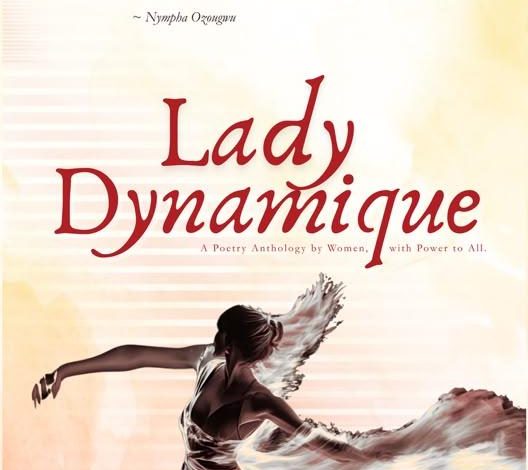
LADY Dynamique: A Poetry Anthology by Women with Power to All, edited and curated by Nympha C. Ozougwu, is a collective women’s anthem and manifesto of self-empowerment and self-affirmation. It’s as unapologetic as it is searing in locating a place for women in a society matrix that often places them in compartments that diminish their humanity. The sub-title ‘A Poetry Anthology by Women with Power to All’ sets out the manifesto early: we are women with power! This defining declaration sits at the heart of a gender that finds itself at the bottom of the rung without knowing how, but determined to climb up to where it rightfully belongs: at the negotiating table alongside the men, who, consciously or unconsciously, with the help of other women like themselves, orchestrated their demotion for wrongs they are not aware of.
The poems emanate from engagements among women in Lady Dynamique Network, founded by self-styled ‘Nigerian culture architect and social advocate,’ Nympha C. Ozougwu. In founding the network, she’d had to ask the deeply introspective question: ‘what happens when women are given a space to think, create, and speak without being pre-defined’ by society’s scrutinising, patriarchal lens? It’s essentially a conversation hub among women for women to ventilate about their condition in a world that often tends not only to see but not inclined to notice or acknowledge women. And this mentality engenders a social conditioning where women are at the receiving end of all manners of ugliness society chooses to fling at them.
Now, these women, who have gone through society’s purification fire, will have none of anything that tends to put them down any more. Emboldened by the newly forged self-awareness of their individual and collective power, they have come out stronger, like the phoenix, to live dynamically and unapologetically. They will answer to no one but themselves to whom they owe their being: not parents, not family, not husbands, the usual euphemism for the opacity called society that conspires to stifling women’s growth and aspirations.
“There was no grand blueprint,” Ozougwu explained the founding philosophy or lack of it behind Lady Dynamique Network, adding, “instead, a community formed; women connecting through shared work, curiosity, and care. Today, as we write, Lady Dynamique Network includes over 500 members… has reached more than 5,000 women and girls through its programmes and collaborations. Its growth has been organic, sustained by trust, word of mouth and consistent engagement.
“At Lady Dynamique, empowerment is not treated as spectacle or promise. It’s practised in small, steady ways: learning new skills, sharing personal stories, and seeing lived experiences acknowledged with respect. Creativity sits at the centre of this work. Through cultural exchange, storytelling, and creative education, the network meets different women across different backgrounds and stages of life, using expression as tool for reflection and connection.”
Ozougwu asserts that Lady Dynamique anthology is borne out of this reflectiveness carried out among women this anthology as, “The network’s first poetry collection. This anthology is not polished for display; it is a record of 90 female voices; honest, searching, and rooted in lived experiences. It makes room for strength and uncertainty to exist side by side, without forcing resolution.”
Ozougwu is clear-eyed about the mission of the anthology in espousing gender ideals that society often glosses over and asserts strongly the place of women in it.
“Lady Dynamique Network holds that gender equality is shaped in everyday practice. When women are trusted with their own stories and supported in shaping them, change becomes durable, carried forward by the women themselves.”
“In curating Lady Dynamique,” Ozougwu further affirms the all-female group’s manifesto, “the network extends its mission to the literary space, creating a tangible manifestation of its name and values. This work embodies the principles that guide women’s empowerment, visibility, and agency, and we know that we have created a masterpiece that exposes the depth of women’s lives for the world to see and feel with seriousness and respect.”
Of course, the first poem that unarguably sets the tone for the anthology is written by the editor and curator herself, Ozougwu, titled ‘The Awakening.’ As the name suggests, women have lived all their lives in seeming slumber, sleep-walking their way around rather than actually living. But a time comes when they need to wake up from sleep and be cleared eyed for others to notice their presence and properly engage with them. The poet-persona has just arrived at that defining junction, where sleep has cleared off her eyes, and she’s wide awake, questioning every and all things to remove the confusion that has plagued her all along. It’s indeed a moment of affirmation.
The first stanza aptly captures it thus: “By all means, my lady, affirm/ for affirmation is not arrogance,/ it is remembrance/ it is the daily roll call of your worth/ the gentle yet deliberate charging of your spirit/ away from borrowed shame/ away from rooms where your name was never meant/ to echo with purpose.”
After affirming her awareness engendered by being awake, the next is to question every tradition or societal restrictions that limit her aspirations. Next is the inevitability of blooming unto beauty, as obstacles on her path have been cleared by her awareness and questioning mind that had long been silenced. It’s a remarkable moment of clarity and transformation, to go from confusion to self-awareness and arrive at the junction of blooming and beauty. And as she proclaims:
“Then comes The Bloom/ Suddenly, you are visible./ Your voice carries./ Your time becomes currency./ Everyone wants what you offer;/Your care, your brilliance,/ your influence wrapped in femininity.”
Ozougwu concludes this aspirational poem by re-echoing the need for affirmation: “Affirm, my lady./ Affirm again./ For this is the beginning.”
For proper perspective and context, Faith Welima Andrew’s ‘We Are Woman’ is self-defining in intent. To understand the anthology, we need to understand what a woman is, and as Andrew says, a woman is so much more than society has permitted itself to understand:
“For she is more than your traditions/ And your stories of horrendous fiction/ For she is a marvellous nation/ glorious without hesitation/ …A woman is a masterpiece/ An epitome of creation/ An all in one being/ With a side of everything…/ …Womanhood flows in our veins/ And adorned us with a name/ We Are Woman.”
Rebecca Durojaiye continues with Ozougwu’s spirit of feminine affirmation with her piece titled ‘Especially When Your Voice Shakes’, and enjoins women to take ownership of any space they found themselves, as a way of not just opening doors for other women coming behind but expanding every restrictive space that tends to choke women.
“You owe it to the ones coming after you/ To spread and stretch yourself/ When you walk into rooms/ Hold your neck on your head because/ You are capable of so much more/ Always more/ There is always more.”
Chiamaka Ariwodo continues the ‘sleep’ metaphor with her piece, ‘Where Sound Sleeps’, saying society prefers women to be seen and not heard, where their silence is not golden but a loss of voice and presence, a denial of their humanity to exist and affirm.
“I wasn’t born dumb, though brought up silenced,/ Being loud wasn’t an option, being heard was a privilege./ How dare I speak now, verbalise all I’ve been told to suppress,/ How dare I defy the bane of ‘etiquette’ as I’ve come to know.”
But a moment comes when her spirit awakens and the injustice of such forced silence erupts into a loudness that no one can silence any more. The evil in the land is enough to awaken the dead. This forces the poet-persona out of her forced silence in the third stanza:
“But I saw the land weep,/ I heard the earth wail…/ In the depths of my despair/ I heard a voice long subdued…”
Indeed, these poems by 90 female poets read as though written by one person in the uniformity and universality of their resonance and the affirmation of women’s voices as they share diverse experiences that converge in the exposition of collective female trauma.
And the piece, ‘I learned My Name by My Mouth’ by Andullsalam Azeezat, stands as a testament and manifesto of the anthology like Ozougwu’s. It’s an agglomeration of the collective voices of these women who are verbalising and having their stay after a long season of forced silence. Abdullsalam sings of herself and all other women, embodying all their voices in a collective effort at reclamation of female agency:
“I stand among other women/ not identical,/ each of us carrying a different rhythm/ in our throats/ Together, our words lean toward each other,/ forming a chorus that refuses to be erased by histories,/ refusing to be forgotten.”
In ‘Pretty Lies, Bruised Truths’, Easter Nganga sings of the collective trauma of women, and how it’s usually couched in pretty words that guilt-trip women into silence and acquiescence, and which deny them their humanity in service of patriarchy and society:
“Sad, how we’ve wrapped abuse in roses,/… Girls taught early how to soften pain,/ Hide it under silk and filters, /Turn gaslight into candlelight,/ And call silence a safe home.”
And in the next stanza, she delivers the punchlines, how men and women’s conflicting emotions are judged by society differently. While men’s uncouth and violent behaviours towards women are excused, women are told in uncertain terms to be tolerable and understanding of their men’s excesses.
‘He yells-/ We say, “He’s just tired”./ She cries-/ We say, “She’s just too much”./ And truth, poor truth,/ Is gagged beneath the pretty lies/ We wear like perfume,/ Passed down like heirlooms/ From woman to woman,/ From aunties who called endurance “love”.”
Ozougwu’s Lady Dynamique anthology is defining in its apt portriat of women’s consciousness and their collective pain and trauma in the hands of society and patriarchy. And these poems by these 90 women are some sort of collective exorcism of age-old traumas women have had to endure. But what is at its core is a call for redemption. It’s somewhat an apology for past pains women suffer, but more importantly, a call to account for today and the future. It affirms that never again shall women be treated like before, like items that have no say in how they live their lives. It is awareness unto being reborn into a new being capable of taking charge of sef.
Ozougwu concludes Lady Dynamique anthology with a dedication piece to all women, and rings so true and pure:
“In honour of the women/ Who dare to rise,/ who bear the seen and unseen,/ who bare their voices, bodies, and truth,/ who care across generations,/ and who hear beyond language/ – women in motion, women in power, women whole.”