
By Mudiare Onobrakpeya
THE history of modern Nigerian art is often told through the lives of its celebrated masters. Yet behind many of these masters were teachers, craftsmen and early art educators whose contributions have received remarkably little attention. Edward Irivwoje appears to have been one of these important but largely forgotten figures.
These preliminary notes are an attempt to begin reconstructing his story. Irivwoje was an artist and art teacher who worked during an important period in the development of formal art education in Nigeria.
Available recollections associate him with Western Boys High School, Benin City, where he taught art, and with Government College, Ughelli, where he also served as an art teacher.
His importance becomes particularly intriguing because of his connection with Professor Bruce Onobrakpeya, who encountered Irivwoje during his formative years. Onobrakpeya remembers him as an exceptionally gifted teacher whose enthusiasm and ability made a considerable impression upon him.
This places Irivwoje within an important, but insufficiently documented, genealogy of Nigerian modernism: the generation of teachers who awakened artistic curiosity in young Nigerians before many of those students proceeded to formal professional art training.
At some stage in his development, Irivwoje travelled to Kumasi, Ghana, apparently in pursuit of further artistic knowledge and experience. This aspect of his biography deserves particular investigation. Kumasi occupied an important position in West African art education, and further research may establish where Irivwoje studied or trained, the nature and duration of his stay, and the artists or teachers with whom he came into contact.
Following his return from Kumasi, Irivwoje is believed to have moved to Ibadan, where he continued teaching art. A tentative geographical trajectory therefore begins to emerge:
Benin City → Ughelli → Kumasi → Ibadan.
If this sequence can be properly documented, it may reveal a fascinating story of the movement of artistic knowledge between Nigeria and Ghana during the formative decades of modern West African art.
Perhaps the most poignant aspect of Irivwoje’s story concerns the conflict between artistic ability and formal academic certification. By the accounts presently available, Irivwoje possessed considerable natural ability and practical knowledge of art. Yet he apparently did not possess some of the conventional academic qualifications increasingly demanded by the formal educational establishment.
At a time when GCE, matriculation requirements, teaching qualifications and other certificates were becoming important measures of professional advancement, a gifted practitioner without the required credentials could find himself increasingly disadvantaged. Irivwoje’s experience therefore raises a much larger historical question:
How many gifted African artists and teachers were excluded from professional advancement because their knowledge and abilities could not easily be accommodated within inherited Western systems of certification?
In Irivwoje’s case, the consequences appear to have been painful. According to recollections that still require further corroboration, his inability to advance within the formal educational structure caused considerable frustration. Eventually, he is said to have withdrawn from active artistic practice.
If confirmed, this would make his story more than the biography of a forgotten art teacher. It would make Irivwoje an important case study in the history of colonial and early postcolonial African art education—the story of a talented individual caught between indigenous creative ability, practical artistic knowledge and an educational bureaucracy increasingly governed by certificates.
There is another reason Irivwoje deserves renewed scholarly attention. His influence upon the young Onobrakpeya potentially places him within the intellectual ancestry of one of Africa’s most significant modern artists.
Great artists rarely emerge in isolation. Somewhere in their development, there is often an early teacher who notices an inclination, encourages experimentation or simply demonstrates that becoming an artist is possible. Irivwoje appears to have played something of this role.
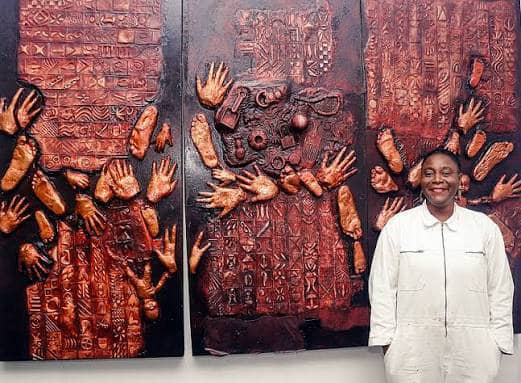
Prof. Peju Layiwola, like Edward Irivwoje, an artist, art educator and mentor, stands beside one of her numerous cast works
The historical importance of such a teacher cannot be measured merely by the number of surviving paintings or sculptures bearing his signature. A teacher’s greatest work may sometimes survive in the imagination of his students.
Seen from this perspective, recovering Irivwoje’s story becomes part of recovering the deeper history of Nigerian modernism itself.
These notes remain preliminary. Important questions are still unanswered, including: When and where was Edward Irivwoje born? What was his family and community background? When did he teach at Western Boys High School, Benin City? What were the exact dates of his appointment at Government College, Ughelli? Where precisely did he study or receive training in Kumasi? Did he attend an established art institution in Ghana? Who were his teachers and contemporaries? When did he move to Ibadan, and at which institution did he teach there? Are any paintings, drawings, sculptures, teaching materials or photographs by him still in existence? Are there former students who remember his teaching? Are there surviving appointment letters, school records, staff photographs, exhibition catalogues, newspaper references or family documents What ultimately became of Edward Irivwoje?
Answering even a few of these questions could restore an important missing figure to the history of Nigerian art education.
This preliminary research is therefore also a public call for information. We invite former students of Western Boys High School, Benin City, Government College, Ughelli, artists, teachers, historians, archivists, members of the Irivwoje family, residents of communities where he lived or worked, and anyone who may have encountered Edward Irivwoje to share what they know.
No recollection should be considered too small. A photograph, school register, old letter, artwork, signature, newspaper cutting, exhibition catalogue, family story, recollection of a classroom encounter—or even the name of another person who knew him—may provide the missing link needed to reconstruct his life.
Who was Edward Irivwoje? What became of his art? Who did he teach? What survives of his work?
We particularly appeal to anyone possessing photographs, artworks, documents or personal memories relating to him to volunteer this information for historical research.
Irivwoje may have disappeared from the written histories of Nigerian art, but his influence did not necessarily disappear with him. It is time to find Edward Irivwoje and return his story to the history of Nigerian art.
* Dr. Onobrakpeya, an art historian and collector, announces the start of August Harmattan Retreat this week and invites interested persons to reach out to him on how to be part of the festival