Culture is not museum exhibit; it breathes, evolves, belongs on international stage without apology, says Ekuma

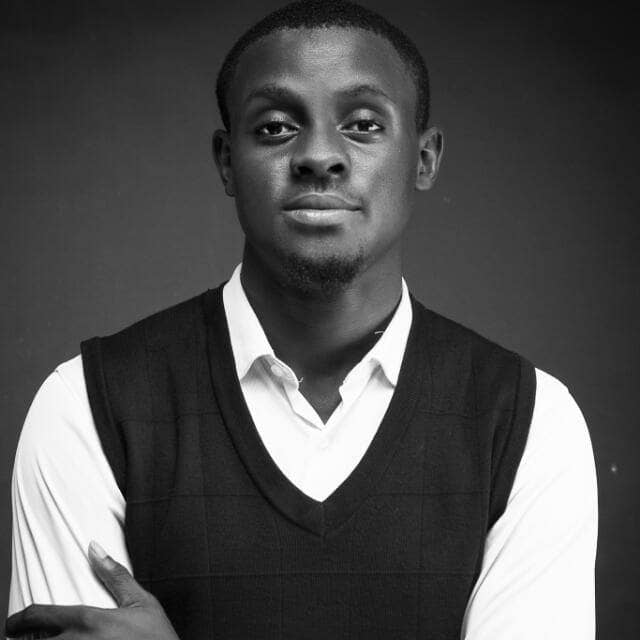
Emmanuel Otozi Ekuma holds the aces in two complementary-yet-often-assumed-contradictory fields: the Arts and the Sciences. He is a flutist, biomedical scientist, drummer, and dancer. In this interview, he shares insights into his journey as a creative and offers perspectives on how the arts can be reckoned with globally
By Anote Ajeluorou
How would you describe yourself beyond being a drummer, flutist, and dancer?
AT my core, I am a storyteller and a custodian of culture. I believe rhythm is the heartbeat of every civilisation — from my first touch of a drum, I understood that music is communication, history, and identity wrapped in sound. The flute added melody, dance gave physical expression, and performance became the vessel carrying it all to global audiences. Through these art forms, I bridge the ancient and the contemporary, preserving what our forebears created for the generations yet to come. That intersection of tradition and creativity is where I live and do my most meaningful work.
Was there a specific moment you realised that this was your life’s path?
Growing up in Ebonyi State, Nigeria, culture was my classroom. Igbo festivals, drumbeats, and traditional dance surrounded my childhood. Elders playing the flute at dusk moved something deep within me. Later, performance became my way of preserving these precious moments before time and modernity erased them forever. As for the specific moment, it came while watching an older drummer perform at a village ceremony, I felt an overwhelming sense of belonging. That rhythm spoke directly to my soul. In that single moment, everything became clear. This was not a hobby or a pastime; this was my calling, my purpose, and the truest expression of who I am.
How do drumming, flute, and dance come together in your creative identity?
They are not separate crafts to me — they are one unified language. The drum provides the heartbeat; the flute carries the melody; dance gives it physical expression; these performances capture all for eternity. Together they form a complete story — body, sound, movement, and memory converging into a single powerful cultural statement that transcends borders and speaks to every human soul.
Beyond performance, what does rhythm mean to you?
Rhythm is the invisible thread connecting all living things. It exists in breathing, in seasons, in heartbeats, and in human relationships. Beyond performance, rhythm is how I navigate life itself — finding pattern in chaos, balance in uncertainty, and meaning in stillness. It is not something I practise; it is something I am.
You have a major background in Biomedical Sciences. Does this have any influence on your artistic side?
Absolutely — more than most people would expect. Science taught me precision, discipline, and deep observational skills — qualities that translate powerfully into mastering traditional drumming, flute and dance. In the laboratory, a single error carries consequences. On stage, a misplaced rhythm disrupts everything. Both demand total commitment. Science also taught me to look beyond surfaces and understand underlying patterns — a skill that profoundly shapes my performing eye. Most importantly, both science and art share the same mission — preserving something precious for humanity. Science did not dilute my artistry. It sharpened it unexpectedly.
How has your upbringing or environment influenced your artistry?
Ebonyi State shaped everything I am as an artist. Growing up surrounded by Igbo festivals, communal ceremonies, and intergenerational storytelling gave me an artistic foundation that no formal institution could replicate. My environment taught me that art serves community, preserves identity, and carries truth. Every performance I create today carries the fingerprints of that upbringing; it is impossible to separate where I came from and what I create.
What kinds of stories or emotions are you most drawn to expressing?
I am most drawn to stories of identity, belonging, and resilience. The emotions that move me deepest are those that live at the intersection of joy and longing — the bittersweet feeling of celebrating a culture while simultaneously fighting to preserve it. I am drawn to stories of ordinary people carrying extraordinary cultural weight, ancestors speaking through living descendants, and communities finding strength in their traditions. These are the stories that matter most and last longest.
What does your creative process look like, from inspiration to final output?
It always begins with listening — to my environment, my community, and my inner voice. Inspiration rarely announces itself loudly; it whispers through everyday moments. Once an idea takes hold, I let it breathe and develop organically before touching any instrument or camera. Drumming and flute-playing then become my thinking tools; rhythm helps me shape the emotional architecture of whatever I am creating. Dance follows naturally, giving physical dimension to what the music has already mapped. Bringing it all together as performance is always the final layer — the frame through which everything is captured, preserved, and presented to the world with intentionality and purpose.
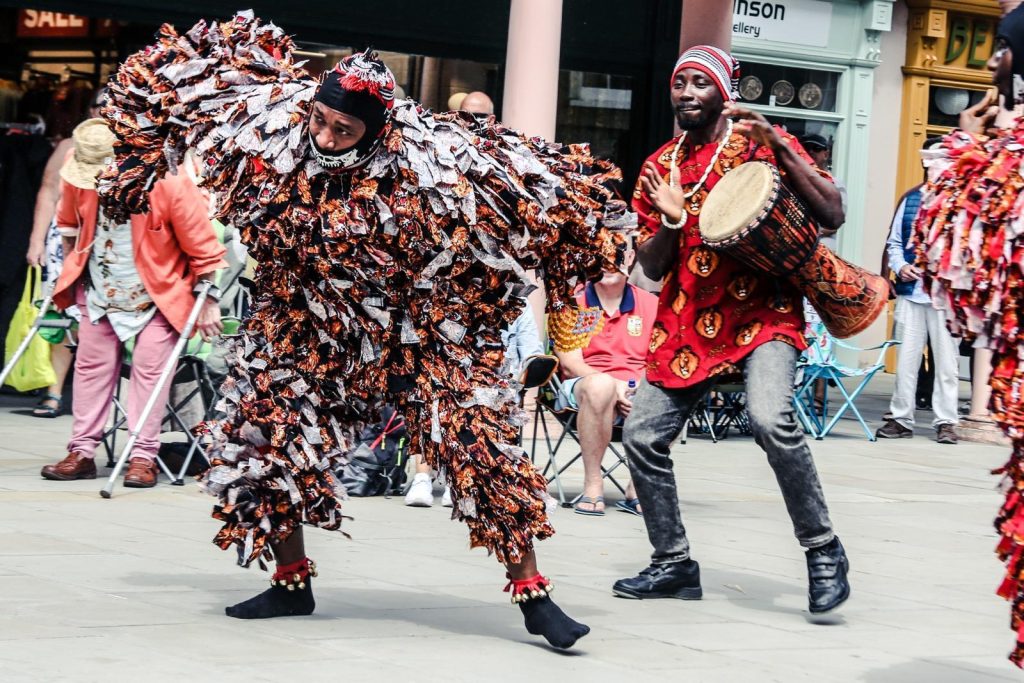
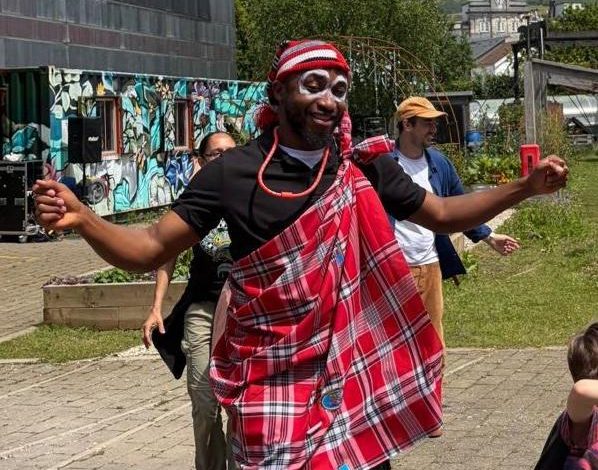
Emmanuel Ekuma in masquerade attire dancing to the rhythm of the drum at Brecon International Festival
Which project or performance best represents you so far, and why?
Without question, my performance at the Brecon Jazz Festival in Brecon, Wales, stands as the most defining moment of my artistic journey so far. Taking the stage at one of the United Kingdom’s most celebrated and internationally recognised music festivals was itself a profound statement. However, what happened during that performance transcended anything I had anticipated.
I drummed, played the traditional flute, and danced simultaneously, bringing the full weight of Igbo cultural expression onto a stage that had never quite seen anything like it. There was no script, no compromise, and no dilution of tradition. It was raw, authentic, and entirely rooted in the heritage I carry.
But what made it truly unforgettable was the audience. The local community at Brecon did not just watch — they embraced it. I witnessed something beautiful unfold in real time — people from an entirely different cultural background connecting deeply with rhythms and melodies born thousands of miles away in southeastern Nigeria. That connection confirmed something I have always believed: that authentic cultural expression needs no translation. When art is genuinely rooted in truth and identity, it speaks universally.
The warmth, curiosity, and genuine appreciation I received from the Brecon community reminded me exactly why I do what I do. It was not just a performance; it was a cultural bridge built in real time, between Africa and the United Kingdom, between ancient tradition and contemporary celebration. That moment represents everything I stand for as an artist.
What challenges have shaped your journey as a creative, and how did you overcome them?
Being multidisciplinary in industries that prefer labels, limited resources, and cultural displacement were my greatest challenges. But I overcame them by letting authentic performance speak louder than any explanation. Taking the stage at the Swansea Arts Festival, the Ekene Igbo Ball, and the Brecon Jazz Festival proved that traditional Igbo art forms resonate powerfully across diverse audiences. The Windrush Celebration was particularly memorable. Beyond performing, I took the opportunity to teach students the art of traditional drumming, explaining its cultural significance, history, and technique. Watching young people connect with that knowledge confirmed that every challenge I faced was worth it.
Have you had moments where your work deeply connected with an audience?
Absolutely! Those moments are why I do what I do. At the Brecon Jazz Festival, I watched audiences from entirely different cultural backgrounds lose themselves completely in rhythms born from southeastern Nigeria. The connection was instant, raw, and deeply moving. At the Windrush Celebration, the impact went even deeper. Teaching young students the art of traditional drumming — explaining its history, cultural significance, and technique — and then watching their faces light up with understanding and excitement was profoundly fulfilling. Those students did not just learn how to drum; they connected with a heritage that transcended their own backgrounds. At the Swansea Arts Festival and the Ekene Igbo Ball, I witnessed my own community’s pride ignite watching traditional Igbo art forms celebrated on prominent stages. That collective pride is irreplaceable.
But perhaps the most powerful connections happen in the quietest moments — when a single audience member approaches after a performance with tears in their eyes, unable to fully articulate what they felt but knowing something inside them was moved. Those moments confirm that authentic cultural expression needs no translation. It bypasses language, background, and geography and speaks directly to something universally human. That is the impact I live and create for.
How do you use your art to engage with community or cultural identity?
My art is fundamentally an act of community service and cultural responsibility. At the Ekene Igbo Ball, traditional music and dance anchor diaspora communities back to their roots. At the Windrush Celebration, teaching young students traditional drumming built powerful bridges of understanding across different heritages. At Swansea Arts Festival and Brecon Jazz Festival, I carried Igbo cultural identity onto international stages with pride and authenticity. Capturing it on stage/screen preserves everything, creating living archives for future generations. My art does not just celebrate cultural identity; it actively protects, shares, and ensures it survives for generations yet to come.
What role does collaboration play in your creative practice?
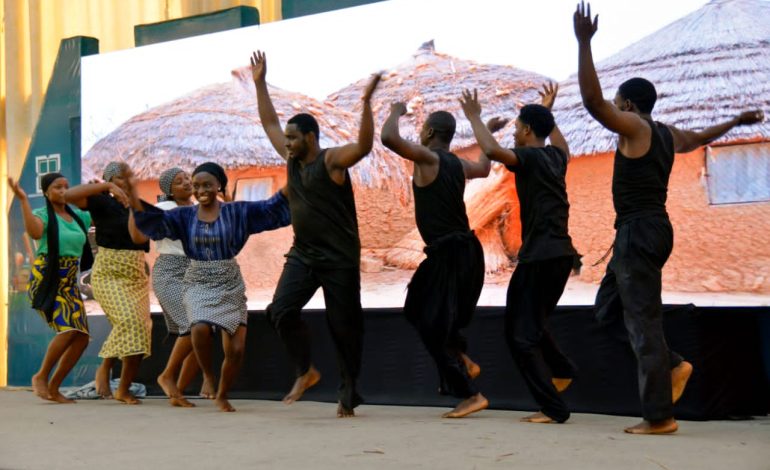
Collaboration is the soul of everything I create, which is why being part of Nganga Performing Arts and Mobile Theatre is so central to my artistic identity. Traditional music and dance have never been solitary pursuits — they were born in community and thrive in community. Within Nganga, we collectively carry the responsibility of preserving and presenting cultural art forms with authenticity and excellence. No drummer performs alone; no dancer moves in isolation. Every stage we have graced together — from the Swansea Arts Festival to the Brecon Jazz Festival — has been powered by our collective energy, discipline, and shared cultural purpose. Collaboration does not just enhance my creativity; it defines it entirely.
What misconceptions do people often have about your kind of artistry?
The biggest misconception is that traditional art forms are primitive or culturally limited — belonging only in village settings rather than international stages. Brecon Jazz Festival and Swansea Arts Festival proved otherwise definitively. Many also underestimate the technical mastery required. Within Nganga Performing Arts and Mobile Theatre, drumming, flute, and dance demand years of dedicated practice, deep cultural study, and extraordinary discipline — equal to any classical art form. Finally, people assume traditional art cannot emotionally connect across cultures. Every international performance I have delivered has shattered that assumption completely. Authentic cultural expression is universally human and needs no translation.
How would you weigh your interest in the Arts, compared to the Sciences?
I refuse to place one above the other because both represent complete expressions of who I am. Science feeds my analytical mind while art feeds my soul. Together they create a balance that makes me a more complete human being and a more perceptive artist. However, if I am being entirely honest, art is where my heart truly lives. Science is what I studied and practised with dedication and excellence. But traditional drumming, flute and dance with Nganga Performing Arts and Mobile Theatre — that is where I feel most alive, most purposeful, and most authentically myself.
The intersecting lines of arts and medicine are gradually evolving. How would you say your unique position as one person in both fields—and with insight from multi-varied worlds—contributes to global sustainable development?
My position at the intersection of science and arts is uniquely powerful. Science gave me evidence-based thinking while art gave me cultural insight; together, they allow me to bridge communities, healthcare systems, and cultural preservation in ways neither world achieves alone. Through Nganga Performing Arts and Mobile Theatre, we strengthen community mental health and social cohesion — scientifically proven benefits. Through performing arts, I document cultural wisdom contributing directly to UNESCO sustainable development goals. Sustainable development is ultimately human, and humanity thrives only when cultural roots and scientific progress remain powerfully connected.
What keeps you going during difficult or uncertain periods?
Purpose! When your art is rooted in something greater than personal ambition — in cultural preservation, community identity, and ancestral legacy — doubt becomes temporary but purpose remains permanent. I think of the elders whose traditions I carry, the young students I taught at the Windrush Celebration whose eyes lit up discovering drumming for the first time, and my brothers and sisters within Nganga Performing Arts and Mobile Theatre who share this mission collectively. That responsibility never allows me to quit. Purpose always outlasts difficulty.
What does success means to you as an artiste?
Success to me is never measured by fame or financial reward; it is measured by cultural impact. The day a young person picks up a traditional drum because of a performance they witnessed, the moment an audience member from a completely different background feels genuinely moved by Igbo music and dance, the instant a filmed cultural performance outlives its creators and educates future generations — those are my definitions of success. Within Nganga Performing Arts and Mobile Theatre, we celebrate success collectively — every stage conquered, every community reached, and every tradition successfully preserved and passed forward is a victory worth celebrating.
If someone experiences your work for the first time, what feeling or message do you hope they leave with?
I hope they leave feeling that they have encountered something genuinely alive — not a performance frozen in the past, but a living, breathing cultural force that is urgently relevant today. I want them to feel the universality of rhythm, the power of identity proudly expressed, and the beauty of a tradition that has survived centuries and still pulses with extraordinary vitality.
Beyond feeling, I want them to leave with a message — that culture is not a museum exhibit. It breathes, evolves, and belongs on every international stage without apology. And that wherever they come from, their own cultural roots carry a beauty worth celebrating, preserving, and sharing fearlessly with the world.
Emmanuel Ekuma and the evocative essence of methodical rhythms, creative mastery and enduring purpose: A review
Ever so often, Emmanuel Ekuma, a culture creative and bio-scientist, takes off his lab coat and takes on the stage, inspiring cultural awareness and bridging the gap of human connection, through rhythms rendered by the flute, drums, and dance.
Performance on the flute emerges through enthralling notes, calling forth tunes that evoke powerful imaginations and shared memories. Drumming takes on a dexterous rhythm, blurring the lines between the culturally past and the traditionally present. Dancing carries a measured stance, bringing forth a smoothly balanced gait, that echoes beautifully, glide after glide.
Through Ekuma, performance emerges with a unique authenticity that breathes through generations, motivating influences that are expressed through impact that unites worlds and cements cultural legacy that drives global sustainability.
* Ajeluorou is a renowned Arts and Culture Critic, and a celebrated journalist in Arts, Culture, Lifestyle and Entertainment with many publications to his name including Igho Goes to Farm (children’s book – 2019), Libations for Africa (poetry – 2022) and Moonbeam (Ed – 2025)