Prize laureates Ifowodo, Abiola spotlight religious violence, cultural heritage in Nigeria

By Godwin Okondo
LAWYER and poet Ogaga Ifowodo has described literary prizes as vital instruments for validating writers and bringing their work to wider audiences while filmmaker Feranmi Abiola has called for greater documentation and recognition of Nigeria’s emerging cultural movements to claim proper ownership before they hit they woder world. While Ifowodo is winner of The Nigeria Prize for Literature 2026, Abiola is a joint winner of The Nigeria Prize for Creative Arts 2026. They made the observations in separate interviews following the Grand Award Night organised by NLNG in Lagos on October 9.
While Abiola’s documentary, Mara Mania, explores an emerging music and dance movement driven by young Nigerians, Ifowodo’s poetry collection, Why Does God Need a Gun?, interrogates religious violence, persecution and the use of faith to justify atrocities. Their remarks highlighted the importance of documenting Nigeria’s cultural experiences, supporting artistic expression and preserving stories that might otherwise be overlooked.
Ifowodo, winner of the USD$100,000 Nigeria Prize for Literature for Why Does God Need a Gun?, described his recognition as both a substantial financial reward and an important endorsement of his work.
The poet said the prize’s significance extended beyond its monetary value to the validation it provided and the opportunity to introduce his collection to a wider reading public. “I don’t know any writer anywhere who would not be exhilarated by the prize that comes with this amount of money,” he said.
Comparing the award with the T. S. Eliot Prize, which carries a £25,000 reward, Ifowodo noted that The Nigeria Prize for Literature offered a substantially larger financial reward for poetry.
“This prize is three times that amount, so winning it is a big deal. Any writer who does not feel fulfilled by it probably needs to do something else. He probably doesn’t really know what it means,” he said.
However, he argued that the greatest value of literary recognition could lie in the credibility it conferred on a writer and the attention it brought to their work.
“The more important thing about the prize is the validation that it gives. Prizes may be small, but in terms of what it does to validate you as a writer, as an artist, sometimes that can even be more valuable than the actual amount of money that comes with the prize,” he said.
He added that winning the award had helped position him before readers as a writer whose work deserved attention. “Either from the monetary value of the prize or the validation, I am entirely grateful, and I feel that it has done a great deal to put me in the eyes of the reading public as somebody whose work is deserving of attention,” he said.
Ifowodo’s winning collection examines the contradictions between religious belief and violence, questioning how atrocities could be committed in the name of a God understood to be loving and merciful.
Explaining the motivation behind the work, he said he was troubled by the use of religion to justify cruelty, oppression and the persecution of people because of their beliefs.
“We all see the degradation, the blasphemy, because when I look at it, at its core, that is blasphemy. Taking the name of God in vain, to commit all of these atrocities in the name of God,” he said.
He argued that religious claims about the sanctity of human life needed to be examined alongside historical instances in which religious authority had been invoked to justify domination, conquest and violence.
The poet also questioned patriarchal interpretations of religious traditions and narratives used to justify the subordination of women, arguing that such beliefs deserved critical scrutiny.
At the heart of the collection, he said, was a broader examination of the relationship between religion, power and human freedom, particularly when claims of divine authority were used to legitimise violence against others.
A central inspiration for the collection was Leah Sharibu, the Nigerian schoolgirl abducted by Boko Haram in 2018 who became widely known for reportedly refusing to renounce her Christian faith while in captivity.
Ifowodo said Sharibu’s courage profoundly influenced his decision to write the book, adding that he did not want her experience to be erased from public memory.
In his acceptance speech at the award ceremony, he dedicated the prize to her, describing her determination as the inspiration behind the collection. “I dedicate this award to Leah Sharibu whose extraordinary, even inhuman, courage in refusing to renounce her faith for her captors’, as a Faustian bargain for her freedom, awed me into writing ‘Why Does God Need a Gun?’” he said.
He said Sharibu’s experience raised difficult questions about religious conviction, human dignity and the treatment of people whose beliefs differed from those of their captors. In his view, her story needed to be preserved not only as an account of suffering but also as a testament to individual courage in the face of extreme pressure. The poet said he was determined that her captors should not succeed in silencing her or erasing her experience from public consciousness.
In his acceptance speech, Ifowodo also explained that the collection’s central sequence, “From the Forest of a Million Demons (Leah Sharibu Lifts the Veil)”, culminated in the poem “Soon, Archangel Michael Will Free Us”, which explores the hope of freedom through the experience of a captive speaker.
“The captive speaker dreams of regaining freedom. But that very hope unveils the predicament of theodicy, the idea of an Almighty, loving and merciful God in whose name unspeakable atrocities are routinely committed,” he said.
He argued that humanity’s hope lay in recognising the equality, dignity and freedom of every person, regardless of religious affiliation or social identity.
“The truth, however, is that it is our better angels that will free us. I mean that humanity’s hope lies in the unequivocal acceptance of the inherent and inalienable equality, dignity and freedom of thought and belief of all humans, irrespective of gender, race, class, creed, colour or social identity,” he said.
Ifowodo described the poet as a witness whose responsibility was to preserve the memory of suffering and challenge attempts by religious and secular authorities to impose a single way of seeing, believing or living.
“The poet as witness seeks, through language, to keep alive the memory of the ‘impress of extremity,’ of the relentless efforts of authoritarianism, secular or religious, to force us into one way of seeing, believing or being,” he said.
He commended the gas company NLNG for supporting Nigerian and international literature, urging the company to sustain its investment in literary and cultural development.
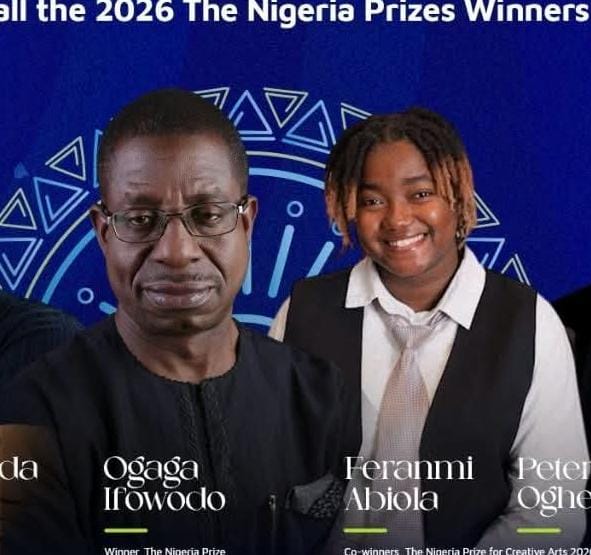
Dr. Ogaga Ifowodo (left) and Feranmi Abiola
MEANWHILE, Abiola, who emerged joint winner of the inaugural Nigeria Prize for Creative Arts alongside filmmaker Peter Oghenetega Oke (Beyond Tarkwa Bay), worth USD$20,000, said Mara represented a distinctive Nigerian sound whose potential remained insufficiently recognised at home. She described the movement as a fusion of soulful music and energetic street dance, driven by young people who continue to experiment with sounds and movements despite limited resources.
“Mara is Nigeria’s EDM, and we just don’t know that yet,” he said, comparing the genre’s potential to that of electronic dance music. “We will start to know that when people from overseas start to spotlight them or make remixes before we realise that that’s a Nigerian sound. We wanted to, from the ground up, straighten the story. This is what Mara is; these are the people who are creating this genre or sound. We wanted to make sure that it is told by Nigerians.”
Abiola explained that the documentary was conceived to introduce audiences to the people behind the movement, their creative processes and the circumstances that shaped their work. She said Mara differed from other street music styles because of its distinctive combination of soulful melodies, emotional depth and energetic dance.
“Mara is a sound that blends emotional or soulful music. You can play it while you are happy and you can also play it while you are sad,” he said, recalling the description given by DJ Khalifa, one of the people interviewed for the documentary.
Although she described Mara as an evolution of Nigerian street music, Abiola said it was not simply a derivative of earlier styles such as Galala, which emerged from Ajegunle in Lagos, rather, the movement incorporated diverse musical influences to create a distinctive sound that was increasingly attracting attention through social media platforms such as TikTok.
According to her, the term Mara Mania captures the high energy, frenzy and intensity associated with the music and dance culture.
Beyond documenting the sound, Abiola said he wanted the film to challenge assumptions about the young people associated with street culture, whose creativity and musical knowledge were often underestimated.
“One of the comments that got to me was that people had a perception of who these people were, because immediately you hear the streets, the trenches, you just think something else,” he said.
“You already have a different perception, but seeing these people speak about their craft and hearing them talk about their process, you are struck by how intelligent they are and how their process works.”
She said the documentary enabled audiences to appreciate the thought and experimentation behind the movement, including the unexpected musical influences that informed the work of its DJs and dancers.
For Abiola, the project also offered an opportunity to portray the participants as young Nigerians with ambitions, challenges and aspirations beyond their involvement in music and dance, noting that the movement had begun opening doors to international opportunities, with one of the DJs embarking on a European tour before the documentary was completed.
Asked about Mara’s prospects over the next five years, she said the genre was likely to grow significantly but warned that Nigerians needed to recognise and embrace it. “It’s going to be big,” she said. “But it also needs Nigerians to know about it and accept it. Most people don’t know about it, but people overseas are paying attention to it. So, we need to take our own thing and treat it as ours.”
Abiola said documenting the movement was particularly important because Nigeria risked losing control of the narratives surrounding its cultural innovations if it failed to preserve their origins and development. She cited the debates surrounding the origins and ownership of Afrobeats as a reason to ensure that the history of emerging Nigerian sounds was properly documented from the outset.
She said Mara Mania sought to establish a record of the people responsible for developing the movement, ensuring that their contributions would be recognised as its popularity grew.
However, the filmmaker said the production exposed the difficulties Nigerian documentary makers face when attempting to research and preserve the country’s cultural history. She explained that he had to spend considerable time with the Mara community, attending dance practices, observing its members and learning about their lives before developing the documentary’s narrative.
Rather than conducting interviews and leaving immediately, he immersed himself in their activities to understand the movement and identify the people whose contributions were essential to its history. “I had to spend time with these people, even begin filming, to do some recording, just to get the meat of the story. From there, I go back to do more research,” he said.
One of his biggest challenges, however, was the difficulty of accessing archival materials that could have helped establish the movement’s history. Abiola said the production had to rely largely on available resources and direct engagement with the people involved because it lacked the budget for extensive archival research. She argued that the problem reflected a broader need for Nigeria to improve the documentation of its cultural developments and make existing materials more accessible to researchers and filmmakers. “I would say we are doing the best we can, but we need to also do more, and also encourage documentary filmmakers,” she said.
“There are a lot of filmmakers out there that want to tell stories, but don’t have the resources. I wouldn’t have been able to tell these stories if I didn’t have the backing.”
She called on Nigerian television stations to take a more active role in documenting the country’s cultural experiences and making their archival collections available to independent filmmakers.
“I would tell them to take a back seat and look at all the stories that we have in Nigeria and try to amplify them more, and also the archives that they have should be more accessible to people. We need them to be at the forefront and tell more of these stories,” she said.
Abiola added that filmmakers often lacked information about the procedures required to obtain archival materials, making it necessary to open discussions between broadcasters, archivists and independent producers.
She said greater access to historical footage and other records would help filmmakers tell more comprehensive stories about the people, communities and movements shaping contemporary Nigerian culture.
Despite the challenges, he said the documentary demonstrated how creativity could flourish in difficult economic circumstances, pointing to underground DJs, producers and dancers who continued to develop new sounds without sophisticated equipment.
The film took approximately three months to produce. Abiola credited his crew, executive producers and the French Embassy in Nigeria for supporting the project and the wider community. The first screening took place at Freedom Park in Lagos in November 2025, attracting members of the community who filled the venue before celebrating with a Mara party.
The documentary has since received encouraging responses at screenings and secured selections at several festivals, with further submissions awaiting decisions.
Abiola said she hoped the film would encourage more Nigerians to recognise the cultural significance of emerging movements before international attention determined how they were understood.