Old and wise: 7 authors still active after 80

By Henry Akubuiro
THE older we get, the less active we get in life. You cannot be forever young. Little wonder workers worldwide look forward to retirement. In 1881, the first official retirement age globally was pegged at 70 in Germany by Otto von Bismarck, the former Chancellor of the German Reich, and was reduced to 65 in 1916. Taking a cue from Germany, more countries began adopting an official retirement age. Britain passed the Old Age Pensions Act 1908, which set the initial retirement age at 70, and, later, lowered it to 65 for men and 60 for women in 1946. The US also adopted an initial retirement age of 65. By the mid-20th century, almost all nations had adopted a retirement age in 1935. It is believed that a worker will have put in his best at 65 to deserve his rest in private and pension to compensate for his decades of labour.
But these retirement protocols do not apply to every creature under the sun. From the corporate world, legal practice, academia, engineering, journalism, the literary world, among others, many have refused to call it quits at 65. For creative writers and many in the creative industries, a life of vegetation doesn’t hold any attraction. Some keep champing at the bits till well over 80. There are also a few in their 90s who haven’t given up the life of seclusion and letting their imaginations run riot. They are wedded to the muse, and the muse sets the tone for their creative impulse.
Like every other profession, old age affects writers, but in a positive way often. Older writers draw on a wider range of life experiences, emotions, and observations, which tend to make their characters and situations more believable and relatable. Of course, life experience fosters greater understanding of human nature, complex themes, and subtle nuances, thereby improving storytelling. It is a given that decades of reading, writing and research can refine the skills of an aged writer in language, voice and structure. Indeed, older adulthood makes the capacity for language production stronger into older adulthood, despite potential memory loss issues, health challenges like diminishing eyesight and sitting for too long at one place.
Age is an asset, not a barrier: the literary resumes of some aged writers speak volumes. The Guinness World Records recognise South Korea’s Kim Hyung-seuk, the author of Hyung-seuk, 100 Years of Wisdom, published in March, 2023, at over 103 years as the oldest author alive. America’s Jim Downing, who once held the title of the world’s oldest living author, published The Other Side of Infamy, a novel, at 102. Nigeria’s Nobel laureate, Professor Wole Soyinka, (born 1934), a poet, playwright and novelist, has remained a very active author at 91. Soyinka’s last major work, a novel entitled Chronicles of the Happiest People on Earth, was published in 2021 at the age of 86. Currently, he is an arts professor at the University of Abu Dhabi.
In Africa, there are, however, a number of celebrated, aged authors who haven’t been active on the literary scene like Soyinka has been. Ghana’s Ayi Kwei Armah, famous for his novel, The Beautyful Ones Are Not Yet Born, was born on October 28, 1939, but he hasn’t been productive creatively in recent years. South Africa’s Zakes Mda, former winner of Commonwealth Writers’ Prize, is a prolific novelist, playwright and poet. He is 78 years old now, two years shy of 80. His most recent work was Wayfarer’s Hymn, published in 2021 at 73. Born in 1948, the Nobel laureate, Abdulrazak Gurnah, the Tanzanian Nobel laureate, is three years shy of 80, His most recent work, Theft, was published in 2025.
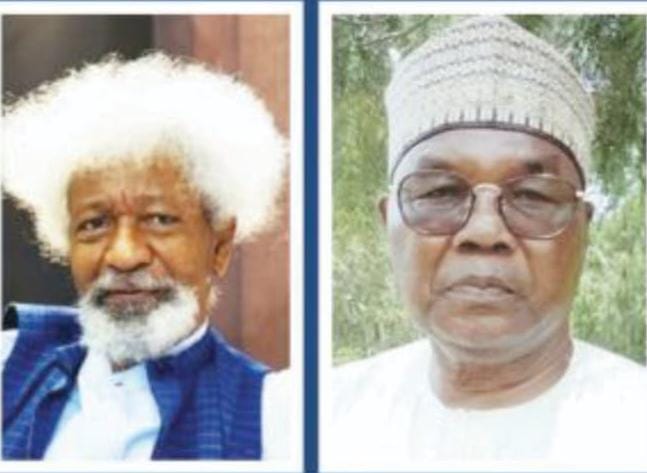
Prof. Wole Soyinka (left) and Dr. Bukar Usman
Across the Atlantic, Margaret Atwood, 86, the Canadian novelist, poet and literary critic, was a joint winner of the Booker Prize in 2019 at the age of 80 for her novel, The Testaments, a sequel to her famous The Handmaid’s Tale. She has published over 100 works.
Isabel Allende, 83, a Chilean-American, is known for her richly detailed family sagas and magical realism. She has continued to be an active author. Her latest work, My Name is Emillia del Valle, was published in 2025.
British author, Len Deighton, the acclaimed spy and military history novelist, is currently 96 years old and still active as an author. Rated among the top three British spy novelists, he has had a celebrated career spanning over 50 years and also recently contributed to new publications. His memoir, Book of Lives: A Memoir of Sorts, was published in November, 2025.
Back to Nigeria, Dr. Bukar Usman is perhaps the most active Nigerian author in his 80s, judging by the volume of works he churns out yearly and the ones still in progress. From folklore, culture and history books, non-fiction and books on policy, security and public administration, he has been fecund in output. But his greatest literary asset has been in publishing books on Nigerian folklore. It is hard to find any other author with the same collection of published folklore books he has written in both English and indigenous languages.
In the last four years, he has published Conversations with Bukar Usman (Klamidas, 2022), My Literary Works: Reviews and Reports (Klamidas 2022), 13th National Conference on Literature in Northern Nigeria (2023), Reflections on the Nigerian Public Service: Way Forward for Governance, (2024), A Review of Boko Haram and other Security Challenges in Nigeria (2024), Bura Women Development Association (BUWDA), Abuja Chapter, (2025), and A Review of A Journey in Service: An Autobiography – Ibrahim Babangida (2025). Before these books, he had published dozens of books on folklore, including the popular Treasury of Nigerian Tales (TNT) anthologies, which are often donated to booklovers, schools, agencies and institutions worldwide.
On December 10, 1942, Usman, former permanent secretary in the presidency and current president of the Nigerian Folklore Society, turned 83, and it was time for fans, friends and family to celebrate the author of over 40 books. When The Sun reporter visited his office at Maitama, Abuja, shortly before his December birthday, he witnessed a busy office with works in progress and a storehouse of many books.
“After my retirement in 1999, I made up my mind to share with the public some of my experiences in my over three decades in the public service of Nigeria in privileged positions. In the course of doing so, I veered into folktales from which I and many renown persons had benefited immensely in childhood days and adulthood. That made me conduct pan-Nigerian research in folktales. As I share my views and findings in the areas of my focus, the feedback from readers with the media as one of my cheerleaders, as well as recognitions in the form of honorary awards I received from within and outside the country made me feel that what I am doing is being appreciated and that encourages me the more,” he said.
Usman may well be considered a late bloomer in the sense that much of his literary works came about after his retirement from civil service at an advanced age. “As I explained several times in the past in some of the interviews I granted to the media, it is true I was not known as a writer while in service. However, that did not also mean that I had not been writing in my official capacity. I did in a limited sense. My retirement only gave me more free time to devote to writing and I fully took advantage with the help of God who graciously blessed me with good health and the faculty to do so. As I stated elsewhere, I believe every human being has a gene of writing. It only needed a small push to thrive and the public support I got did act as a spike,” he said.
For Usman, it is hard to pick the best book from his ouevre: “I have been confronted with the same question in the past. My response, which I wish to reaffirm, is that it is like a father being asked to point to a favorite child. True, although one may have a favorite child, it is inadvisable for one to openly express. And so, for my books, it is up to readers to say the one they enjoy best from their perspectives and assessments.”
Usman has long resolved that, with God’s blessings with good health and sound mind, he would continue to engage in literary activities. “When I turned 80, I decided to write a book and resolved on a title Looking Back, Looking Forward: 80th Birthday Reflections and Reports. This and a few other books are in print, and, by the grace of God, would soon be released. Your question has only prompted and hastened me to share this information,” he noted.
What’s his writing regimen? He told The Sun: “I am seriously engaged in literary works with a few staff mainly in evening hours on working days while the weekends and public holidays are devoted to reading and reflections to supplement the little I do alone in the remaining hours.” Usman, at 83, has continued to shape African and world literature as he approaches the twilight of his literary career.
As we can see from the careers of many veteran writers globally, age is no barrier to creativity. Some have even published their most successful works later in life, such as Harry Bernstein, who achieved fame at 96 with his memoir, The Invisible Wall. You, too, can be the next.
* This feature article by Henry Akubuiro was published in the Sun of February 1, 2026, P. S15 and online at https://thesun.ng/old-and-wise-7-authors-still-active-after-80/?amp