
NPL 2026: Advisory Board receives over 223 entries as adjudication process begins

By Godwin Okondo
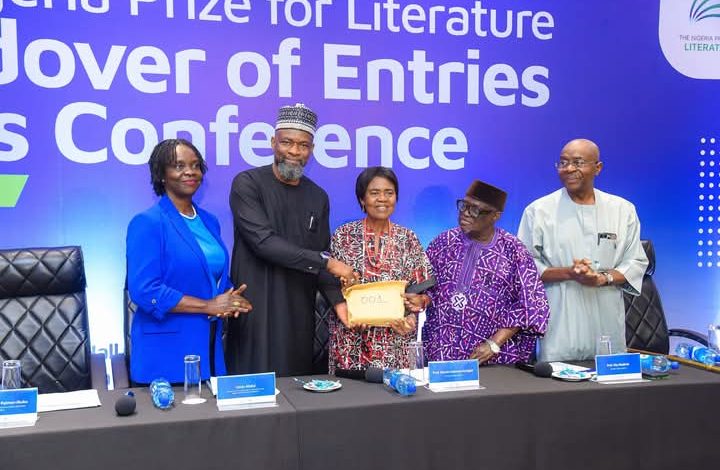
THE Nigeria Prize for Literature, sponsored by NLNg, has formally entered its adjudication phase following the handover of 223 entries by its Advisory Board to the panel of judges at a press conference held in Lagos on April 20, 2026. The figure submitted, which reflects a strong outing for poetry category, underscores sustained participation from writers across the country and beyond. It also reaffirms the prize’s standing as a major platform within Nigeria’s literary landscape.
Speaking at the event, the General Manager, External Relations and Sustainable Development at NLNG, Dr. Sophia Horsfall, described the handover as the beginning of a rigorous and defining process. Represented by Abdul Umar, Manager, Government Relations, she said, “This marks the start of a process that demands attention, patience, and sound judgement, and will ultimately determine the work that defines this year’s Prize.”
She noted that the 2026 edition, valued at USD$100,000 and widely regarded as one of Africa’s most prestigious literary honours, is dedicated to poetry, a genre she said demands “precision, depth, and the ability to express complex ideas in few words and with clarity.” According to Horsfall, expectations for the category remain high, particularly in light of the 2022 cycle, which produced a winning work (Romeo Oriogun’s Nomad) that continues to resonate within contemporary Nigerian literature. Last year Sanya by Oyin Olugbile won for prose fiction.
Horsfall further emphasised that NLNG’s role extends beyond sponsorship to sustaining a credible and impactful literary ecosystem. “At NLNG, we have consistently provided a platform that supports excellence and inspires a sustainable future,” she said, adding that the prize has, over the years, contributed to the growth of reading culture, encouraged discipline in writing, and strengthened Nigeria’s literary space.
She also highlighted the broader cultural significance of the prize, noting that each cycle generates national conversations that extend beyond the literary community. According to her, the prize “sparks anticipation, debate, critical reflection, and cultural engagement,” reinforcing literature’s role as both a mirror and moulder of society.
The entries were formally handed over to the Advisory Board chaired by Akachi Adimora-Ezeigbo, who described the moment as a critical transition in the prize’s lifecycle. “This moment marks an important transition… ushering in the most critical phase of the process,” she said.
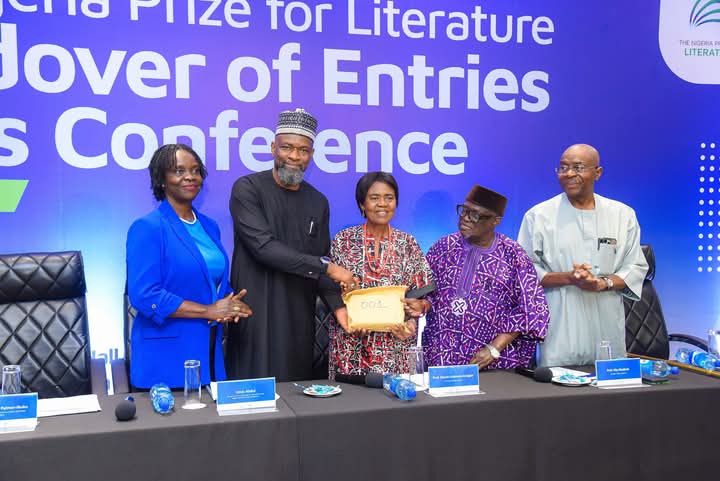
NLNG’s Manager, Corporate Communication and Public Affairs, Anne-Marie Palmer-Ikuku (left); Manager, Government Relations, NLNG, Abdul Umar handing over entries to Chairperson, Advisory Board, Prof. Akachi Adimora-Ezeigbo while other Advisory Board members – Professors Olu Obafemi and Ahmed Yerima look on.. in Lagos
Adimora-Ezeigbo stressed that the prize has earned its credibility through a rigorous adjudication framework anchored on fairness and merit. “Every entry is read thoroughly and independently,” she said, explaining that the Advisory Board and judges subject each work to careful scrutiny, interrogation, and assessment against established standards.
She urged the literary community to maintain confidence in the process, noting that its consistency over the years has sustained the prize’s integrity. “The process is thorough, unbiased, and strictly merit-based,” she added.
On the poetry category, she challenged the notion that the genre is less demanding than others. According to her, “There is very little room to hide. One cannot rely on length or excessive explanation. Every line must be precise; every word must justify its presence.” She further pointed out that the level of exactness demanded in poetry is where many entries often fall short.
She added that while the prize ultimately produces a single winner, its broader objective is to identify a work that will shape literary standards and influence future writing. “The sustained relevance of the work, the conversations it stimulates, and the influence it exerts over time are the true measures of the prize’s impact,” she said, noting that the winning work often becomes a benchmark within African literature.
In her closing remarks, NLNG’s Manager, Corporate Communication and Public Affairs, Anne-Marie Palmer-Ikuku, reiterated the organisation’s commitment to maintaining the prize’s credibility and cultural relevance. “There are very few platforms in Nigeria that have consistently shaped a field the way this prize has shaped literature,” she said, attributing its enduring reputation to years of careful judgement and a shared commitment to excellence.
She commended the Advisory Board for its integrity and acknowledged the role of the media in amplifying the prize and sustaining public discourse around it. “Through your work, conversations on the prize continue, and these works find their place in the public domain,” she noted.
Palmer-Ikuku added that the months ahead would require “critical attention, unbiased judgement and publicity,” expressing optimism that the adjudication process would produce an outcome reflective of the high standards the prize has come to represent.
With the handover completed, the Advisory Board and panel of judges are expected to commencnigeriae months of detailed reading and deliberation, leading to the selection of a longlist of 11 entries, a shortlist of three, and ultimately, the announcement of the winning work in October.
However, unlike previous years the management of the prize remained silent about those who will judge the prize, as no judges have been named.