
An overflow of knowledge in David Mozie’s ‘1000 Words of Wisdom’


By Anote Ajeluorou
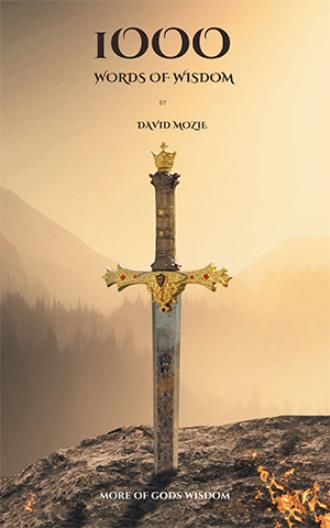
1000 Words of Wisdom: More of God’s Wisdom by David Mozie advertises itself as a spiritually grounded compilation of introspective quotes that connect modern inspirational writing with reflective practice. The book offers readers a rhythmic and deep interaction with faith-based philosophy by embracing brevity as purposeful stylistic devices rather than adhering to a conventional literary framework.
Each of the book’s succinct entries serves as a stand-alone insight. Together, these observations create a multilayered examination of Christian living in which faith is viewed as an active, everyday practice rather than an impersonal theory. Mozie’s method is noteworthy for emphasizing application; his words are instructive rather than merely descriptive, urging readers to absorb and embody the ideas put forth. This provides the work a useful aspect that sets it apart from works that are only meditative.
The book’s oral quality is one of its distinctive characteristics. It appears that the text functions as both a written and a performative piece because several of the statements read like affirmations or uttered pronouncements. “Calls to trust”, “believe”, and “act in accordance with Christ” are among the phrases that have a repetitive cadence that evokes the mood of sermons or spoken-word ministry. This gives the writing a lively quality and puts it in a good position to be adapted into digital, audio, or performance media.
The transformational power of faith is the central theme of Mozie’s work. A coherent spiritual framework is created by the text’s recurring themes of grace, redemption, endurance, and divine identity. The idea that identification in Christ is the cornerstone for conquering hardship, developing purpose, and finding fulfillment is constantly reaffirmed by the author. This focus on identification is especially interesting since it reinterprets spirituality as an existential and personal anchor.
The book’s accessibility is another asset. Mozie steers clear of complex theological terminology in favour of simple phrases that a broad audience may understand. Because of its universality, the book is appropriate for readers at many stages of their spiritual development. The book provides opportunities for reflection and connection, regardless matter whether one is just beginning to explore faith or looking for confirmation of longheld views.
Simultaneously, the tone is unadorned and unrefined due to the language’s simplicity. The writing occasionally deviates from standard grammatical accuracy, yet this does not compromise its ability to communicate. Conversely, it strengthens the impression of authenticity and immediacy, giving the impression that the reader is experiencing ideas in their purest and most direct form. This style trait is consistent with the book’s devotional goal, which prioritizes message clarity over literary polish. Mozie also made known an understanding of the human predicament in general.
Structurally, the book’s expansive sequence of entries creates a sense of abundance. The sheer volume of reflections reinforces the idea that wisdom is inexhaustible and ever-present. However, this abundance can also be overwhelming, as the absence of thematic grouping or progression may make it challenging for some readers to navigate the text systematically. Introducing subtle organisational frameworks in future iterations could enhance readability without compromising the book’s fluid nature.
From a creative standpoint, 1000 Words of Wisdom… occupies an intriguing place between motivating philosophy, literature, and devotion. Its format is in line with modern consumption habits, where readers regularly look for succinct, powerful content that they can return to repeatedly. A forward-thinking creative vision is suggested by the work’s versatility, especially its potential for incorporation into internet platforms, daily devotionals, or multimedia manifestations.
Crucially, the book exhibits a high degree of intentionality. This book exhibits significant creative potential in the given environment. It presents a new voice that contributes to the cultural landscape of inspirational and faith-based literature by fusing spiritual understanding with approachable eloquence. Its format, performance undertones, and ability to captivate people across several media are what make it unique.
1000 Words of Wisdom: More of God’s Wisdom is a unique and intentional book that reinvents devotional writing for a modern readership. It provides a resource that is both contemplative and useful because of its succinct format, positive tone, and steadfast emphasis on faith. Mozie’s work may potentially become a major contribution to contemporary spiritual literature with further development and investigation of its creative possibilities.