
An afternoon with Femi Osofisan

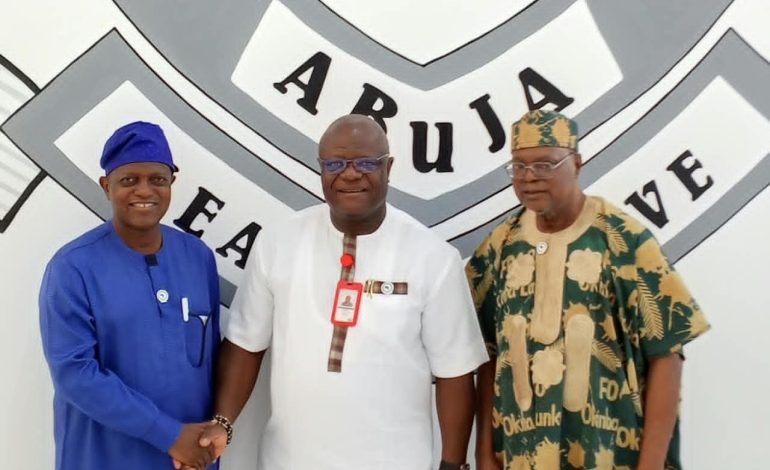
By Abiodun Adeniyi
RARELY does one encounter an intellectual whose body of work, accumulated over decades of rigorous thought and creative endeavor, leaves little doubt about the legacy he will bequeath to posterity. Emeritus Professor Femi Osofisan is undoubtedly one such figures: a distinguished playwright, poet, essayist, literary critic and one of Africa’s most consequential voices in dramatic literature. His reputation precedes him, and his works are among those one ought to have encountered in school, studied in the classroom, and returned to repeatedly for their intellectual depth, artistic ingenuity, and social relevance.
He visited Baze University last week for the Pan-African Writers engagement, which another accomplished writer, Secretary General of the Pan African Writers Association ( PAWA), Dr. Wale Okediran, facilitated. What followed was a memorable afternoon with a literary sage whose intellectual instincts became evident almost immediately.
“Where is your Theatre Department?” he asked. Then, surveying my office, he observed again: “Your office needs more works of art. You put one here, you put another there…” In these casual remarks lay the instincts of a man for whom the arts are not afterthoughts but essential instruments of intellectual cultivation.
The afternoon took another turn when I pronounced his pseudonym, Òkínbà Làúnkó. He corrected me. He explained that the second name should not be pronounced “Launko” but “Launhuko.”
It was a small but memorable lesson, delivered with the immediacy of a teacher who understands that knowledge resides not only in grand theories and celebrated texts but also in the details through which language, identity and cultural meaning are preserved. Even in casual conversation, the scholar in him was at work.
Perhaps, this is what distinguishes the truly accomplished intellectual: the inability to stop teaching, even when there is no formal lecture to deliver. Osofisan embodies the artist’s imagination, the critic’s interrogation, the scholar’s discipline, and the public intellectual’s commitment to society.
His writing has challenged received wisdom, interrogated injustice, revisited history and mythology, and explored the possibilities of resistance, collective responsibility and social transformation.
His literary repertoire includes Morountodun and Other Plays, Tegonni: An African Antigone, Once Upon Four Robbers, The Chattering and the Song, Another Raft, Esu and the Vagabond Minstrels, Women of Owu, The Oriki of a Grasshopper and Other Plays, Yungba Yungba and the Dance Contest, Aringindin and the Nightwatchmen, Kolera Kolej, Wesoo, Hamlet! or, The Resurrection of Hamlet, and Who’s Afraid of Solarin?
Each offers a glimpse into the imaginative universe of a writer who has made the stage a site for interrogating power, rethinking inherited narratives and imagining a more just social possibilities.
To spend an afternoon with Professor Osofisan is therefore to encounter more than an accomplished writer. It is engaging a living intellectual tradition, one that insists on literature’s relevance to public life, the necessity of critical inquiry, and the arts’ responsibility to illuminate the human condition.
His visit was a privilege, but it also reminded me that great minds do not merely leave books behind. They leave questions, sensibilities, and ways of seeing the world that continue to educate long after the conversation ends.
* Prof. Adeniyi is the Vice Chancellor of Baze University, Abuja, Nigeria