Igoni Barrett, Rukky Brume talk ‘Whiteface’, ‘It Comes in Waves’ at Ake Festival 2026

By Lordson Noel
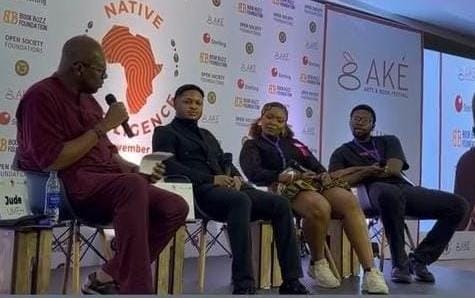
AKE Arts and Book Festival 2026 opened on Thursday, 19 November and closed on Saturday, 21 November 2026 at Silkwood Hotel, Ikeja, Lagos. The place was a teeming hive of festival activities all through the three days that included the opening ceremony, book chats, panel sessions, performances and book exhibition. There was also Q&A from the audience to the writers and artists that animated the festival gathering that included guests from Nigeria, other African countries, the Caribbean, Europe, America and Asia.
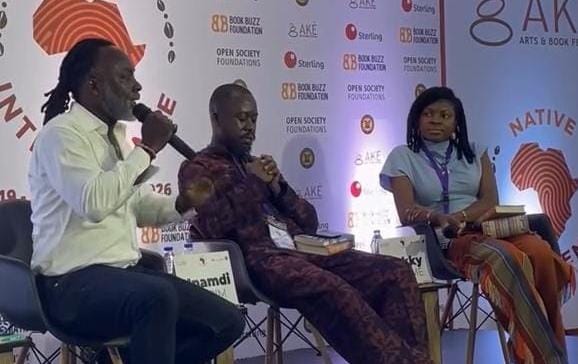
The first book chat with A Igoni Barrett and Rukky Brume was hosted by Nnamdi Ehirim. Barrett spoke about his latest work Whiteface, the follow-up to his earlier novel Blackass. He said Blackass was his first novel after two short story collections. He had written it without thinking much about publication, just putting down what came from the subconscious, and then it got picked up, translated and did well. That success, he said, messed with his sense of what he should write next. He pulled back for about 10 years. He made friends who were not writers, read books as a reader, and every time he sat down to start something new he found himself trying to return to the old book. At some point he realised that there was still another story inside it that had not been finished. Whiteface became the way to get that story out so he could move on. He said people told him that sequels in literary fiction usually do not do well, but he wrote it anyway, for himself.
The book follows the same character four years later. He has a good job in Abuja, money, a townhouse, an SUV and a garden, but he still feels like he is only climbing more ladders. He goes to Europe on a one-month holiday to see the place people keep telling him he is from. In Amsterdam, Oslo and Milan he meets different migrants, including a Kenyan writer, a Nigerian based in Atlanta, and a woman who may or may not be his sister. Barrett said the character’s ability to travel came from having a job and money in Nigeria, not from the colour change itself.
Once he got to Europe, looking the way he did let him hear conversations he would not have heard if he had still looked Nigerian. He also spoke about the playful side of both books. In Blackass there is a female writer character, and in Whiteface there is a Kenyan writer the character follows in Oslo. Both are versions filtered through his own mind. He said the idea for Blackass first came to him in 2012 while he was standing at the side of an oil-subsidy protest in Abuja, watching festival founder Lola Shoneyin and others. He wrote it down and forgot about it for years before pulling it out when he was ready to write a novel.
Someone asked why he chose to revisit the character at this point. Barrett said it was because the story was not finished and he needed to clear it from his subconscious, so he could write other things. Another person asked about the difference in how the character experiences Europe compared with a woman who has a similar background but a different complexion. Barrett said it was not the colour that got him the ticket. It was the job and the money. The colour only changed what he could hear once he got there. A third person asked about the Kenyan writer the character meets in Oslo and why Barrett wanted to include that conversation about African identity. Barrett said every character is filtered through his own mind, and the writer in Oslo is a version of that. He also said the book is speaking to other books, including Kafka’s The Metamorphosis, but the idea itself did not come from Kafka.
Brume spoke about her first book, It Comes in Waves. She said she lost her father about 15 years ago, in September, and the experience left her feeling isolated. She was a young person surrounded by people who were starting their adult lives and looking forward to things, while she was carrying grief and pretending to do like the others. She wanted to put that feeling down, but real grief can feel ordinary and sad, so she chose fiction instead. Brume said fiction let her explore the isolation and also bring in family secrets and different versions of the same person.
In the book, the daughter actually likes her father and he likes her, too. They have a loving bond, and she also has a decent relationship with her mother. Brume said she had not seen many African stories where the parents are not the main source of trauma, so she wanted to show a more ordinary, loving relationship. The father is already dead at the start of the book, and his presence is built from how different family members remember him. Their contradicting experiences of him shape how they grieve. Someone asked why she chose to write a father the daughter actually likes. She said she wanted to put down the kind of ordinary parent-child relationship she had not seen much of in African fiction.
Another person asked why the story is driven so much by dialogue instead of the character’s inner thoughts. Brume said the subject is heavy and she wanted the book to feel like you had walked into a real family conversation rather than reading long explanations. There is a lot of sharp, humorous talk between the siblings and other relatives, she said. She enjoyed writing the loud auntie who causes chaos every time she enters a room, and one of the daughter’s school friends who talks a lot of nonsense but is charming. She also liked writing the best friends. The story is driven by the siblings coming together to plan the burial and the constant chatter that comes with that. Someone else asked how she built the father as a character when he is already dead and never really speaks. Brume said in the first draft he was almost a ghost. In later drafts she started showing how different people experienced him, so the daughter’s picture of him becomes fuller as the story goes on.
A. Igoni Barrett (left); Nnamdi Ehirim and Rukky Brume