AI bias, colonial prejudice in western publishing, prize spotlighted at Ake Festival ’26

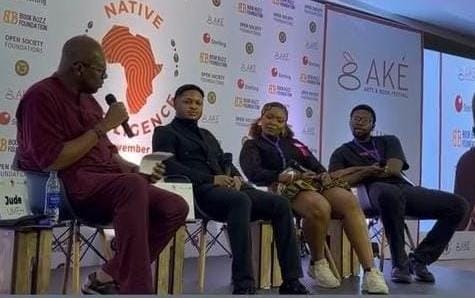
By Godwin Okondo
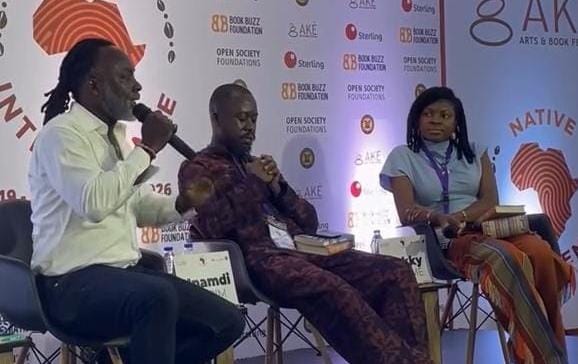
THE growing use of artificial intelligence in publishing has raised so many questions about originality and authorship, with African three writers warning that accusations of AI-generated writing by self-appointed western gatekeepers could become another way of questioning the intellect of Africans and writers of colour. They spoke during a panel discussion titled “The Future of Creative Work with Artificial Intelligence” at Ake Arts and Book Festival, on Thursday, November 19, 2027. They examined the intersection of technology, race, colonialism and creative expression that dovetails into the festival theme for this year ‘Native Intelligence’.
At the heart of the theme that the discussion flashes out is the inevitable question: where is the place of Africa’s native intelligence if artificial tools keep flagging it and ignoring its exceptional excellence that it fails to understand, because it does not fit its pattern?
The panel featured writers Jerry Falade, fantasy fiction writer Marvellous Michael Anson (First Born of the Sun and Heir of the Shadow) and Osahon Ize-Iyamu (Strange Horizon and The Dark), hosted by AI specialist Jude Umeh (The World Beyond Digital Rights Management and a short story ‘Kalabashing’), who shared their concerns about the growing reliance on AI detection tools and the possibility that such technology could reinforce existing prejudices in the global publishing industry. Falade, whose crime novel, Call Me, I’ll Hide the Body, which secured a $2 million deal from Macmillan, was withdrawn following allegations that it had been written with artificial intelligence, questioned why Black writers were increasingly being required to prove the originality of their work.
He described the experience as frustrating, particularly after what had initially appeared to be a promising breakthrough in his writing career.
“I signed with this great agency and it was like a dream,” he told Ake festival audience. “Within the first day, I got like three phone requests in 20 hours. I was on a Zoom call with my agent when I got this crazy multimillion dollar deal. We were selling in other countries as well, like the UK, Germany and Ukraine.”
However, the excitement was short-lived when a journalist contacted him about rumours that he had used AI to write the novel. According to him, the allegations reportedly followed an assessment of his manuscript using an AI detection tool, raising questions about the reliability of such systems and the difficulty writers face when asked to prove that their work is entirely their own.
According to him, “One day, one journalist reached out and told me there were rumours about me using AI. Apparently, someone ran my work through an AI detector, and these things are known for flagging works that don’t conform to their standard of writing. Then there’s the burden of proof. How do I prove that I wrote it? Except you stream yourself when writing, there is literally no way I could prove that I did this thing myself. So, it’s really crazy.”
Falade said the incident made him question why the responsibility of establishing authenticity appeared to fall disproportionately on Black writers, adding, “I couldn’t rant on social media, but my contacts on WhatsApp felt the brunt of it, because they were the only ones I could complain to without my manager deleting my posts. I wondered why the burden of proof must always be on us, and I realised there was a pattern to this thing.”
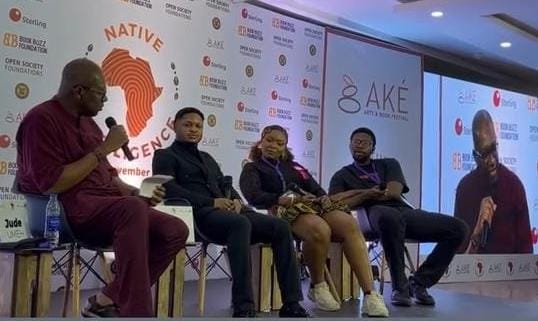
Panel on AI
He further argued that economic vulnerability made some writers easier targets, alleging that Black authors who secured major publishing deals or literary recognition had increasingly found themselves facing accusations of using AI.
“These people pick on those who are economically defenseless,” he lamented. “Over the last six months, six coloured authors have been accused of using AI when they’ve won an award or gotten a very good deal. How many white writers have been accused of using AI?”
For Anson, the problem is rooted partly in the colonial foundations of the English language and the expectations imposed on writers whose storytelling traditions and expressions are shaped by indigenous languages. She argued that African writers were often judged against narrow standards of what constitutes acceptable English, even when their writing reflects the rhythms, structures and influences of their native languages.
“How deep colonialism runs in our world today is that we are forced to speak English,” she submitted. “We are forced to speak a very colonial type of English that existed when the colonials arrived. When you learn to speak or write in a monotonous kind of way, and it’s because you didn’t have a choice when learning it.”
According to her, the problem becomes more apparent when African writers attempt to communicate indigenous experiences through a foreign language, noting, “When it comes to storytelling, you’re telling it in a very formal manner. Translating your native language to your colonial language for them to understand, in the way you were forced to learn, then they say you sound a bit too structured.”
Ize-Iyamu also questioned the assumption that writers should be able to provide definitive proof that their manuscripts were not generated by AI, arguing that even attempts to document the writing process could be challenged.
“Even if you decide to stream your writing, someone would say you left Word to go to something else. I feel like the bias against Black writers isn’t new. It has manifested itself in various forms over the years,” he said.
He noted that African writers already contend with numerous obstacles in getting their stories understood and accepted, particularly when their works draw from oral traditions, indigenous expressions and cultural experiences unfamiliar to foreign readers.
“The stories we tell most of the time come from oral storytelling or translations,” he said. “You translate a proverb from Yoruba to English, and someone says it doesn’t make sense? How would it make sense to you? Did you grow up in the same circumstance?”
He warned that demanding proof of human authorship without understanding the cultural foundations of a writer’s work could further marginalise African voices.
“That question of proof, at the end of the day, ends up causing more harm, because there’s really nothing we can do to convince people who are not trying to understand us, that our work is human-written, per se, especially when you are not being seen as human to start with,” he said.
Drawing a historical connection between contemporary AI accusations and earlier attempts to discredit Black writers, Falade said the suspicion surrounding their intellectual abilities predated the emergence of artificial intelligence. He recalled the experiences of historical Black writers, including Phillis Wheatley and Harriet Jacobs, who faced questions about their ability to produce literary works because of their race. He said Wheatley’s writing was subjected to scrutiny by an 18-member panel, while Jacobs’ authorship was disputed by those who believed that her white editor must have been responsible for the quality of her writing.
Falade also cited Nigerian writer Amos Tutuola, whose novel The Palm-Wine Drinkard attracted criticism over its unconventional use of English, adding, “If you write too well, they say a white person wrote for you. If you write poorly, they say you are barbaric. Now they will say you plagiarised someone’s work from the past.”
On the place of generative AI in creative writing, Ize-Iyamu described the technology as a form of fast food, warning against writers becoming too dependent on tools that could undermine their understanding of the stories they create. He acknowledged that AI could be useful in developing fictional worlds and providing initial frameworks but insisted that writers must retain control over their characters, storytelling systems and creative decisions.
As he put it, “You could use it in world building, but when it comes to your characters, you need to think about how they handle the problems they encounter, and how the system works in that world you’ve created. You have to be the one to decide on the systems and mechanics and how things came about that way, because the truth is when you just use AI to write something, you don’t understand that work.”
He added that AI could help create a template for a fictional world, but writers must immerse themselves in that world rather than allow technology to determine its entire creative direction.
The discussion also turned to the possibility of developing artificial intelligence models built around African languages and indigenous knowledge, with the panel members expressing reservations about the potential consequences. Anson questioned whether African countries and institutions had the necessary structures to develop and protect such technology, warning that indigenous knowledge could be appropriated or repackaged for the benefit of Western interests.
“Someone is going to sell us out,” she said. “If you’re going to create a native intelligence with all these languages, someone is going to say, ‘Why don’t you tell the Westerners more about this, and rationalise it?’ So they have their language model and they have ours. We don’t have the system to create something like that.”
Ize-Iyamu was similarly cautious, arguing that not every aspect of African cultural knowledge should be made available for technological exploitation.
“I think our ways of speaking and our oral storytelling are sacred to us. I’m not sold on the idea of having an African language model. I think it isn’t the way forward,” he said, and stressed the need for Africans to determine what aspects of their cultural heritage should be preserved for future generations and what could legitimately be shared with the wider world.
“We need to know what we keep for ourselves and what we give to our descendants, and what we can actually share with the world. It’s not everything that should be put in a public forum, that could later be used to exploit us,” he added.
Falade, however, argued that preserving indigenous intelligence was particularly important because expressions and metaphors that might appear strange to outsiders often carry meanings that are readily understood within their cultural contexts. Using Yoruba as an example, he explained that the language’s extensive use of metaphors, particularly in humour and insults, could easily be misunderstood by people unfamiliar with its cultural nuances. He recalled an instance in which someone prompted an AI tool to interpret such expressions, but the resulting response failed to capture their intended meaning.
“We need to hold on to our native intelligence. We will not change the way we write to please anybody. We’ve done it in the past, but now, we need to stick together and say no. We need to keep our intellect to ourselves,” he said.
The discussion ultimately raised a broader question about who gets to determine the standards of originality, literary excellence and acceptable expressions in an increasingly technology-driven publishing industry, particularly when those standards are applied to writers whose cultural experiences differ from those that shaped the dominant literary traditions.