From the Map to the Territory – The Workover

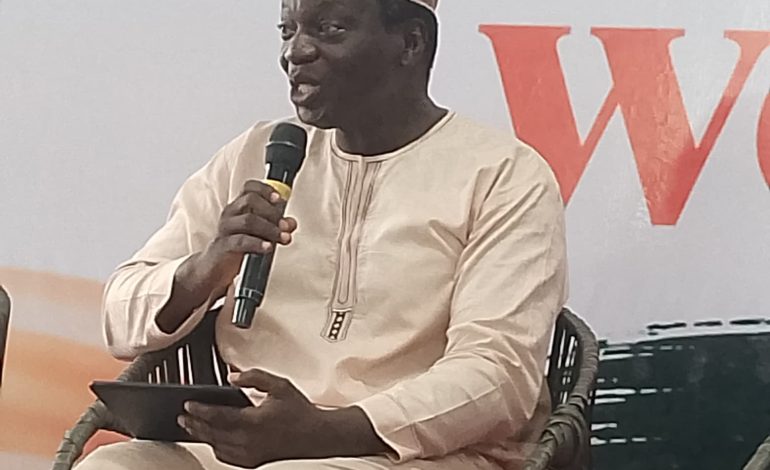
By Tade Ipadeola
DISTINGUISHED guests at this Lagos Book and Arts Festival 2026, greetings. It is an honour indeed to be asked to deliver this keynote address and to have you all in audience. Let me quickly sound a caveat: to this carpenter and his hammer, every problem presents as a nail. I therefore crave your indulgence for what may sometimes come across as a parochial vocational disposition. But do walk with me across this our old field of many tender flowers.
This year, the organizers chose as the theme for discourse an urgent noun that originated sometime in the 1920s from the work of oil field workers. That noun underscores the critical importance of repairs on the field and the labour-intensive nature of the undertaking. Workovers are necessary for the safety of the environment and for any hopes of progress. The mindfulness required is not a luxury but pure unadulterated necessity.
In the way that most of the wind happens where most of the tall grasses grow, the need to adapt field practices of geologists has percolated into the practices of archeologists and now anthropologists. The particular practices I have in mind are the gridding and pegging which enable workers to achieve the workover in a systematic manner. If we are indeed cultural landscape workers and our primary landscape is Africa, the repair works urgently at hand demands that we grid and peg our terrain in order to work effectively and efficiently. We do well not to waste any time. It really does not matter that pegging is a recent tool in our arsenal against field problems. It matters a great deal that we utilize it as best as we can.
Similarly, in jurisprudence, there is a doctrine called ‘covering the field’. It operates in federal contexts where there are polycentric centers of power and influence. The doctrine is invoked to ensure that there is minimal conflict between those centers of power and influence even as the entirety of the federation is optimized for flourishing. To optimize, the territory is mapped into grids and, in a manner of speaking, pegged. This is another way of saying that the workover is our Swiss Army knife in the struggle against retrogression.
Once grids and pegging are decided, the workover can start on a steady basis. I did say that the way the organizers framed the theme for the year incorporates a measure of urgency. It is that urgency that leads us away from terrestrial metaphors, giving way to the aerial and sidereal. We must repair this jetliner of our collective cultural patrimony while it is in full flight or we risk a costly crash.
Hubert Ogunde in 1966 Lagos
WE almost always begin where we are as the poet Czeslaw Milosz observed. In our present case, that place is Lagos. And this year, 2026, makes it 60 years since the year 1966 when a salubrious event involving the travelling theatre artist and filmmaker, the late Herbert Ogunde occurred here. Between 1964 and 1966, the government of the old Western Region of Nigeria had effectively banned Ogunde from staging any of his plays throughout the Western Region of Nigeria. In clear contrast to that muzzling of free expression of ideas, Lagos welcomed Ogunde and his theatre troupe as it had done even during the days of British colonial administration. The metropolitan temper of this city is what I want to briefly comment upon today in our quest for this urgent workover.
Big cities foster big, even if contending, ideas. If they don’t, they should. The thought experiment I propose is for us is to test, even stress-test, the current temper of our cities in Africa today. Is Johannesburg able to pass this test in the face of xenophobic pressures? Is Mogadishu accommodating of African differences or even Somalian differences? Can we screen our contending film ideas at FESPACO in Ouagadougou today without some form of censorship? Finally, can the Lagos of today pass the test of inclusivity across the political spectrum as it once famously did pre-independence and immediately after political independence in 1960? I think we all sense the answers to these questions. The point is that the civic spaces across the continent have not visibly expanded or deepened as we need them to, hence the need for continental workover.
An unspoken element in the ‘Afropolitan’ binary is the latitude afforded the African in Western metropolises even in the face of well disguised racism. Questions can be asked by an upwardly mobile singer or technology entrepreneur in Venice that may prove inimical to their health in Asmara or Kigali. This is another way of saying that we need each ‘polis’ across Africa to be concomitantly a ‘civis’ and culture workers have a great part to play in this workover from mere polis to flourishing civis. We need books unbanned, we need films streaming across our borders and we need people and their goods moving, together with ideas, unimpeded by red tape.
The sheer irony of a black African born in Kwazulu Natal referring to another black African born in Zimbabwe or Ghana as ‘African’ as if the brother from Kwazulu Natal is Asian or European needs to be interrogated and unpacked. To borrow yet another device/expression from oilfield workers, the culture workers on the continent need to install and service ‘Christmas Trees’ in these continental sites of irony in order to regulate the landscape and prevent random blowouts.
Citizenship and the Leap from Friction to Frisson
WHILE the rest of the world expands its thesaurus of possibilities and dreams, we are caught in the maws of global economic and social flux from which even planned societies reel. To be sure, we are not the only ones experiencing some reversal of cultural fortunes. For example, the Indian subcontinent has lately witnessed a number of respected writers and artists withdrawing out of protest from the cultural institutions built into the modern foundations of that country to promote amity due to hard right policies regulating the religious atmosphere in India. Again, the number of books on the banned list in the United States of America has increased over the last couple of years. India and the United States are held up as shining examples of democratic domains. The temptation is to say with Chaucer,
“For if gold ruste, what shall iren do?”
That is a temptation to resist. As history has taught us, interpreted to us through scholars like the venerable Cheikh Anta Diop, we have, as Africans, deepened human discourses and built institutions that have fostered our way of life on the continent for centuries before encountering the East or West. We should see the current interregnum for what it is, just another instance in a succession of interregna that has visited our continent.
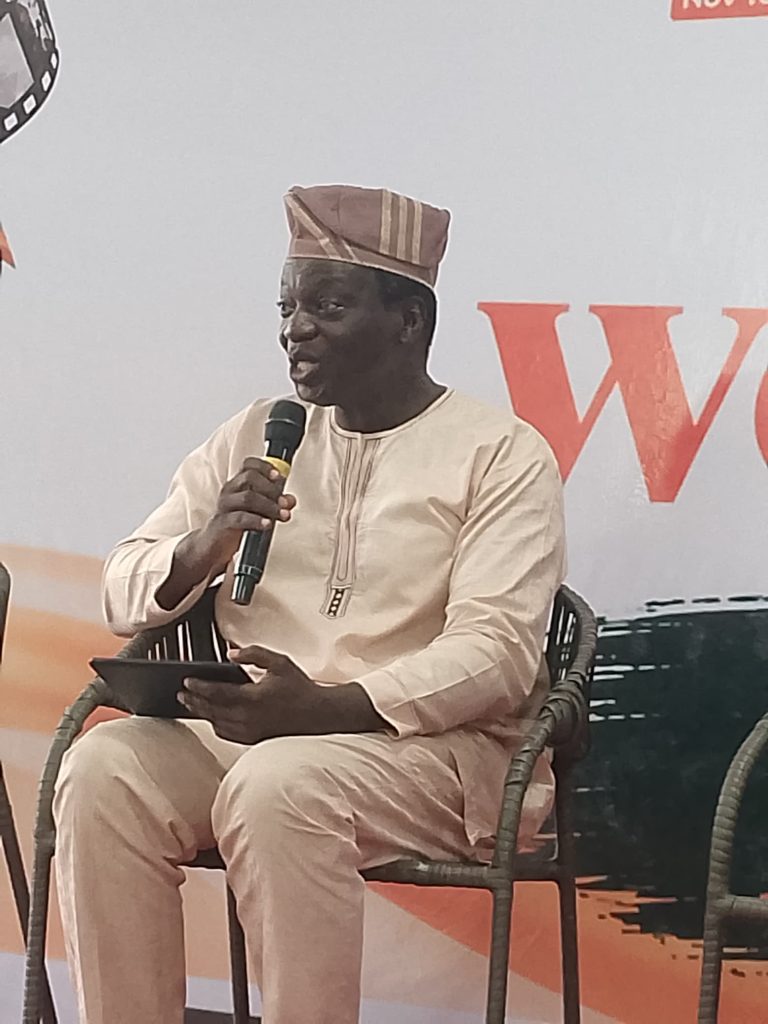
LABAF Colloquium Keynote Speaker, Mr. Tade Ipadeola
We may wish to borrow pages from that percipient playwright, Femi Osofisan, whose Twingle-Twangle, A Twyning Tale hides many gems in plain sight. The play encourages more African citizens to engage African states and their apparatuses across the continent in more meaningful conversations about our collective destiny as a people. We must not ever allow those in authority at whatever level to become complacent when our collective welfare as a people is concerned. We must, as the scholar Ebenezer Obadare expansively shows, recognize and inventively utilize humour in our interactions with state and even non-state actors. And we must as a people renew that quest to restore humour to the high plane of regard it once occupied in our collective African consciousness, after all, when a matter is too grave for even tears, our elders recognize the efficacy of humour however dark.
The quest for the ideal state of being, for optimal conditions for human flourishing, depends in part on the collective ability to obtain some frisson out of the friction of our collective human interactions. We cannot attain critical mass from silos, whatever the physics of atom bombs suggest. Most importantly, Africans MUST begin to see themselves as CITIZENS and not subjects because therein lies the critical key for the workover we desperately need.
Bring Back the Book and Other Campaigns
ONCE upon a time in Nigeria, the Federal Government launched a spirited campaign to bring back the book into the country. Today, if there are any remaining milestones of that campaign, they are mostly vestigial. What has stayed the course is the harm-a-book abomination of Boko Haram. Of course it is easier to destroy than it is to build anything. The chief proponent of the Bring Back the Book campaign at the time was no less than the President of the country. Surely, he and his advisers must have factored the quantum of necessary investment it would take to bring back the book into reckoning? Apparently not. The initiative was promptly binned by the successor administration and nothing of it has since been heard. What if the government seriously pursued bringing back the book?
Before Bring Back the Book there was the 6-3-3-4 curriculum change in the country which witnessed the introduction of introductory technology sheds in every secondary school in Nigeria. The budget was in billions but today hardly any introductory technology shed remains standing anywhere in the country. The sheds were all systematically looted by fellow Nigerians.
For every moribund introductory technology shed or Bring Back the Book initiative there are dozens of other initiatives from 1960 that are abandoned every election cycle. The waste is incredible and the indifference by public officials is simply criminal. It is as if the country itself has willfully resigned itself to retrogression and dissipation while the rest of the world advances in leaps and bounds. It beggars belief that governors in Nigeria travel to Wimbledon and Flushing Meadows, take selfies there while watching championship tennis and return home to their states where not a single tennis court meets ATP standards. Truth is stranger than fiction indeed and it has become necessary to call out these telltale pathologies if indeed the workover we so sorely need has to begin immediately.
I comment the organizers of this festival for establishing a community library and for collaborating with other community libraries in making books available to those who wish to sit and read or borrow. This is the way to go.
Assistive Implements or Abominable Inventions?
I cannot end this keynote without addressing the elephant in the room. Suddenly, language is at the center of everything once again. LLMs or Large Language Models are today at the heart of everything machine learning. Those machines fed with our words are now accelerating towards recursive learning and have already established clear dominance in some hitherto exclusively human fields of endeavor such as mathematics and engineering.
This should be good news for novelists, poets, playwrights and essayists but it is not. There is an abominable glut of AI slop, with some ‘writers’ putting out up to a hundred books a year. There are now music platforms publishing AI generated music complete with AI ‘artists’. The same is true for films. What does it mean that machines can now create this simulacrum into which audiences are plunged and immersed wholesale? Truman Capote comes to mind here with his satirical riposte on live television way back in 1959 “That’s not writing, it’s typing.” And humans can never out-type the machine. Let us stick to writing.
Without any apologies or pretensions, I say that festivals such as LABAF, which celebrate, interrogate and promote literature and literacy as well as the best artistic works across the various genres now have an extra duty to ensure that the human quotient is not diminished and that vigilance is exercised continually in service of the human and the humane. The two topmost metrics for these AI monstrosities are money and human attention. What does it mean when Africans who should be focused on rebuilding the continent spend valuable time and money training AI machines with their data and time? Training the ghosts in the machine into recursive learning mode?
Are we Luddites? No. Can we avoid the reality of artificial intelligence? No. Should we engage it? Absolutely. But we engage on our terms, not on the terms set by big capital hosted outside the continent with pipelines of mega data streaming straight out of Africa into those remote locations. There are uses to which we can put these machines but I propose that those uses remain strictly assistive. Our workover of human/machine interactions on the continent must stipulate the primacy of the human above the machines. What shall it profit the people, after all, to gain a slice of the coming material glut only for our essence to be lost amidst indiscriminate consumption?
The world as we know it will continue to change and most of that change will be inflected with deep machine learning. Our paths, as Africans, must respect the well-trodden paths of the ancestors who understood the continuum we share with the unborn and the departed. Tools have their place but Africans have always known that no amount of tools can replace the ‘ifikunlukun’ or the communion we share when we gather in this way to review our prospects and fortunes.
As a people, we can already see the results of privileging STEM over the humanities except we are playing the ostrich. By all means we must, as W.E.B Du Bois pointed out, recognize the talented tenth in our midst and encourage them in the pursuit of that which their talent dictates. If today a sea of talented Africans live and thrive outside the mother continent it is because we have failed to heed Du Bois on the continent. Professor Olufemi Taiwo in his slim but powerful book, Africa Must Be Modern, a book which featured as one of the festival books here at LABAF in the year of its publication, has more than adequately shown why the pursuit of knowledge even when we cannot see immediate use for that knowledge, matters. Let a million flowers bloom here on out.
A Word Concerning the Visual Arts
BEGINNING with the sack of Benin City in February of 1897 and the massive looting of artifacts from that city, what became Nigeria eventually began to experience a vast, systematic pillage of our cultural production from centuries back in crates and crates of antiques which ended up in private and public collections in the West as well as Asia. The trafficking did not abate and the usual suspects gorged themselves full until the very eve of independence.
But our plundering wasn’t always done with obvious violence. There were subtler things done to us as well. Kano leather was for centuries traded around the world as Moroccan leather, for example. Imagine the compounded cultural capital that would have accrued to us if only we had kept and stamped the origins and provenances of these leather works intact?
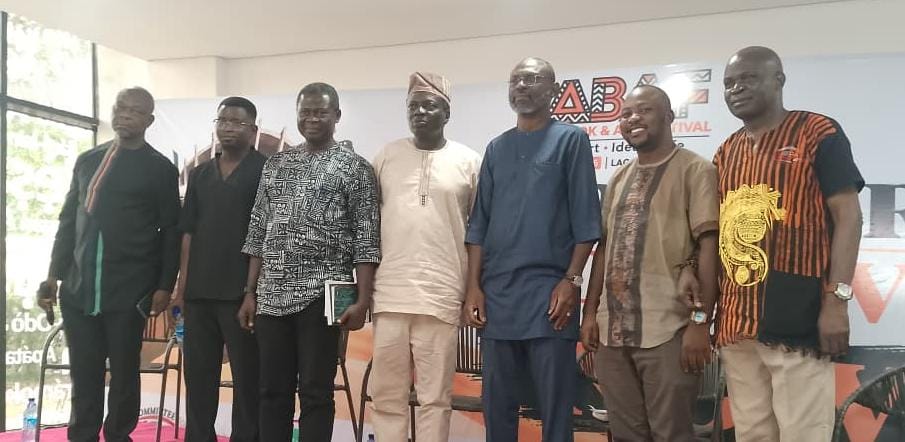
CORA Secretary-General, Mr. Toyin Akinosho (left); Fesrival Colloquium panel members, Sodiq Adesokan and Prof. Patrick Oloko; colloquium keynoter, Tade Ipadeola; panel moderator, Dr. Abimbola Agbojuaye; Dotun Famoriyo and CORA Programme Chair, Mr. Jahman Anikulapo
Today, trafficking in antiquities and contemporary artworks is largely a marginal criminal undertaking. It is my argument that we can begin to understand where we are today if we reexamine our laws regulating antiquities specifically and artistic productions generally. And we can establish a timeline using October 1, 1960 as a reference point.
Upon attaining political independence, the Independence Constitution vested the preservation and administration of antiquities in the various regions. Starting with Gowon’s 1974 Decree and culminating with the 1999 Constitution, the Federal Government of Nigeria took over the administration of antiquities in Nigeria almost entirely. There have been unintended consequences in the aftermath of the federal takeover of all things antiquities and one of such is how contemporary artists working as sculptors and painters have found themselves shackled by federal red tape.
Another unintended consequence is the question of the reception and preservation of returned antiquities from Western museums and galleries. These complications are many but they all stem from the confusion in the laws which need an urgent workover so that the field is covered without hamstringing artists. There is some urgency to this task because, unattended for much longer, we will begin to see a mass migration of artists out of Nigeria.
Our painters and sculptors need not have to part a sea of red tape in order to gain currency in international galleries and exhibitions. A mask created for an egungun festival yesterday should escape the death-clutch of antiquities laws designed to keep artifacts from a thousand years ago in country. This is another way of saying that these laws need greater input from practitioners, art historians and other experts as soon as we can muster them.
Our Cassandra Complex: A Chronic Crisis Condition
THE poet, Ogaga Ifowodo, dared to ask a pertinent question which thankfully received due attention with his latest collection of poetry, Why Does God Need a Gun?
More and more there is an intensification in the crisis condition under which we live in Nigeria and many parts of Africa. The source of the wahala is the same, true believers who claim to act on behalf of God, using guns to impose their will on others. It is not a problem we can ignore or treat as a marginal menace any longer. We need all hands on deck, people in the social sciences, the humanities, medical sciences – everyone. The curse of Cassandra, as we know, is that no one would believe her. The chronic crisis condition under which the nation, and most nations in Africa have existed these past decades does not help. We have been bludgeoned repeatedly and become accustomed to violence and attending immiserating consequences.
Finally, the workover noun should not be confused with the “work over”, a phrasal verb with at least a century’s head start over the more benign noun in the English lexicon. The ‘work over’, two words, is an expression that sprouted from the streets among fully credentialed blue-collar workers but which has since been kidnapped and fed on a brutal fare by politicians. Today, entire countries in Africa are being ‘worked over’, systematically menaced and violated by that curious breed as we speak. There is a third, near, ear-rhyme expression. The walkover. And about this we have something to say immediately – there is no such thing for us Africans.
This is not the time to roll over and quit. Let everyone know the makeover starts now!
Ipadeola, lawyer, poet and winner of The Nigeria Prize for literature 2013 (poetry category with his work, The Sahara Testaments), delivered this keynote at Lagos Book and Art Festival 2026 at J. Randle Centre for Yoruba History and Culture, Onikan, Lagos