
Second chance at love and living in Onose Callima-Inino’s ‘The Third Day’

By Anote Ajeluorou
WHEN Amaeze Igbinosa lost her parents in a car crash at age nine, she thought that was the end of the world. But her aunt Ehenede came through for her, took her in and raised her as her own child. She would fulfil her sister’s desire for her daughter to attend boarding school. But battling the loneliness that comes from being separated from her aunt after the vacuum created by the death of her parents, it was hard for Amaeze to move into the unfamiliar world of a boarder. But a little spat with another new student Alero Odele would turn into a lifelong friendship and new family for Amaeze.
Onose Callima-Inino’s The Third Day is imbued with the themes of Christian love, a lost pilgrim finally finding her way back home to God and finding love and happiness again after a turbulent period of intense trial and test of faith. Having secured a bank job and working alongside her friend and sister, Alero, Amaeze is shopping for her wedding gown as marriage to Osaro looms large. But again tragedy strikes and Osaro dies in a car crash in a thunder striking twice in the same spot scenario that leaves Amaeze both heart-broken and loosing faith in God and total disconnection from her Christian faith. Is Amaeze’s life wedded to tragedy? Would she live out her days a spinster and loveless? Can she open her heart to love again after Osaro? These are the questions Callima-Inino tries to answer in her debut novel, The Third Day.
And for two years Amaeze seems indeed wedded to sorrow, as she mourns her dead fiance, consumed by the pre-wedding tragedy. Alero is the ever faithful friend and sister. But even that has its limits, especially when Alero’s romance with Ehis is blooming and they’re at the verge of getting married. Alero is mindful of the turn of events but there’s not much she can do for Amaeze other than pray for her and devise means to bring her back from the brink of sorrow.
When Sidney Braide, the new auditor, arrives from Port Harcourt to assume duties at the bank Alero and Amaeze work, there seems nothing much to it at first. Alero is friendly and soon warms up to him after running into him after her church service, but not Amaeze, who can’t be bothered about what happens around her. She focuses on her work and sinks deeper and deeper into mourning Osaro. When Sidney becomes a regular guest at the home she shares with Alero and they go on a shopping spree, Amaeze is alarmed at the development. She’s determined not to be friends with the new auditor.
But Sidney is a persistent man. He, too, hasn’t had it rosy with women in his recent past. His fiancee Port Harcourt had abandoned him and got pregnant for the church choir master in the middle of planning for their marriage. A devastated Sidney would clam up after that for eight years before relocating to Benin City where he meets Alero and Amaeze. When Amaeze finally decides to quit her bank job to start-up as an event planner, starting with her friend and sister, Alero’s wedding, it seems ordinary enough. But at this point, Sidney has broken ice with Amaeze after a memorable Christmas visit where Amaeze is forced to play host to him and offer him food; he’d come bearing gifts for her. Alero and Ehis are away in the village to meet his parents, providing a moment for Sidney and Amaeze to forge a somewhat uneasy friendship.
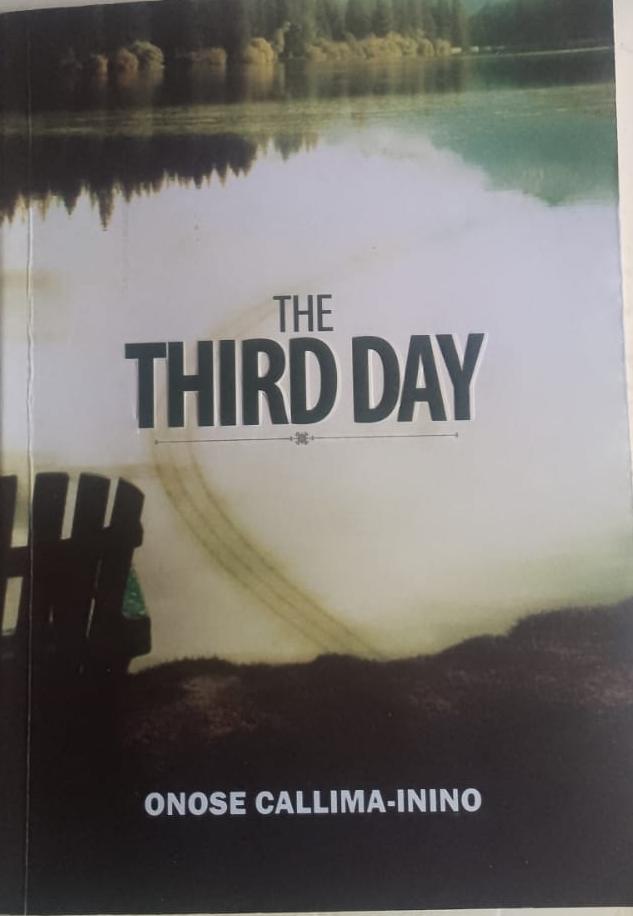
What happens to Sidney and Amaeze after this quaint meeting? How does Amaeze renew her faith in God and where does it lead afterwards? Callima-Inino’s The Third Day is about a rebirth after moments of tribulations in the life of a Christian. The double tragedies Amaeze suffers as a child and as an adult are enough to test anyone’s faith in what they believe and lead to a descent into the abyss of despair about life and living. Like most Amaeze asks God hard questions about her existence and the purpose of her life if it were a catalogue of tragedies. It is not an easy place to be, where Amaeze finds herself. But how does she claw her way back up to God again after her soul-searing questions?
Callima-Inino sets out to reach her fellow Christians and others who daily experience Amaeze-type misfortunes, where deaths rob her of family and love. The second verse she takes from Isaiah 6: 1—3 (King James) not only lends the novel its title but also its thematic intent: ‘After two days will he revive us: in the third day he will raise us up and we shall live in his sight.’ Callima-Inino’s The Third Day is a subtle exhortation on clinging to God even in the face of unrelenting difficulties. Callima-Inino is preaching a message of hope even in what appears hopeless situations. She takes Amaeze through the furnace of tragedies. Does she become a better person afterwards?
The Third Day is an easy read that will appeal to every reader, young and old. Its evangelical message and intent are unmistakable and speak to what many people are going through in their daily struggles to come to terms with in their own lives. However, it could have benefited from better editing to remove some niggling structural and narrative errors. These do not detract from its enjoyment the novel nevertheless.