The politics of the personal and the collective: A reading of Bioku’s ‘The Shape I Took’

By Oko Owi Ocho
ONE of my favourite essays on poetry is George Szirtes’s “Missing Dates/Sleeve Notes”. It puts into proper perspective the thrill of confessional poetry. Although in Africa, we have been committed to what is called the literature of social commitment, over the years, younger writers have been protesting against the prescriptivism inaugurated by the Achebe-Soyinka generations. This form of confessional poetry was cemented with the fourth-generation poets, after the dispersal poetics of the third generation, which shifted away from the mythopoetics of the writers before them.
Shakirat Ayodeji Bioku’s poetry brings Szirtes to my mind for the sole reason that the latter asks in his essay, “Where is the poem, the poem experience to which we respond? And what has it to do with our experience of the world outside the poem? Is there a what that has been said? And does that what speak for a condition or, in fact, do anything for my specific condition?” (Poetry, Vol. 191, No. 1). These questions seem to ask one of the most vital questions in the reading and interpretation of poetry. They seem to be asking: to what end does someone’s confessional poetry speak to my own specific condition?
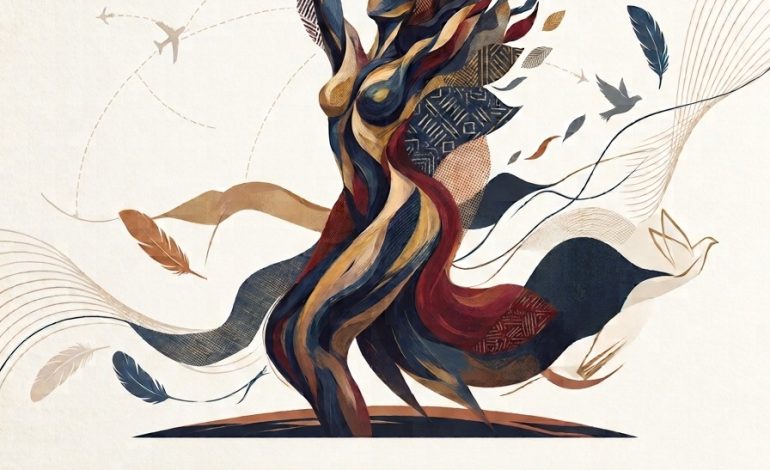
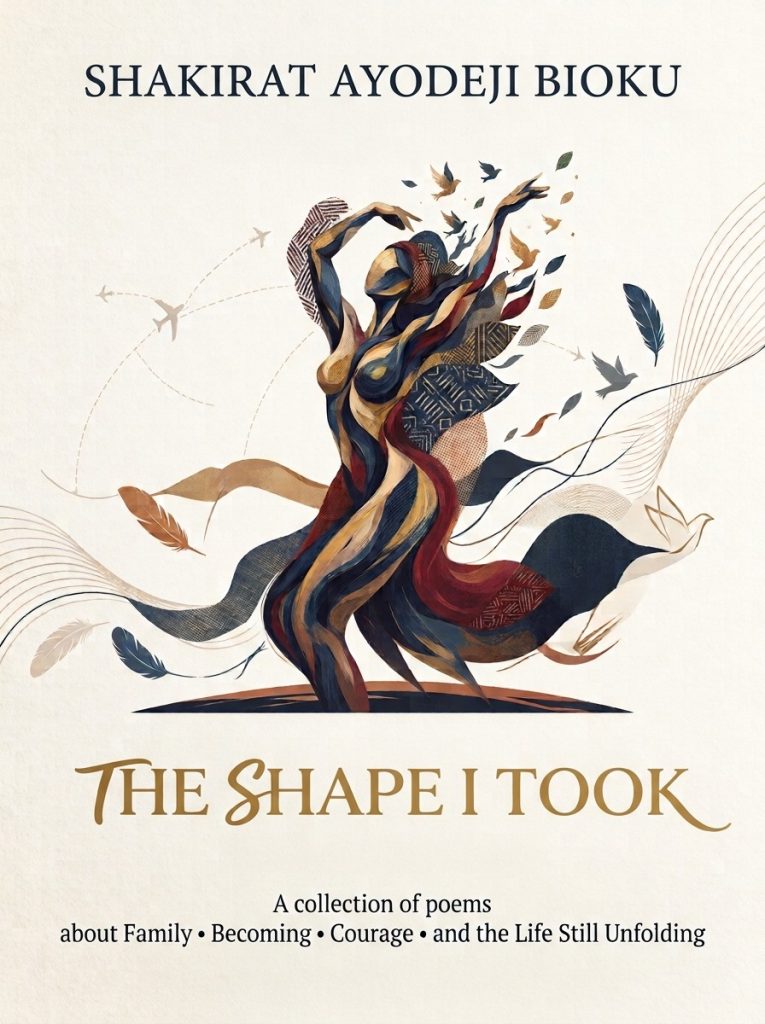
Bioku’s The Shape I Took gets one wondering about the depth and beauty of confessional poetry. It poses questions as to whether the confessional poem speaks to the condition of collective existence. From the first poem, “The House Had Many Doors”, we find ourselves approaching the poet as she welcomes us into the space where she grew up. “I grew up in a house/where love did not always/sit at one table.” This simple opening is an exploration of an entire worldview—the place of affection in homes. The place of family is one long story within African creative expressions. Most writers often have punches to throw at their homes or exonerate them for the beauty they have shown them. Bioku shows a poet’s life through the bildungsroman of growing up and how it affects our worldview. She notes that:
As a child,
I did not know
that a family could carry
so many invisible maps.
I only knew
that some people
seemed to know
where they belonged,
while I was still
learning the shape
of my own name.
So, growing up is a private affair, but it is also an occasion for understanding the world—that of ourselves and of others. This is also the concern that appears in “My Mother’s Secret Language”.
The poet tells readers that, while growing up, we probably misunderstood certain things. For instance, there was a certain complexity in our mothers’ love that we did not understand, but which age has cleared up. The persona thought that her mother’s decision to always make her available to serve others and thereby expose her to encounters with other people’s existential choices and senses of being was a way of always giving her away: “For years,/ I thought my mother/ was always giving me away.” Whenever “Someone needed/ a child to travel with./ Someone needed company”, the mother made her available. As a result, the story she built was that her mother did not want her: “Children are excellent storytellers/ when nobody/explains the plot.” However, when the truth dawned on her and she came to this realisation, she gained a perspective that extended beyond just the relationship between mother and daughter: “…she taught me/ to look again/ at people I thought/ I had already understood.”
Bioku speaks to the condition of collective existence—the innocence and sentiments of childhood—and shows how growing up makes us understand the impact and efforts of the people around us. One might wonder how this theme is important, but it speaks to deeper politics beyond the surface value, and the politics it engages with concern the sense of familial politics in contemporary society. In the age of postmodernism—the contemporary cultural fragmentation of every sense of grand narrative, even family included—Bioku reminds us of where we are coming from.
While we might think that some of the things we see on social media in modern times are just “cruise”, there is cultural erosion that has eaten away at the patch of earth in which values stand, and society is on the verge of complete collapse. So, if people have become so individualistic, entrapped within the “postmodern project of de-deification, de-absolutization of reason, of man, of history, etc., on the one hand, and of a return to, or a rehabilitation of, obscurity, the unknown…”, which is symptomatic of “the hypocritical self-flattering cry of overfed and spoilt children of hypercapitalism” (Dennis Ekpo, “Towards a Post-Africanism: Contemporary African Thought and Postmodernism”), Bioku’s projection of what bonding and family values feel like is more than a personal reflection; it is a reminder of what society was and should be.
I believe poetry is more than just an emotional collection. As we have learnt from African history and the place of our poetry in preserving history, we must appreciate contemporary writings that also try to preserve it. And this is what I get from The Shape I Took. The “I” is not just an individual; it is also the collective trail of our social evolution. This is aptly reflected in “The Hunger After the Win”, where the condition of victory and the experience of winning that Bioku captures reflect a human condition. The poem captures the appetite that winning brings and how the poet’s discovery is meant to communicate something to us.
To return to the premise upon which I based this review, is there a personal condition which is not also reflective of a certain collective will? Does the poet live alone inside the metaphors which are purely forged from the steel of her own condition, or is even that which is personal also an extension of a collective condition, despite how starkly different the poet can be? My belief—and I am reminded of this fact by reading The Shape I Took—is that poetry, even when confessional, communicates experiences that emerge from certain conditions which always extend beyond just the poet or the persona. When the reader gets to Bioku’s “I Collect People, Not Labels,” it seems to provide answers to my own philosophy and social aesthetics of poetry.
I have always collected people.
Not intentionally.
They simply arrive
from different places
with different stories
and different ways
of seeing the world.
Hence, the idea of collecting people and not labels is hinged on the belief that people-centred poetry is the true essence of poetry. And this applies to any theme. Take love poems, for instance: the condition of loving does not belong to the poet alone. The poet collects and reflects the affection that humans before us, and maybe those after us, may feel, as we also feel it. As people arrive from different places with their unique stories, the duty of the poet is to write poetry that gives a name to conditions that reside within us all. This, for me, is the true essence of Bioku’s writing.
* Owi Ocho is a poet, performer and culture critic