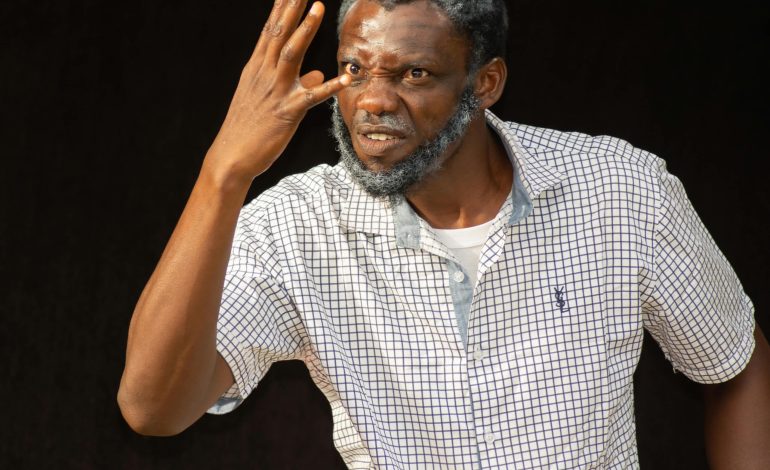
When NLNG honoured literary, scientific, creative excellence at Grand Award Night 2026

By Godwin Okondo
WINNERS of The Nigeria Prize for Literature 2026 , Science and Innovation, and Creative Arts have called for greater investment in Nigeria’s human potential, especially youths, stronger support for innovation and the preservation of the country’s cultural heritage. This was as the sponsor of the prizes, NLNG, celebrated outstanding achievements across the literary, scientific and creative sectors last Friday, 9 October 2026 in Lagos.
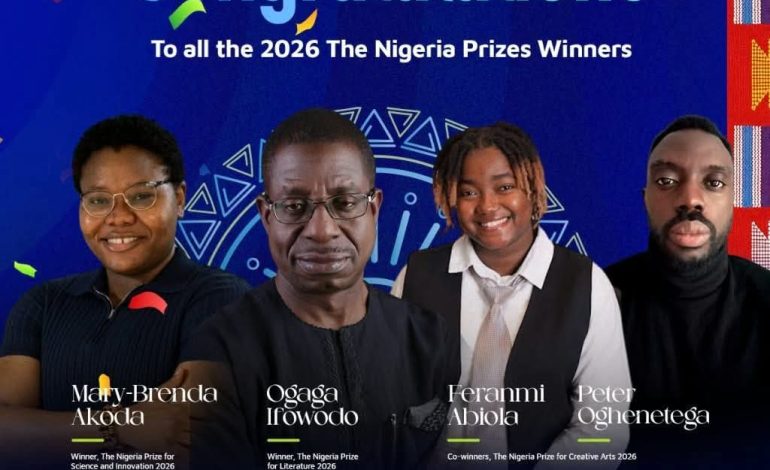
The calls came at the Grand Award Night, where poet and lawyer Dr. Ogaga Ifowodo won USD$100,000 prize for literature for his collection, Why Does God Need a Gun? while Mary-Brenda Akoda received the USD$100,000 prize for science and innovation for her artificial intelligence-powered medical imaging technology, GenScan AI. Filmmakers Peter Oghenetega Oke and Feranmi Abiola emerged joint winners of the inaugural Nigeria Prize for Creative Arts for their documentaries, Beyond Tarkwa Bay and Mara Mania, respectively.
Speaking at the ceremony, NLNG’s Managing Director and Chief Executive Officer, Mr. Adeleye Falade, described the occasion as a celebration of excellence and an opportunity to reflect on the responsibility of preserving achievements that inspire future generations.
“Tonight is a celebration of excellence, perseverance, and the courage to pursue a vision. We are also here to reaffirm NLNG’s enduring commitment to strengthening the culture of excellence in Nigeria’s literary and scientific communities,” he said.
Falade, whose address was anchored on the theme “Heritage”, said the concept went beyond remembering the past to embracing the responsibility of building on the achievements of previous generations.
“Heritage is not merely a record of our past; it is the legacy we preserve, strengthen and pass on. It is reflected in the values we uphold, the achievements we celebrate and the opportunities that we create for future generations,” he said.
Recalling his secondary school days at Government College, Ibadan, Falade spoke of an occasion when distinguished alumni were recognised for their accomplishments. Among them were Dr. Aribisala, recognised for his contributions to agriculture, Akinola Aguda, who served as Chief Justice of Botswana and Nobel laureate Prof. Wole Soyinka.
Falade said seeing Soyinka at the ceremony brought back memories of the event, reinforcing the importance of celebrating individuals whose accomplishments become a source of inspiration for others.
He traced NLNG’s commitment to national development to the vision of its founders, who recognised the potential of Nigeria’s natural gas resources to drive economic growth and energy development.
“More than three decades ago, a group of visionaries looked beyond the challenges of their time and recognised an opportunity to transform Nigeria’s abundant natural gas resources into lasting value for our nation,” he said. “They saw the potential for a resource that was once largely wasted to become a driver of economic growth, national development, and energy progress. Today, that vision continues to shape our journey.”
According to Falade, the establishment of the Nigeria Prize for Literature and the Nigeria Prize for Science and Innovation more than two decades ago reflected the company’s determination to recognise exceptional accomplishments while encouraging discoveries and creative works that improve lives.
He said the science prize had honoured contributions across health, agriculture, engineering, energy, technology, climate resilience and sustainable development, while the literature prize had become one of Africa’s most prestigious literary awards.
“The impact of these prizes extends far beyond the individual laureates. Each winning work becomes part of our national heritage, reinforcing values and preserving stories, discoveries and ideas that will continue to inspire future generations,” he said.
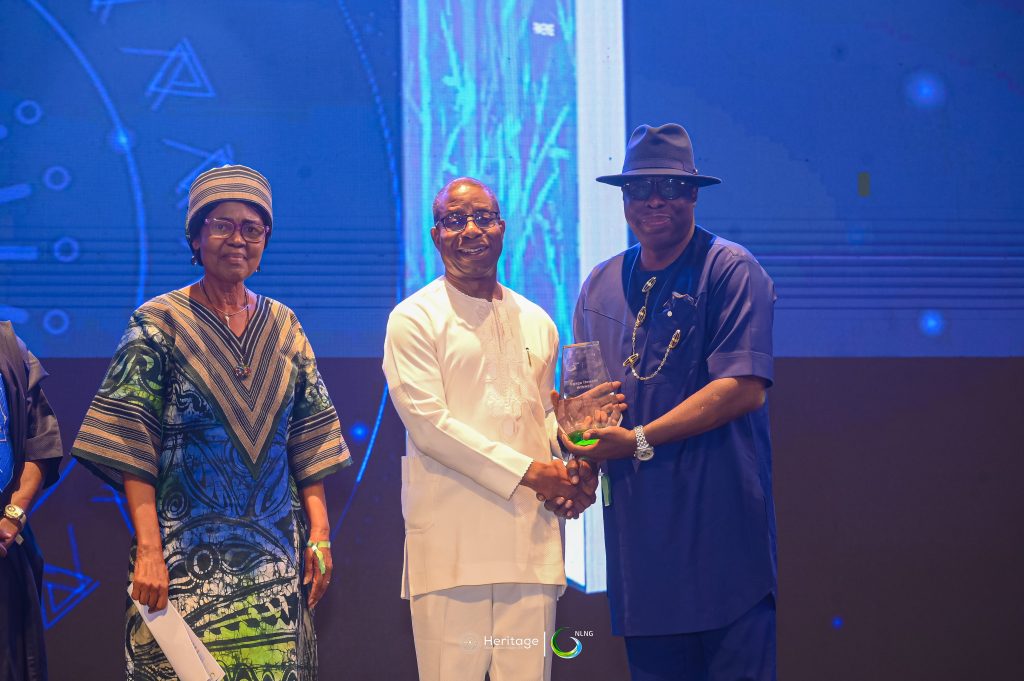
Dr. Ogaga Ifowodo (middle) receiving his prize plaque from NLNG’s MD, Mr. Adeleye Falade while the Chairman of Advisory Board, Prof. Akachi Adimora-Ezeigbo (left) looks on
Falade also highlighted the introduction of the Nigeria Prize for Creative Arts, which was presented for the first time at the ceremony, describing it as an extension of the company’s commitment to celebrating Nigerian talent.
“Across the world, Nigerian creativity continues to earn admiration. Our music, films, visual arts, fashion, theatre and cultural expression resonate far beyond our borders and continue to influence global culture. Nigerian creativity speaks a language the world understands,” he said.
He added that the new award was designed to recognise artists who preserve the country’s cultural heritage while reinterpreting it for a new generation.
Nobel laureate Soyinka, who addressed the gathering, offered a humorous reflection on the relationship between the sciences and the humanities, urging scientists to appreciate the importance of imagination in intellectual discovery.
Welcoming scientists to an event he jokingly described as one traditionally dominated by the humanities, Soyinka said, “The humanities have generously decided to celebrate our junior siblings, and I want my colleagues in the humanities to be kind to them.”
He recalled his difficult experiences with science and mathematics in school, admitting that he had little affection for the subjects and their teachers. Soyinka recounted that after leaving school, he threw away his science books, which he said had tortured him throughout his time in the classroom. His relationship with mathematics took an unexpected turn when he was invited to serve on the board of an organisation associated with transfigural mathematics.
“I was showing this journal all around, very proud, and I was saying, ‘You people said I was a dunce,’ which I was, but I took my revenge when I left school, I opened the window and threw out all my scientific books which had tortured me all the time I was in class,” he said.
Despite his past difficulties, Soyinka argued that scientific inquiry could not flourish without imagination, insisting that creativity was not the exclusive preserve of writers and artists.
“We know that imagination is not limited to the humanities. In fact, if you have no imagination, to begin with, you will not translate facts, figures, metallurgy, physical sciences, you will not even begin to do your calculations. You have to have a vision to start with,” he said.
He commended NLNG for bringing the disciplines together through the awards, describing the introduction of the Creative Arts Prize as an opportunity to extend the boundaries of imagination and encourage engagement across fields of knowledge.
While accepting The Nigeria Prize for Literature, Ifowodo said his winning collection explores religious violence, human freedom and the contradictions that arise when atrocities are committed in the name of faith. He explained that the collection’s central sequence, “From the Forest of a Million Demons (Leah Sharibu Lifts the Veil)”, culminated in the poem “Soon, Archangel Michael Will Free Us”, which examines the hope of freedom through the experience of a captive speaker.
“The captive speaker dreams of regaining freedom. But that very hope unveils the predicament of theodicy, the idea of an Almighty, loving and merciful God in whose name unspeakable atrocities are routinely committed,” he said.
Ifowodo argued that humanity’s hope lay in recognising the equality and dignity of all people, regardless of their identities or beliefs.
“The truth, however, is that it is our better angels that will free us. I mean that humanity’s hope lies in the unequivocal acceptance of the inherent and inalienable equality, dignity and freedom of thought and belief of all humans, irrespective of gender, race, class, creed, colour or social identity,” he said.
He described the poet as a witness whose responsibility was to preserve the memory of suffering and expose attempts by religious and secular authorities to impose a single way of seeing, believing or living.
“The poet as witness seeks, through language, to keep alive the memory of the ‘impress of extremity,’ of the relentless efforts of authoritarianism, secular or religious, to force us into one way of seeing, believing or being,” he said.
Ifowodo commended NLNG for its contribution to Nigerian and world literature, dedicating the award to Leah Sharibu, whose refusal to renounce her Christian faith while in captivity inspired him to write the collection.
“I dedicate this award to Leah Sharibu whose extraordinary, even inhuman, courage in refusing to renounce her faith for her captors’, as a Faustian bargain for her freedom, awed me into writing Why Does God Need a Gun?” he said.
He urged the company to sustain its support for the literary and cultural sectors, describing the award as a significant honour.
Akoda, winner of the Nigeria Prize for Science and Innovation, said receiving the recognition from her home country held particular significance, despite having previously received international awards.
“I’ve been fortunate to receive international awards and recognition, but there is something incredibly special about being recognised by your home country, and also to be the first woman and youngest person to receive this prestigious prize,” she said.
She expressed hope that her achievement would encourage more young Nigerians, particularly girls and young women, to pursue ambitious goals in science, technology and entrepreneurship.
“It’s an honour I do not take lightly, and I hope this moment inspires other young Nigerians, especially girls and young women, to go after their boldest ambitions,” she said.
Akoda also paid tribute to her mother and brother, who supported her through the difficulties of research and entrepreneurship, recalling how she repeatedly described her work as the most challenging project she had undertaken.
She said the development of GenMRI, the medical imaging technology associated with her winning innovation, had tested her resolve, but her family consistently reminded her that she had overcome difficult challenges in the past.
“When I was at my low, I would tell them, ‘This is the most challenging project I’ve ever done,’” she said, recalling their response: “You said the last time, you will overcome.”
Akoda said their encouragement proved right, adding that the award represented a step towards a broader goal of making medical diagnosis more accessible and timely.
“For us at GenScan AI, the company, this prize is not the destination; it is a stepping stone towards our larger vision, which is that no one should suffer or die because of a delayed diagnosis,” she said.
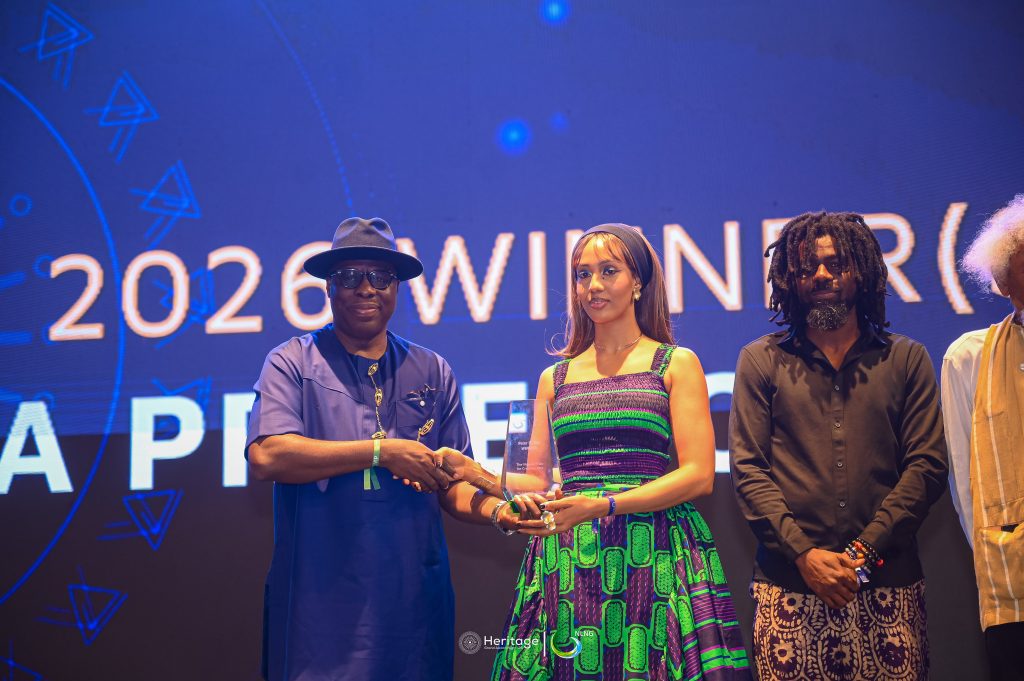
NLNG’s MD/CEO, Adeleye Falade, presenting award to the producer of Beyond Tarkwa Bay, Rume Onosede (middle) while the consultant for The Nigeria Prize for Creative Arts 2026, Joel Kachi Benson (right) looks on
She called for continued support to help the company deploy its technology in hospitals and make it accessible to patients in Nigeria and around the world.
Oke, joint winner of the Creative Arts Prize for Beyond Tarkwa Bay, and represented by Rume Onosede at he event, said the documentary highlighted the resilience of young Nigerians who continued to pursue their ambitions despite difficult circumstances.
She described the award as an opportunity to draw attention to the need for a safer country, better infrastructure and greater support for the nation’s youth.
“The film is about young Nigerians who are doing everything they can despite the odds and unending challenges,” he said. “This film is a call to action because we need a safer and better Nigeria that can support its youths and provide infrastructure, because there’s so much potential.”
Oke noted that Nigeria’s large youth population represented an enormous resource that could contribute to the country’s development if adequately supported.
“For me, this award recognises the fact that Nigeria is also acknowledging that we have so much potential in this country, and I really do pray that we continue to do what it takes to make this a reality for future generations to come, that Nigeria is a country that we can build together,” he said.
He added that the film emerged from conversations about Nigerians who had lost hope but continued to persevere in the face of adversity.
Abiola, the other joint winner of the Creative Arts Prize, thanked NLNG for the recognition and acknowledged the people whose participation made Mara Mania possible.
Describing the documentary as an exploration of Mara, a street music and dance culture, she thanked those at the heart of the project for allowing her to tell their story.
“‘Mara Mania is a documentary that explores Mara, which is a high-street music and dance, and I want to thank people at the heart of this documentary and my crew, for giving me the chance to tell your story,” she said. She also expressed gratitude to her family for their support.
The awards marked a further expansion of NLNG’s effort to recognise achievements across literature, science and the creative arts. Through the prizes, the company seeks to celebrate outstanding Nigerian talent while encouraging innovation, preserving cultural heritage and inspiring future generations to contribute to national development.