This cup that overflows

By Eugène Ebodé
Through a critical and deeply humanistic reading of the 2025 Africa Cup of Nations, Professor Eugène Ebodé, Cameroonian writer and administrator of the Chair of African Literature and Arts at the Academy of the Kingdom of Morocco, questions the emotional outbursts that followed the final and highlights the symbolic divisions revealed by the event. Between organizational success, popular fervor, and digital excesses, his text calls for a return to sport’s primary purpose: a playing field governed by rules, responsibility, and ethics. Beyond soccer, he invites a pan-African reflection on memory, historical traumas, sporting citizenship, and the need to transform tensions into dialogue and collective construction
Dear African citizen,
FROM my position as Chair of African Literature and Arts at the Royal Academy of Morocco, I am fortunate to be able to witness a powerful intellectual and political choice: since 2015, this academic institution, under the patronage of His Majesty King Mohammed VI, has sought to make Africa a horizon of thought. But which Africa are we talking about? An Africa that thinks for itself, that confronts the issues of its time and assumes its historical responsibility, in accordance with the founding principles of the Academy laid down in 1977 by His Majesty King Hassan II.
One of the issues of our time, following the 2025 Africa Cup of Nations, concerns precisely the emergence of irrationality in the public sphere, amplified by digital gossip. Anonymous expression no longer counts as a point of view: it masquerades as a court of law. Inflammatory remarks, devoid of nuance, slide into clamor and invective, with algorithmic scolding fueling the fever of hatred, conspiracy theories, and irrational anger.
I watched the matches, breathed in the fervor of the stadiums, shared in the popular excitement. I saw a beautiful competition and a great host country. I even saw visitors strolling through the gardens of the Academy, marveling at the sight of the orange trees and, invited to pick the ripe fruit, marveling at their juicy drink.
A successful CAN, a country that rose to the occasion
ALMOST unanimously, the Kingdom of Morocco has just organized one of the most successful editions of the Africa Cup of Nations. The new 24-team format involved heavy financial investment, increased logistics, and unprecedented organizational demands. This type of event tests a country’s ability to deliver sustainable and functional infrastructure within tight deadlines.
Opinions converge and praise the quality of the sports infrastructure, the urban and suburban road network, the gastronomy, and the Moroccan design arts. Many visitors praised the beauty of the cities, particularly Rabat, the condition of the asphalt, the constant cleanliness, the attention paid for years to public health, and the diligence of the agents assigned to maintaining an admirable environmental aesthetic. As for the enthusiasm of the people, it was expressed in a warm, festive welcome, marked by a sincere desire to share a moment of continental conviviality.
Admittedly, there were more spontaneous affinities between Moroccans and certain nationals. Such is the nature of human relations, which are never mechanical. For my part, throughout the competition, it seemed to me that Moroccan fans, dreaming of a final, supported several teams, including Senegal. The two nations share a spiritual history—particularly around the Tijaniyya—a love of history, a passion for the visual arts and cinema, and a deep appreciation for literature.
In this regard, how can we fail to mention here that the Academy of the Kingdom of Morocco has scheduled a day of tribute and in-depth study of the work of Léopold Sédar Senghor for June 24, 2026? We are already hard at work, with the kind and invaluable assistance of Her Excellency Ms. Seynabou Dial, Ambassador of Senegal to Rabat, to prepare and commemorate in style the 25th anniversary of the passing of the first President of the Republic of Senegal. Léopold Sédar Senghor was one of the very first members of the Academy of the Kingdom of Morocco, which includes other illustrious Senegalese figures: Professors Souleymane Bachir Diagne and Alioune Sall. These men of immense culture, sources of kindness and simplicity, are people from whom I love to learn when they visit Rabat during the Academy’s sessions.
The overflow: A symptom of something else
HOWEVER, after an epic final—intense, balanced, and entertaining from a soccer perspective—its unexpected conclusion, preceded by a long and unusual interruption, was followed by overflowing emotions: agitation in the stands, an absurd ballet around a towel behind Senegal’s goal, and above all, the sudden dramatization of a bilateral relationship that had been displaced from the strictly state sphere.
Senegal played well. Both nations, carried by brilliant athletes, deserved to win.
SO, why this feeling that something else is manifesting itself and piercing a solid shell? Something of the order of the repressed, which surfaces in the tension and accusations, and finds in social media a mirror that is both distorting and magnifying. It is this “something” that gives the feeling that the cup is not only full of the intoxication of victory, but that it is overflowing. What is it overflowing with? Not joy, but torrents of hatred and fury, fueled by what Spinoza called the sad passions.
I received numerous messages, including one from a writer asking me what I had to say. Many others were raw emotions, uncontrolled outbursts. It is in response to this call that I address myself, from Rabat, to the citizens of Africa.
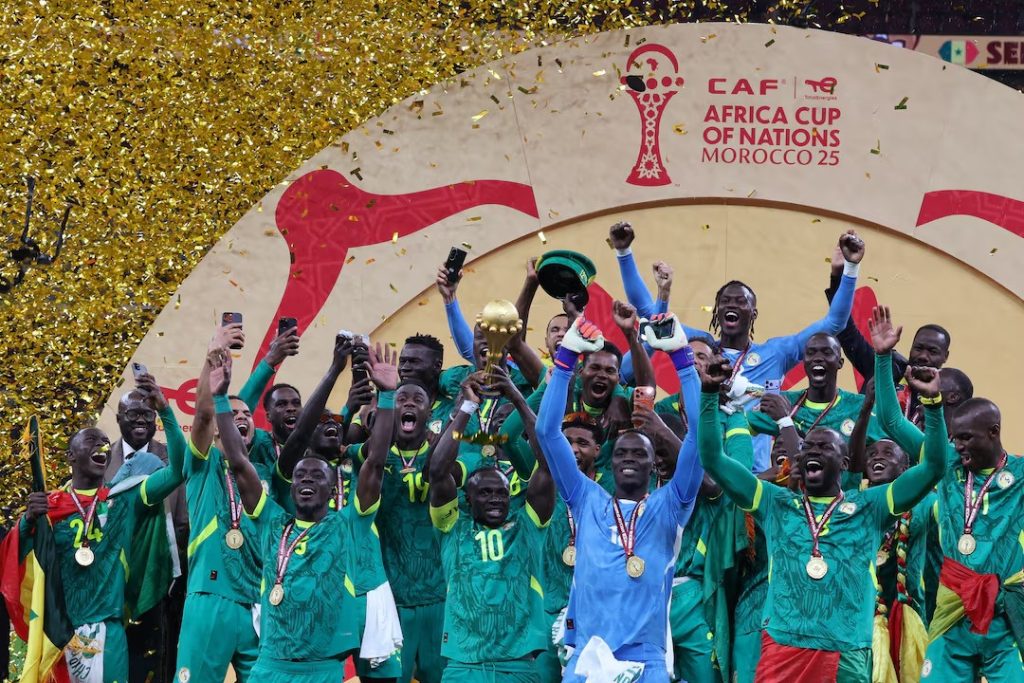
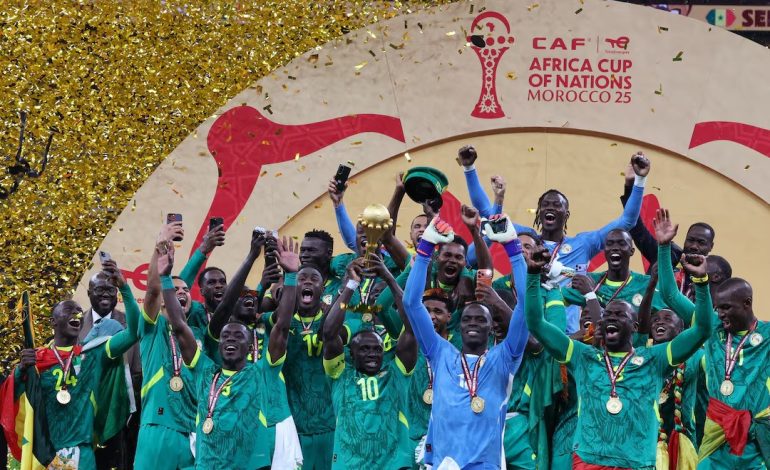
Senegalese national football team celebrating victory in Morocco
The rules of the game
SOCCER is a game, but it is also an art. Like any game, it has rules. To play, you must agree to abide by them. It requires individual skills and collective choreography, takes place in one location—the field—within a set time frame—90 or 120 minutes—plus extra time, and involves various tactics.
One figure guarantees the very possibility of this: the referee. He is the ruler of the game. Without him, there is no match. His authority, now assisted by VAR, is based on a tacit consensus. His decision is irrevocable. To delegitimize the referee is to undermine the symbolic architecture of the game and lose oneself in arbitrariness.
Every player and every spectator owe him respect—respect for the person, respect for the whistle.
I am reminded here of Michel Leiris and what he said about “The Rules of the Game” (Gallimard, Biffures, 1948): “There is only regulated play, and it is the rules that determine the risk, the intensity, and the value of what is at stake.” Leiris set the conditions for joyful knowledge and a festive mood.
Leaving the CAN stadiums, and even after the final, in my anonymity, I encountered only friendly glances and had calm discussions. So where does the current unrest come from? “Social media,” as Joseph-Antoine Bell rightly observed, calling for calm and recalling the values passed on by his parents: fairness, rules, responsibility.
I remember my student days at Sciences Po, when, as president of the student association, we invited Joseph-Antoine Bell, then captain of Olympique de Marseille, to give a lecture at our school entitled: Sport, a factor of national cohesion or a source of international dysfunction? That was forty years ago. He was already talking to us about ethics, responsibility, and lucidity. As a goalkeeper, he did not see his position on the field as that of an exile, but as a springing rampart and a point of relaunch.
He repeats it today: if the cup overflows, it is because we have forgotten what is reasonable. Because of an excess of that deleterious feeling that others are depriving us of oxygen or owe us something. When this feeling flares up, it only leads to drama. Does this mean that sport excludes all drama? No. Sporting drama must remain artistic, not turn into hatred. Hatred kills. Theatre teaches us to control our emotions; sport should be a practical school for this. It must keep its distance from chauvinism, fanaticism, and the venting of animosity. The story of Heysel on May 29, 1985—the European Cup final that saw riots in the stands between Liverpool hooligans and Juventus supporters, resulting in nearly 40 deaths—reminds us where excess leads. Sport itself refers to the unpredictable: it is the glorious uncertainty of its outcome that makes it great. And if Corneille’s maxim tells us that to win without risk is to triumph without glory, there is no need, after a final, to mobilize battalions of whistlers and stigmatisers who use videos to fan the flames of discord between northern and southern Africa.
The questions of our time
THE 2025 Africa Cup of Nations did not create these tensions: it may have simply revealed them. Hence the need to identify the profound issues they raise.
Among them:
– the issue of slavery and its various forms, including in the Arab-Muslim world;
– the need for a pan-African memorial to pay tribute to those who were deported;
– the establishment of residences focusing on the biographies of African leaders so that African thought and memory can be better shared;
– the establishment of a day of remembrance in pan-African institutions;
– teaching history that includes all forms of slavery, as well as contemporary African traumas (Rwanda, apartheid, economic misery against a backdrop of mineral wealth, self-hatred, and depigmentation), without prioritizing or denying any of them;
– The organization of symposiums on African traumas and their symbolic reparations;
– A collective reflection on conflict and its modes of resolution;
– Promotion of “sports citizenship” courses in primary education;
– Inclusion in a renewed charter of Pan-Africanism of the fundamental principle that historical responsibilities cannot be passed on to future generations.
The Chair of African Literature and Arts aims to address these issues from different angles: memorial, scientific, generational, symbolic, and ethical, in line with the words of the Permanent Secretary of the Academy: “Let us bring to life the ethics of the scholar, not entrenched in his ivory tower, but fully connected to the affairs of the city.”
It is in this spirit that the Chair of Literature’s next symposium, scheduled for January 28, 2026, will revisit the memory of the 1945 Manchester Congress and the January 4, 1961 Casablanca Conference. During the latter symposium, His Majesty King Mohammed V, surrounded by Nasser, Nkrumah, Modibo Keita, and Sékou Touré, reaffirmed—as he had already done in Anfa in 1943—that “African independence must be total and Africa must be totally united.”
Conclusion
WE had a wonderful 2025 Africa Cup of Nations. We must now emerge from the darkness of tragedy and enter into a bright future of brotherhood. Other Africa Cups of Nations will come. Let us not drown them in the foam of resentment laced with irritation. Let us not allow anger to disfigure our faces and stifle the spirit of celebration. In 2030, Morocco will be celebrating, and Africa will be celebrating too, for the World Cup.
May the cup no longer overflow with hatred, but with meaning. Ill-conceived, poorly expressed, or exploited divisions sometimes reveal only the gray foam of the sea of human relations. Sport calls for performance and surpassing oneself. It reshuffles the cards of national pride, of course, but it also reveals the dead ends into which blind passion rushes, ignoring what it tramples and destroys in its path.
It is up to us Africans to learn to contain the cup so that it remains a source, not an abyss. This is also what Morocco’s centuries-old diplomatic legacy teaches us, promoting dialogue as a means of achieving a respectable and respected Africa.
* This article written by Prof. Eugène Ebodé, Administrator of the Chair of African Literature and Arts at the Academy of the Kingdom of Morocco was originally published in French online at https://quid.ma/societe/cette-coupe-qui-deborde-par-pr-eugene-ebo.