‘The Great Delusion’: Exploring Ebhohon’s ‘Afrocession’ to rethink Africa’s place in the world at Ibadan

By Godwin Okondo
ON February 26, 2026, the Institute of African Studies (IAS), University of Ibadan (UI), hosted a book panel session on The Great Delusion in celebration of Black History Month. The event, held at Drapers Hall, was organized in collaboration with the Institute of Episteresurrecist Arts – IEA and the African Studies Students’ Association (ASSA).
The discussion brought together a diverse panel of scholars and creative practitioners, including a literary critic and pan-Africanist, Hajia Olabisi Adegoke, a poet, dramatist and conversationalist, Kunle Wizeman Ajayi and the author of The Great Delusion and founder of the IEA, Majekodunmi Oseriemen Ebhohon. Also on the panel was President of the African Studies Students’ Association (ASSA) Mr. Alimi Quadril Ifayomi, while the session was ably moderated by Matilda Adegbola.
Beyond a ceremonial gathering, the session evolved into a rigorous intellectual exchange on history, power, and the future of the African world. At the centre of the discussion was Afrocession, a concept introduced by the author, Ebhohon. He described Afrocession as a framework for the global unification of Black people across the diaspora through a coordinated withdrawal—political, economic, psychological and cultural—from systems that exploit Africa, and a return of Black ingenuity to the continent. According to him, the idea is not aspirational but confrontational, insisting on a reordering of global power relations.
A literary critic and pan-Africanist, Hajia Olabisi Adegoke, affirmed the urgency of this proposition, arguing that Afrocession is “long overdue,” stressing that Africa’s resources and the expertise of its people must serve the continent rather than sustain extractive global systems. Reflecting on The Great Delusion, she highlighted its emotional core, noting her empathy for the tragic character Jack, whose fate embodies what she described as “the human cost of white supremacist arrogance.”
Poet and dramatist Kunle Wizeman Ajayi introduced a note of critical tension, questioning the feasibility of Afrocession within a continent whose political and economic structures remain deeply entangled with Western imperial systems. In response, Ebhohon acknowledged the difficulty of such a project, emphasizing that the play does not romanticize return. Rather, it presents it as a turbulent and costly process—one that demands both the collaboration of the diaspora and Africans on the continent, and a decisive confrontation not only with external imperial forces but also with their internal enablers.
In a reflective intervention, a professor of Molecular Biology, Mark Nwagwu, read aloud a letter written by Jack to George Stinney from Act II of the play. He interpreted Stinney as a symbolic figure—an enduring representation of racial injustice—suggesting that the play situates African suffering within a broader historical continuum of Black dispossession and resistance.
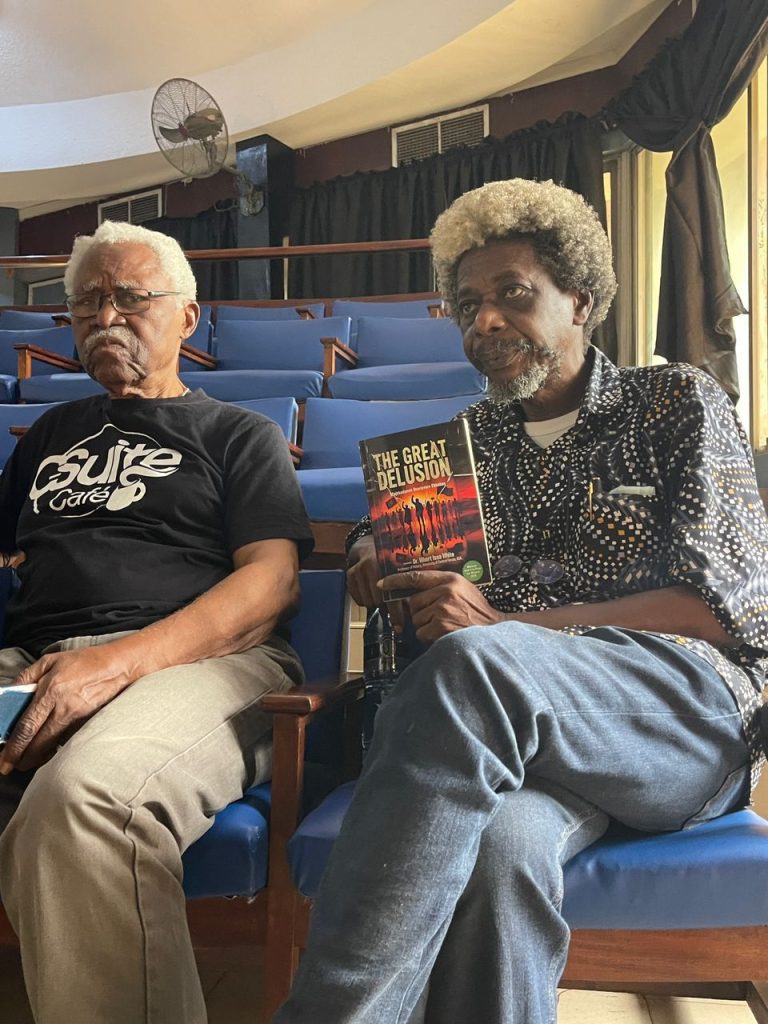
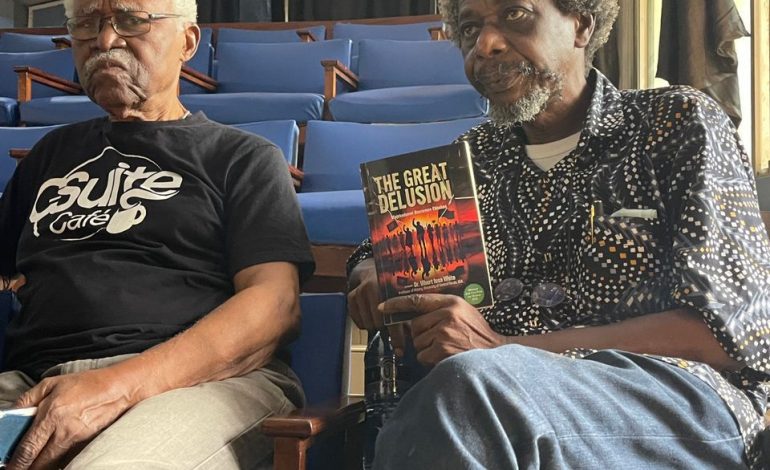
Professors Mark Nwagwu (left) and Sola Olorunyomi displaying The Great Delusion
Th Director of Institute of African Studies, UI, Professor Sola Olorunyomi, described The Great Delusion as a timely African epistemological intervention, aligning its themes with the political thought of figures such as Frantz Fanon, Amilcar Cabral, and Marcus Garvey. He noted that the dramatization of such ideas is crucial in engaging younger generations increasingly drawn to artistic and performative forms of learning.
A particularly striking moment came during the Q&A session when an ASSA student challenged the linguistic politics of the play. Drawing on the work of Ngũgĩ wa Thiong’o, she questioned whether writing the play in English—“the language of empire”—undermines its anti-imperialist stance.
Ebhohon responded by situating the choice within the lived realities of the African diaspora, particularly in the United States, where the story is set. He argued that language, in this context, functions as a tool of reach rather than allegiance.
“A work that exposes the distortions of a system,” Ebhohon said, “cannot be reduced to a celebration of that system simply because it uses its language.”
The event was attended by a wide spectrum of scholars, students, and cultural practitioners, including members of the Poetry Enclave (POEN) and its director, Anthony Ebika and representatives of the Amilcar Cabral Ideological School Movement (ACIS-M), reinforcing the interdisciplinary and intergenerational significance of the conversation.
The session positioned The Great Delusion as part of an ongoing intellectual and artistic effort to rethink Africa’s place in the world, and the terms of its engagement with it.