
Duve Nakolisa’s harvest of ‘Bukar Usman’s Short Stories’ a masterstroke

By Anote Ajeluorou
IT’S quite exciting to see that Dr. Bukar Usman’s literary works are getting serious critical attention. It’s not just Usman’s prolific output demands this level of attention, but also his rigour and dedication to archiving aspects of Nigeria’s cultural heritage. This is where Duve Nakolisa’s efforts become commendable and worthy of attention in bringing together two strands in one neat package. Nakolisa has not only provided a critical aspect to Usman’s creative writing in the short story sub-genre, he has also packaged Usman’s short stories in one book form. This ensures that the critical analysis he has provided Usman’s short stories become companion to the stories in one book form. Quite an ingenuous way of making Usman’s short stories accessible alongside analysis that explicates them.
In Bukar Usman’s Short Stories: A Literary Analysis (KKamidas Communications Ltd, Abuja; 2026), Nakolisa undertakes a rigorous academic approach to Usman’s short stories by providing background and context that inform them and analysing them one after the other in the order in which they are published. Usman has perhaps been the most prominent modern archivist of oral heritage Nigeria has ever known with his many works in that area in the public domain. He has not only written short stories that largely derive from the oral tradition, mostly originating from his Biu Emirate of Borno State cultural milieu, he has lso sponsored the collection of thousands of such folk narratives from across Nigeria in three volumes published in 2018. They include A Selection of Nigerian Folktales: Themes and Settings, People, Animals, Spirits and Objects: 1,000 Folk Tales of Nigeria and Gods and Ancestors: Mythic Tales of Nigeria. Usman’s short stories predate these three collections by 12 years.
In his analysis, Nakolisa makes a distinction between folktales and short stories and indicates where the lines sometimes get blurred between the two, as similarities often crop up. This distinction is somewhat necessary in appreciating Usman’s short stories from oral folk narratives. But a close reading of Usman’s short stories blurs this distinction, mostly as his short stories derive from folk narratives where humans and non-human characters interact, a key element of folktales. While the distinctions Nakolisa makes are interesting, the interactions between the two sub-genres nevertheless often occur more than disappear. For instance, in ‘Narrative Focus’ his distinction that ‘Folktale’ ‘focuses primarily on the actions of the characters and the effects of those actions’ while ‘Short Story’ ‘focuses primarily on the inward struggles or feelings of characters and secondarily on their actions’ may not always be sharply distinct. Characters in folktales are also known to have inward struggles to contend with in the choices they make or lack of it.
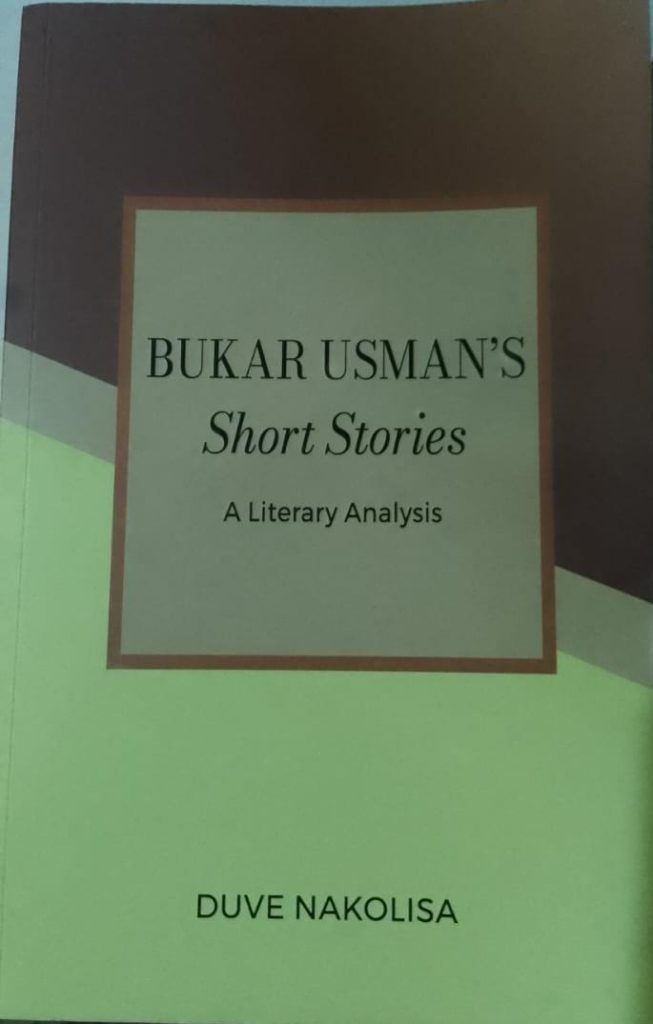
However, Nakolisa’s analysis provides ample illumination on the short story and folklore sub-genres and how they apply in Usman’s creativity in the short stories under preview. Starting with The Girl without Scars and Other Stories through The Stick of Fortune to Girls in Search of Husbands and Other Stories, Nakolisa provides readers with critical analysis of some 26 stories and gives the reader a foretaste of what the stories are about. Nakolisa examines elements such as characters, symbols, imageries and other motifs that Usman deploys to make his short stories interesting and believable portraiture of society then and now.
A common thread that tends to run through the stories, which is derived from the titles, is Usman’s preoccupation with girls, women and feminine energy generally. From ‘The Girl without Scars’ to ‘Girls in Search of Husbands,’ ‘The Old Woman and the Girl,’ ‘Engaged to be Married before her Birth,’ ‘Destined to be Queen’ to ‘The Bride’s Order’ and others, feminine motif runs through Usman’s stories, almost always in some quest to make her living condition better. And like the tortoise motif, these women also tend to get into trouble, not so much from overreaching, but simply because the forces ranged against them are usually overwhelming. This feminine motif would seem to have escaped the critical lens of Nakolisa. It’s something worth paying attention in further explication of Usman’s stories. In a strongly patriarchal society like Usman’s and his native Biu, preoccupation with female characters in stories is more than just passing coincidence. It indicates the centrality of women in society, much as this is usually disputed in favour of men. The titles alone indicate that girls and women are not passive participants in society, but beings that play active roles in shaping it, not with their presence alone but their acumen and ingenuity.
Nakolisa concludes his critical analysis of Bukar Usman’s Short Stories: A Literary Analysis thus, “… In spite of their folkloric roots, these stories have afforded him (Usman) great latitude to use conventional literary devices to weave culturally authentic and universally appealing stories. Through the diverse interpretations we have harvested from his 26 stories, it is clear that most of these narratives are not tales that explicitly illustrate a single ‘moral’ but rather short stories via which readers can harness various themes… In terms of subject matter, he draws significantly from indigenous oral repertoire, but in narrative structure and literary style, as well as intricacy of plot, he displays creativity and inventiveness remarkable enough to engage and reward serious readers and analysts of his creative writing.”