Preserving the interconnections of humanity in Bukar Usman’s ‘Looking Back, Looking Forward’

By Denja Abdullahi
ON my receipt of the newly published volumes of books from the Dr. Bukar Usman Foundation earlier this year 2026, and after cursorily looking through the pile that came to me in a big carton, I immediately wrote an official acknowledgement in which I penned thus:
The quality of the books in contents and forms and the painstaking research and documentation that must have gone into their conception and productions are worthy of study. I am one of those who believe that the contributions of your person and your Foundation to literary and cultural knowledge production in Nigeria is unparalleled; overshadowing even institutions in the private and public sectors that have been set up to do same.
Anyone who has been receiving or following the publications from the stable of the Dr Bukar Usman Foundation over the years cannot but be confounded by the man’s commitment to the propagation of cultural knowledge and his unwavering dedication to preserving a network of humanistic engagements that breaks barriers and erases borders.
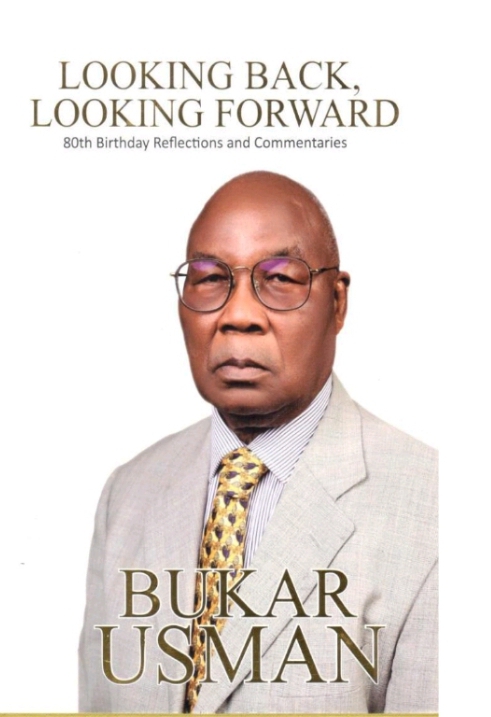
Out of the treasure trove of books I received, one of which I had studied and commented on as a manuscript a year back, which is now published has an extended comment of mine at the back cover as a blurb, another imposingly huge one caught my attention. That particular book under review here: Looking Back, Looking Forward: 80th Birthday Reflections and Commentaries (Klamidas Communications Ltd., Abuja; 2026) stands out because of the milestone it marks in the author’s life. The book is important because, according to the author it is a follow up to his earlier three autobiographies Hatching Hopes (2006), My Literary Journey (2013) and My Public Service Journey (2019). The book was also conceived to contain updates of his reflections on a number of public issues locally and internationally and to also document felicitations and messages received on his 80th Birthday Anniversary which fell on the 10th December, 2022.
The author in his typical ways, for those who know him or have encountered him at work or at play, as narrated in several places in the book, resisted every attempt of friends, close associates and even family to lavishly celebrate his making it to the octogenarian age (54, 894-895). Rather, he decided to document instead of allowing others to hold expensive birthday parties for him, which even if executed in every imaginable grandeur befitting his status and network of connections, would have been fleeting. This book, for which every birthday celebration entreaty was shunned, has proven to be a literary, archival and referential monument to the humanism of Dr Bukar Usman.
The book is in two parts with an extensive appendix and a postscript. The first part, which contains the reflections of the author on his birthday, has three chapters.
Chapter 1 dwells on the leadership lessons gained by the author in the course of his life. Earlier on in life, he learned that a leader should not think he has immunity or is above the laws enacted for all to obey (3). He saw this played out practically from the experience he had in his secondary school days when he was appointed to take over as a head boy from another head boy that was removed when he flouted this golden rule of leadership. He also learned early in life the leadership skill of looking at issues from various perspectives in order to gain cooperation between parties with opposing views. According to him, that skill greatly assisted him as a public officer later in life when interpreting and midwifing policies that were challenged by strong institutional bodies such as the Nigeria Labour Congress (NLC) and the Academic Staff Union of Universities (ASUU) (4). He learned the value of teamwork and team leadership as a veritable sportsman in his King’s College, Lagos days (5). One other valuable leadership lesson gained in those early days was the importance of incentivising and rewarding demonstrated uncommon performance and productivity (6). All these leadership lessons, gained early in life, were fully deployed in the author’s trajectory through public service where he rose from a third-class clerk to a federal permanent secretary before retiring from service in 1999. In his private life and relationship with people, those who have been at close quarters with him must have seen the inherent lessons of the aforementioned leadership traits in him.
Chapter 2 dwells on the author’s reflection on Nigeria’s political, economic, security and cultural situations with a submission that the bulk of ordinary Nigerians, in spite of the self-serving chicanery of the elite class, would always aspire to live together in unity built on their resilience.
Chapter 3 contains reflections on the international system with his analysis pointing out a world where developing or under-developed countries like Nigeria grapple with postcolonial dystopia while being tied to the aprons and neocolonial decisions made by the industrialized Western countries.
Part II of the book in four chapters (4,5,6 and7) dwells extensively on the curation of commentaries and goodwill messages received by the author on his 80th birthday anniversaries as well as his responses to some of the messages received. This part also contains the publication of diverse requests made by various persons to the author and his Foundation, acknowledgements made on reception of book donations and other kinds of supports from the Foundation and the author’s responses to some messages received. This part of the book is effusive in its showcasing of thoughts, felicitations, adulations and gratitude of many people from all walks of life who reached out to the author in well-ordered words to celebrate with him on reaching the age of 80. The diversity of the contents of the messages and the writers in ethnicity, social status, religious persuasions, ages and worldviews is simply astounding. Such outpouring of goodwill in its intensity is often reserved in this clime for someone that is still holding high public office, where favours had been dispensed or being expected. Reading through these messages, many of which go beyond mere expression of goodwill to sketch the author’s impact on people and the society, makes one to wonder how a single person’s life and deeds have been able to develop such deep connections to those of others. Another thing of note in the documentation through the publication of supposedly private conversations as seen in the book, is the author’s conception of expressing his own appreciation to those that have sent their goodwill by inscribing their otherwise private messages into the enduring archive of a book.
The self-reflexivity of Bukar Usman’s documentation and archival practices, reflected in some of his books overtime, should also be seen as a way of paying homage to the humanity of others. With Bukar Usman, no word or line you send to him, no matter your status, sex, age, race or religion, is considered unworthy of being archived to use for a book in the future, with proper acknowledgment and without distortion of the context of your initial communication. Often, when reading his publications, you stumble on your own words shared with him, which you have long forgotten. You then reflect pleasantly on the fact that your thoughts have been found worthy of preservation. The other side to this is the nagging thought that people communicating with Bukar Usman in the future may be conditioned to be wary, gilded or play to the gallery because of the awareness that their words may later come out in print. I do not think so because most of Bukar Usman’s private cum public textual engagements are with persons of relatively high-mindedness, are issues-based and on ennobling things dealing with literature, culture and public administration. It is also apparent that it is not all that comes to him that he makes public. The trainings and on the job experience he has gained as a top flight federal public bureaucrat, cutting across critical periods of Nigeria’s developmental history, would have ingrained in him to know what to make public and what to retain in the classified private archives.
The appendices to the book are domains of the collation of variegated published reviews on Bukar Usman’s books or his own published reviews of other people’s books. This shows that he reads and reflects openly on other people’s thoughts while others do same on him. This section also contains more birthday tributes on him not captured in the earlier chapters, songs, interviews and special ethnographic reports in English and Hausa.
The postscript section that concludes the book houses update on important land marking activities and events in which the author has been involved since his actual 80th birthday anniversary in 2022.
Those activities include his conferment with the prestigious Honorary Fellowship of the Nigerian Academy of Letters (HFNAL) in 2024, participations as keynote speakers at major literary, oral literature and folklore academic conferences and sundry interviews granted and essays written by others on the significance of the honour bestowed on him by the Nigerian Academy of Letters (NAL). This postscript has a section in Hausa language that renders most of the important features in the English language section into that language. That affirms the decolonial predilection of the author in promoting the indigenous Hausa language, which to a large extent makes the book bilingual.
The book, Looking Back, Looking Forward: 80th Birthday Reflections and Commentaries, in its entire scope covers enormous amount of information on auto-ethnography, biography, epistolary communication, philosophical reflections, ethnographic studies, literary criticism, cultural criticism, poetry, songs, linguistic analysis, annotated photo panorama on multiple subjects and practical archival documentations. The book in its expansive coverage and well-indexed format is not a book that one can grasp its rich texture at a reading. It is a veritable reference book with which one could map the trajectory of the author’s thoughts, ideologies and relationships with people of several persuasions and expertise. The documented writings of others in relation to the author can also be studied to reveal a range of humanity in conversation with the author on shared ideals. The history of the author’s literary and cultural practices tilts towards safeguarding cherished memories, folklores, heritages and humanistic preoccupations; and this book is an added tome to the author’s unceasing celebration of the labyrinth ways of humanity.
This review by Denja Abdullahi, FANA, NPOM was published by The Nation under the title ‘Presenting Labyrinth of Humanities’ online at https://thenationonlineng.net/presenting-labyrinth-of-humanities/ on August 9, 2026. It was also published by the Independent under the title ‘Preserving the Labyrinths of Humanism: A Review of Bukar Usman’s Looking Back, Looking Forward: 80th Birthday Reflections and Commentaries’ on August 15, 2026, P. 19 and online at https://independent.ng/preserving-the-labyrinths-of-humanism-a-review-of-bukar-usmans-looking-back-looking-forward-80th-birthday-reflections-and-commentaries/