Otuedon-Arawore’s ‘Asiodu: A Legacy of Dedication and Service’ now in print

By Goke Adegoroye
MY first close appreciation of the calibre of Izoma Philip Chikwuedo Asiodu (fondly called PC Asiodu) was around at the time I was to leave my lectureship position at the University of Ife (now Obafemi Awolowo University) for the Federal Environmental Protection Agency (FEPA) as a Director. It was through briefings by my friends and university lecturer colleagues, Professors Anthony Olusegun Adegbulugbe and Felix Yemisi Dayo. They were always travelling to Lagos, working with Chief Asiodu on a project that was to lead towards forming a company to be known as LUBE OILS LIMITED through which they were going to deploy a collection and recycling technology to solve the environmental menace of lubricating oil that was being discharged carelessly around the mechanics workshops and into the public drains. Reference to the initiative as part of his Chairman’s Opening Remarks at the Nigerian Lubricants Summit 2015 is on page 159 of this book that is being launched today. Even though, as he says in the book, lack of government regulations at the time to make the practice of open discharge illegal and thus make the project economically viable did not allow Chief Asiodu to implement the project, it is instructive to know that when those my two friends were to form their own company, TRIPPLE E Limited in 1992, PC Asiodu was the person they invited as Chairman of the Board.
It was at FEPA that I started to have a distant glimpse of PC Asiodu, through the Nigerian Conservation Foundation (NCF) which his foresight had led him to team up with Chief S.L Edu to establish in 1980. This predates, by nearly a decade, both FEPA and the Natural Resources Conservation Council, the two Federal Government’s agencies on the issue. I also listened to him many times in 1997 at both Plenary and Working sessions of the Vision 2020 Committee of which, in my position at the time as DG of FEPA, I was a member like him.
My close working relationship with PC Asiodu was not until 1999, immediately after Obasanjo was sworn in. He was the Chief Economic Adviser to the President (CEA-P) and Vice Chairman/CEO of the National Planning Commission, and he used to come to the Office of the SGF. I was Director to the SGF and Izoma Asiodu’s guidance in those early days opened my eyes to his versatility, and in response to my probing question about his knowledge and institutional memory of the system, my boss had to confess to a story, which I will reveal later.
Twice I have been fortunate to be bestowed by Izoma PC Asiodu an immeasurable honour that any Nigerian civil servant can aspire to have:
The first time was 10 years ago, 2015, when he accepted to write the Foreword to my twin volume book Restoring Good Governance in Nigeria. As I wrote in the acknowledgements of the book: Chief Philip Asiodu, the founding chairman of the Council of Retired Federal Permanent Secretaries (CORFEPS) is Nigeria’s foremost quintessential civil servant and living reference for integrity, excellence and courage to speak truth to power in the public service. By writing the Foreword to this book, he has bestowed on me the greatest honour that any Nigerian civil servant can aspire to have.
The second time is what led to the assignment that I am carrying out on this podium right now. He called me in early September to inform me that Chief Patricia Otuedon-Arawore was making a book on him and that he would like to request if I would accept to be the reviewer. Me, Goke Adegoroye, being requested to know if I would accept an assignment from the legendary Izoma Philip Asiodu? Such a polished great man – the model that I have always aspired to, both during my civil service career and now in retirement. He was never a Secretary to the Government, or Head of the Civil Service of the Federation. Yet in intellect, brilliance of mind, confidence, and courage to speak truth to power, no SGF or HCSF – dead or alive, can claim to be better than PC Asiodu. Except for his friend and classmate, Allison Ayida, he dwarfed them all, in his generation and the generations after.
Now, to the heart of the business that I am here to perform.
Philip Asiodu – A Legacy of Dedication and Service (Mahogany Limited, Lagos; 2025) is a book by Chief Patricia Otuedon-Arawore and it is published under the Hallmarks of Labour Special Edition Series. It is a total of 596 pages.
The book traces the Roots, Formal Education, Public Service, Post-Retirement Public Sector Assignments and Entrepreneurship of Izoma Philip Asiodu, yet it is NOT an Autobiography. While those biographical details listed above are important, they are not the focus of the book. Accordingly, all that information has been compacted into only the first 32 pages of the book. On the other hand, the next 520 pages, which constitute 94% of the main body of the book, are on Perspectives. Perspectives are a compilation of the views that have been expressed by Izoma Philip Asiodu in papers presented at public functions in official, business and social settings in the last 25 years.
The index density (frequency of mention) as a measure of the importance of a subject matter or issue in a book shows that the key words and the number of times they occur in the book are: Civil service/public service plus civil servants/public servants (228), Public policy (59), Government (137), Governance (83), Oil/petroleum (129), Independence (95), Private sector/Business (87), Investment (83), Corruption (80), Implementation (74), Quality (73), Leadership (71), Process (67), Vision (62), Discipline (61) and Agenda (44).
It will be observed that except for one item, Private Sector/Business (87), all the other key words revolve around civil/public service and governance (1,346). In other words, 94% of Asiodu’s efforts and public engagement in his 91 years on earth have been about his country on the platform of civil/public service and governance by way of situational interrogation and advocacy of the best way forward.
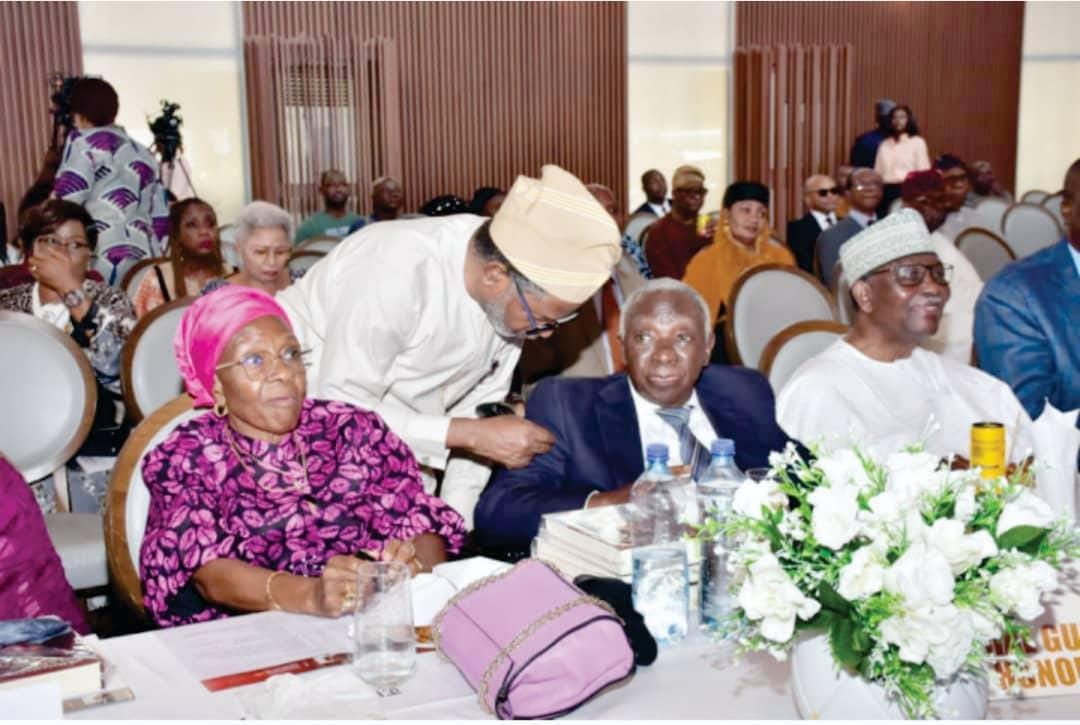
Former Head of State, Gen. Yakubu Gowon (right); Chief Izoma Philip Asiodu (middle) and his wife, Goke Adegoroye standing over Chief Asiodu
Let me now start to take you through the pages to enable us get into the heart of the book – Asiodu: A Legacy of Dedication and Service. My Review is divided into three sections: Asiodu the Man, His Views/Perspectives and Lessons of His Legacy for the Present Generation.
Asiodu the Man
THERE is no gainsaying that the foundation of what molded PC Asiodu to what is being celebrated in this book as “A Life of Dedication and Service” and in respect of which we are gathered here today are: His Roots (pp. 4-5); Formal Education (6-10); Public Service (10-27); Post-Retirement Public Sector Assignments (27-29); Recognitions (30-31); Entrepreneurship (31-32). It is a very rich section.
Asiodu was born in Lagos to a civil servant father who worked with the Department of Customs & Excise, and from whom he took his initials: Papa Philip Chibuzo Asiodu himself went to school in Lagos – St. Gregory’s Grammar School.
Being born of a father who was a federal civil servant led him to spending his early 10 years in Calabar, where he started schooling at Sacred Heart School and then at Hope Waddell Training Institute, until they were back in Lagos, thus enabling the young Efik speaking Philip to complete his primary school at St. Paul’s School Ebute Metta and to enter, through very highly competitive examination, the prestigious King’s College (KC) Lagos before his 12th birthday in 1946. It was at KC, where his budding leadership qualities started to manifest as School Prefect and House Captain, that he was classmates to two people with whom he later had life-long working relationship, namely Otunba C. A. Tugbobo fellow retired Federal Perm Sec and foundation Executive member of the Council of Retired Federal Permanent Secretaries (CORFEPS), and of course his bosom friend and the best man at his wedding, the former Secretary to the Federal Military Government and Head of the Civil Service of the Federation – Allison Ayida now of blessed memory. From KC he went to Oxford University with Ayida, where they both studied Politics, Philosophy and Economics (PPE). I don’t think there is a combination of subjects and university that has succeeded in enthroning Prime Ministers and Presidents all over the world as PPE (Oxon).
In the Public Service where he began his career in 1957, P.C was a trail blazer. He started as an External Service Officer and was one of the 12 pioneering officers of the Nigerian Foreign Service where he had such illustrious postings as:
Assistant Secretary (Political) and Personal Assistant to the Commissioner – Chief M.T. Mbu, himself at 29 years only and years older than P.C. On Attachment to the British. High Commission in Australia, and later to the British High Commission to New Zealand
Second Secretary at the British Permanent Mission to the United Nations Organisation (UNO). First Secretary and Head of Chancery Nigerian Permanent Mission (after formal admission of Nigeria in 1960). Counsellor, later Nigeria’s Charge d’Affaires Nigerian Permanent Mission to the United Nations. Head of the Administrative Division, Ministry of External Affairs. Head of the Economic Division, Ministry of External Affairs. Nigerian Representative in the 6-Nation Provisional Secretariat of the Organisation of African Unity (OAU), Addis Ababa, Ethiopia and Head of the Secretariat for the OAU Foreign Ministers Conference, Lagos 1964.
It was after his assignment as Head of the Secretariat for the OAU Foreign Ministers Conference, Lagos 1964 that he opted for home service. How much of this decision was influenced by the fact that he had just married and didn’t want his young wife to feel lonely, the book does not tell. But enough hint in this direction finally emerges in the testimony of Mama Eugenia Jumoke Asiodu on page 551 of the book where she said: I got married to him when I was under 21 years and it was not easy coping with his long hours of absence from home….
His first posting in Home Service was as Deputy Permanent Secretary in the Ministry of Lagos Affairs, Lagos having been just constituted into the Federal Capital Territory, with Alhaji Musa Yar A’dua as Minister and Alhaji Abdulrahman Mora as Permanent Secretary. In this position, PC was also a Member of the Lagos Executive Development Board (LEDB).
Appointed Acting Permanent Secretary Federal Ministry of Health in April 1965, PC was seconded for 3 months to the Federal Ministry of Commerce and Industries to carve out what became the Federal Ministry of Industries. He returned to the Ministry of Health as Permanent Secretary and was later posted to the Federal Ministry of Industries where he served from 1966 to 1971, and to Ministry of Mines and Power where he remained from 1971 until April 1975 when the Ministry was re-organised and renamed Ministry of Petroleum & Mineral Resources, which he continued to lead to enable it to consolidate.
In July 1975, however, he was posted to the Ministry of Housing and Environment. To me this was a foretaste of what was to come, as he was prematurely retired barely 2 months later, in September of that year, at 41 years of age and having spent only 18 years in service, by the Murtala Mohammed regime which had taken over Government on 29 July 1975.
To say that PC Asiodu was an achiever as a civil servant is an understatement. He is the epitome of all the qualities of an effective civil servant. When I mentioned during a phone call from one of the bosses that I respect the most in their retirement, Dr Bukar Usman, that I was reviewing a book on Chief PC Asiodu the first statement that he uttered was that man, he has an excellent capacity to expand the office he was posted to. He grows anything that he touches at every position assigned to him. He was the one that established most of what we see today as NNPC and many others in the Ministries of Mines and Power. Dr. Bukar Usman was happy to proudly inform me that he worked with Philip Asiodu in the Ministry of Mines and Power in1971 before being deployed to the Cabinet Office in 1972. My reply to him was “That’s very true, sir, the list of his achievements at every duty post is amazing and beyond what I had previously known or presumed”. The highlights of these agencies that berthed on the initiative of PC Asiodu, as contained in the book are: Nigerian Standards Organisation (now Standards Organisation of Nigeria – SON) to Industrial Training Fund, Industrial Inspectorate Division, Negotiations with Volkswagen and Peugeot Automobiles for the establishment of their vehicle assembly plants in Nigeria; the Nigerian National Oil Corporation (later NNPC and now NNPC Limited) where he served as the founding chairman. He saw to the merger of the Electricity Corporation of Nigeria (ECN) and the Niger Dams Authority to form the National Electric Power Authority (NEPA) where he also served as the founding Chairman.
The list goes on, and you will find these on pp. 23-27, while his post-retirement public service assignments, achievements, and recognitions will be found on pages 27-31. He was Special Adviser to the President and Chairman Presidential Cabinet Committee 1983; Secretary (Minister) for Petroleum and Mineral Resources January – August 1993; and Chief Economic Adviser to the President and Deputy Chairman/CEO of the National Planning Commission June 1999-June 2001. His business interests and voluntary organization pursuits in aid of social welfare are on pages 31-32. He was Chairman, Nigerian National Committee of the World Energy Council 1989-1993, International Trustee, Worldwide Fund For Nature; Foundation Member and President of the Board of Trustees, Nigerian Conservation Foundation (NCF) an affiliate of the World Wide Fund International (now Worldwide Fund For Nature); President Ecobank Foundation; Chairman, Board of Patrons of the Nigerian Economic Summit Group, and of its Governance and Institutions Policy Commission since 2005; and, of course, pioneer Chairman of the Council of Retired Federal Permanent Secretaries – CORFEPS (2004-2014) which he helped to establish, and on which Board of Trustees he currently is Chairman.
Asiodu is obviously the best of the best and the views of superior officers that he reported to during his civil service career say it all:
He was described as A man of impeccable manners and infinite charm… A man that always has a cultivating smile. A man with a great gift of the garb. Few nations are blessed with the likes of Asiodu’s and fail to accord them due recognition. – MT Mbu
Simeon Adebo who came in as the substantive Permanent Representative of Nigeria, following Asiodu’s three months as Nigeria’s Charge d’Affaires to the United Nations, said this of him:
If anybody would be said to possess all the credentials for a great diplomat, Philip did. He has a brain as incisive as a razor blade. He was always well groomed and knew how to relate to different classes of people and was a model of discretion…. He also possessed what was a very useful additional tool for successful achievement at the United Nations – a sound knowledge of the French language. He was a great loss to the Nigerian Foreign Service.
A man of great conviction, principle and courage was how he was described by Chief M.O Feyide, Nigeria’s former Director of Petroleum and former Secretary General of OPEC; while Ahmed Joda, his former colleague and retired Permanent Secretary, described him as:
A polished diplomat with wide international contacts, an accomplished civil servant who knew his country more than most Nigerians and, as he speaks excellent French, our travels to France and other French speaking countries were much easier than could have been. He has been a great builder of this country.
Perspectives
GIVEN the synopsis of the first 32 pages of this book which I have provided above on the upbringing, educational background, the public service record and views of his reporting officers and colleagues, it is not difficult to expect that Perspectives which as I said earlier span 520 pages of this book is one prism through which the life of the subject of this book, Philip Asiodu, can truly be seen as A Legacy of Dedication and Service.
Perspectives are a compilation of the thoughts and views that have been expressed by Izoma Philip Asiodu in papers presented at public functions in official, business and social settings, ONLY in the last 25 years. There are 35 of those presentations and they cover such issues as are listed on Roman numeral pages iii – v, namely:
Ethnicity and religious bigotry; Long term vision for the nation; Education for Peace and Development. Fifty Years of Foreign Policy and Diplomacy; Presidential Competence; Medium Term Prospects for Growth and Development; Youth Restiveness challenges; Towards a resilient Economy; Public Service and the Transformation Agenda; Critical Energy for Infrastructure; Economic Diversification; Remotivating the Public Service; Policy Coordination; The Nigerian Oil Industry; Managing Inter-Personal Relations Among Top Echelons In The Ministry; The Way Forward On Abandoned Projects and Failed Contracts; and Re-Orientation in the Management of National Affairs and the Adoption of a Comprehensive Charter of Good Governance.
The thesis of PC Asiodu at all the gatherings where he discussed these topics centered around 4-5 critical issues and propositions, namely: The 1975 Purge of the Federal Civil Service, The Tragedy of Abandoning the 3rd National Plan 1975-1980, A Language Policy to Foster National Integration, The National Vision Imperative AND A Great Role Waiting for a Player.
The 1975 Purge of the Federal Civil Service
THE 1975 Purge is a recurring decimal throughout the book, because of its impact on the federal civil service ever since. However, I want to quote from pages 113 and 114 which provide the best description of what took place.
“The traumatic massive purge of about 10,000 officials over a period of two months, without due process, involving officials from the rank of Permanent Secretary to the class of messengers being retired or dismissed, including some obvious leaders and role models, some without any terminal benefits or pensions destroyed the professional, non-partisan, fearless, prestigious, merit-driven Civil Service and Public Service inherited from the British Colonial Administration. In the process, the nation lost a great deal of institutional memory and international connections.
The more senior ones, who inspired the ideals of the Pre-Independence movement and the patriotic commitments of the leaders of the First Republic, were still energetic in suggesting and developing policies, programmes and projects and who also imbued, as they were, with the old core values would be able to provide some checks and balances were swept away. The suffering, including premature death of scores of officials affected by the purge fueled the resort to make hay while the sun shines, an obvious euphemism for corruption which now threatens the future of the country.
The Tragedy of Abandoning the 3rd National Plan 1975-1980
HOW did Nigeria find itself in the situation of stagnated economic development and failure to create jobs during the rapid global economic expansion of the last four decades was the question he asked on page 134. The answer which he recalls every time “with great pain and regret” was that the 3rd National Development Plan 1975-1980 which was launched in April 1975 was abandoned. Stressing the point further he says:
“The great tragedy is that the Murtala/Obasanjo Administration which replaced the overthrown Gowon Administration in July 1975 effectively abandoned the 1975-1980 Plan with its great promise of creating the basis for economic diversification and industrialization, and also abandoned indeed, the principle and discipline of Planning”. “We may recall the impressive average annual growth rate of 6% achieved under the 1st Plan 1962-1966, later extended to 1968; and after the Civil War, the average annual growth rate of 11.75% from 1970-1975. Ten more years of growth at that rate and Nigeria would have exited from underdevelopment and poverty” (pp. 134-135; also p. 52, 68, 120, 140, 144-145, 196). According to him, “abandoning the Planning and the Discipline of Planning in 1975 resulted in over four decades of floundering”.
As he said on page 114, “The Pre-Purge independent, prestigious, fearless, Civil Service might have been able to succeed in advising against such anti-plan policies and Nigeria’s economic history in the last two decades of the 20th century would have been very different”.
A Language Policy to Foster National Integration
ASIODU sees language as a unifier, a vehicle for national integration. His advocacy in this regard can be found on pages 93 -94 and on page 178. On page 93 he states: “I had hoped following on the early success of the National Youth Service Scheme that we would be able to persuade the Government to introduce a Language Policy to foster national integration. That was before the termination of the Gowon Administration by the coup of July 1975”.
“Such a policy would require each child to learn to read and write in the local language where he or she begins schooling, even in private schools. By the age of 10, the child begins to receive instructions in English as is the practice now. The new policy would be that by the age of 12 or 13 when he or she enters a secondary school, he/she has to make a choice. If he is in the North, he must choose one Southern Language which he will be taught to speak, read or write. The chances are that the child will choose either Ibo or Yoruba. In the South, the child will likely choose Hausa as the Northern Language. All secondary schools will have the necessary language departments. …For the avoidance of doubt, English will still remain the official language of the Federal Government”.
The National Vision Imperative
HIS distaste for the way succeeding administrations after that of Gowon have discarded the 1975-1980 Plan and, while not being able to develop an alternative, have either displayed a lack of interest in the Vision 2010 which they met or simply enjoyed what he terms the “flirtations of Vision 2020” explains why he started advocating for a National Vision and Agenda 2040. This, readers will find on pages 54, 64, 83, 84, 138, 139. The essential elements of the National Vision 2040 and how it will be broken into 4-5 years National Economic Perspective Plans are on pages 55 and 56.
The Search for a Leader, arising from his defined hypothesis of: A Great Role Waiting for a Player
ASIODU, a great planner and man of vision himself, has always been conscious that a good national vision needs a committed leader. Like someone on a treetop or on the pulpit he declares, in the manner of John the Baptist’s Voice of one crying in the wilderness (Isaiah 40:3), in his paper titled Re-Positioning Education In Nigeria For Peace and Development at the Hallmarks of Labour Re-Union Lecture on 14 September 2017 and I am quoting from page 83 of this book:
There is a great role waiting for a player in Nigeria. There is a need for a great patriotic and visionary leader to articulate a National Vision and Agenda of where Nigeria should be by 2040, to be at least a top middle income nation of over 300 million people and to quote from Vision 2010: “A united, industrious, caring, God-fearing democratic society committed to making the basic needs of life affordable for everyone and creating Africa’s leading economy”. Such a leader he says will need to lead a revolutionary change of attitude, beyond party, tribal and religious divides, amongst leaders of all sectors of government and society to embrace all aspects of good governance and re-launch Nigeria irreversibly on the path to unity and greatness. He must be ready to commit his life to this great cause.
He noted on page 123 that Chief Olusegun Obasanjo who came in in 1999 as President unfortunately completely set aside Vision 2010. We can only imagine, as only God knows, the amount of pressures he must have placed on the President to implement that Vision, given that he was his Chief Economic Adviser. Having failed in convincing President Obasanjo, he nonetheless relaxed to see how the Vision 2020 that Obasanjo instituted was going to be implemented. He witnessed during 2009 and 2010 that Government at the Federal and State levels, with the active participation of a broad spectrum of Nigerians, including public and private sector experts and representatives of NGOs elaborated the Vision 2020. However, he soon discovered that it was, in his words, all “flirtation”.
His persistent advocacy for a new leadership that will drive Vision 2040 led him to speak to audience across generations. Whether he was speaking to the very mature audience in top positions or to secondary school pupils, as he did to the Chrisland Schools Limited Class of 2016 at their Prize Giving Day in 2016, the message is the same: “Things must change. … Things will only change when, through the right type of education, Nigeria produces the leadership to develop and inspire us with vision to greatness” (p. 272). His advocacy also drove him to tailor his presentations to speak to the sitting presidents to heed his call to a National Vision.
On page 127 he seized on his presentation titled “Growth and Development In Nigeria – Medium-Term Prospects” which he presented at the Oxford & Cambridge of Nigeria Business Forum on April 18, 2013, to invite the attention of President Goodluck Jonathan to that critical issue as follows:
“The smoothest and least traumatic scenario is for the incumbent President, Dr Goodluck Jonathan, with the authority derived from a universally (local and foreign) acclaimed election to assume that role of imposing good governance in all its aspects on our nation during the next two years i.e. end of his mandate”. What it entails are listed on pages 127 & 128.
On page 138 he spoke in the same vein, in his paper titled “Unemployment, Youth Restiveness and Developmental Challenges” at the Njiko Aniocha Osimili 2017 Annual Lecture, to President Muhammadu Buhari as follows:
“The least traumatic way of saving Nigeria from the threatening disaster of a failed State and violent anarchy is for President Buhari as the elected President to get a group of capable patriotic people to elaborate a new “Vision and National Agenda 2040” and to require all who love Nigeria to identify with him and all”. He goes on “It is critically important to elaborate a National Vision and Agenda 2040 now to enable the Leader mobilise the broad masses of the people to move forward to progress, unity and greatness”.
With the years passing, as he was advancing in age, and yet not seeing the emergence of such a leader, in a paper presented on February 4, 2022, titled: “A Submission to the Sub- Committee on Nigeria in Transition – The 2022 Committee” he declares on page 278:
What hope can we have for the future? I have believed for some years that there is a great role waiting for a player in Nigeria. But he was never tired of advocating for a better and vision-driven Nigeria. Accordingly, extending the target date of the Agenda he said in that 2022 paper: There is need for a great patriotic and visionary leader to articulate a National Vision and Agenda of where Nigeria should be by 2050, at least a top middle income nation of over 300 million people as “A united, industrious, caring “………merely restating the same goal in Vision 2010 that was developed in 1997 but was discarded by the 1999 administration. He says that our past achievements give us hope that the broad masses of Nigerians are waiting for such a leader to call the nation to order and will answer a call to order.
On page 284 as part of that submission, speaking on the Form of Government, he proposed “the creation of the post of Prime Minister in addition to that of Vice President, with the President nominating the Prime Minister and Ministers to specifically designated posts who must be approved by the Senate before they can assume office. The Prime Minister will be charged with day-to-day coordination of the works of the Ministers under the direction of the President”. I am sure that such a Prime Minister portfolio would have been more effective than the ego-boosting title of Coordinating Minister currently in use, as I have questioned its effectiveness – whether with Ngozi Okonjo Iweala or Wale Edun being adorned by it under both the Jonathan administration and the present president respectively. See my books: Restoring Good Governance in Nigeria vol. 1 The Civil Service Pathway (2015), and Leadership in the Nigerian Civil Service: Five Decades of Lessons in Performance, Encounters and Triumphs (2025).
How I wish Asiodu has had an opportunity to meet with President Bola Ahmed Tinubu, to enable him to present the President, as he did to his predecessors, the same call to duty with the new additions highlighted above. As it is, that Great Role that Philip Asiodu has been advocating Is Still Waiting for a Player. The Search Continues!
Lessons of Asiodu’s Legacy of Dedication and Service for the Present Generation of Civil Servants
WHAT Existed at the Entry of Asiodu Compared to the Civil Service of Today. 0Negotiations by the founding fathers of Nigeria with the British government at pre- independence had led them in 1954 to adopt the following statement:
We fully support the principle that all public service questions including appointment, promotion, transfers, postings, dismissal and other disciplinary matters, should be kept completely free and independent of political control. We hope that the traditional principle of promotion according to qualifications, experience, merit, without regard to race will be maintained. (110-111). Unfortunately, the purge of 1975 changed the tone. It destroyed the professional, non-partisan, fearless, prestigious merit-driven civil service inherited from the British Colonial Administration. Asiodu states that “the woes of the civil service were compounded by the promulgation of Decree No. 43 of 1988 which politicised the civil service, as under it the Ministers, transient as they often were, could hire and fire civil servants”.
Asiodu acknowledges the reforms that have been embarked upon since 1999 to reposition the civil service (p. 179) and that, indeed, the National Strategy for Public Service Reforms was launched to execute the reforms in three phases – 2011-2013; 2013-2016; and 2016-2020 to produce a world class Public Service but that the question remains why has so little been achieved over the years to improve the image of the Public Service (p.116). His charge is that the political leadership must demonstrate the commitment to change the image of the public service of an inefficient, rent-seeking and obstructive extortioner to that of an honest, efficient, pro-investment, patriotic, pro-people official. Again, on page 181, he stresses that to deliver any Transformational Agenda, the civil servant must discard the image of the arrogant intimidator or of the corrupt extortioner.
His Recruitment
ASIODU, while still in London after his graduation, was recruited into the service in a transparent and integrity driven process that involved newspaper advertisement inviting applications for trainees to form the nucleus of independent Nigerian Foreign Service. Even though he was recruited into the Foreign Service, he was made to undertake as part of his induction a nation-wide tour that covered several thousand kilometers in the then Nigeria and the Cameroons. Within a few months he was posted on attachment to the British High Commission in Australia to further learn the ropes of diplomacy and acquire the skills in the diplomatic service (p.11-12). As part of his self-improvement on the job, he undertook a 6-month course in French language.
How are officers recruited these days? Vacancy slot sharing formula has become the vogue at every recruitment regulatory agency, board or commission of government without exception. Because those agencies and commissions have been beaten to submission by our political lords at the national assembly and cabinet, slot sharing is now the rule, no matter what the heads of those agencies and commission say in the public. Indeed, the Federal Character Commission usually takes the lead in inducing recruiting agencies to play ball.
When these privileged wards get their letters of appointment they go straight to their desks, if they are lucky to have one or simply loiter on the corridors when and if they report for work. Inductions when carried out are shabby and only exist in name to draw down on the vote. Training is an avenue to simply collect the allowances. Officers are not committed enough to want to invest in themselves to improve their performance on the job. They wait for government to send them for computer training on simple task involving the word application. And it is easy for those young officers to be living in the UK or America and yet will be receiving their salaries every month without fail.
His Career Development and Progression
WHILE Asiodu could be said to be a highflyer, he justified every step on the ladder by his performance. The appellation of “super Perm Sec” was performance driven, denoting a quality officer that his principal relied upon. He was a shining star among his colleagues and earned respect. And his reputation as an exceptional officer radiated ahead of him wherever he went. At each tour of duty, he was an epitome of excellence, professionalism, patriotism, integrity and courage to speak truth to power.
His Retirement from Service
ASIODU’S exit from the service, like those of other civil servants of the great purge of 1975, had no clear basis. The Federal Public Service Commission (FPSC), which employed him but by then had been transformed to the Federal Civil Service Commission (FCSC), was not consulted. Perhaps more striking is the revelation that his case could have been likened to the biblical white lamb, except that he was not offered for the sins of his fellow civil servants but to demonstrate the ultimate powers of that regime. This came out when Allison Ayida the Secretary to the Federal Government and Head of the Civil Service went to the Head of State. Hear him:
“I insisted as Head of Service that everybody must be told why they were being retired (a record 9 Permanent Secretaries at a go” (representing a sizable number of the permanent secretaries at the time). “So, General Murtala Mohammed called Philip and said You, Philip, we know your record, we like you very much. This government would have liked to continue with your service, but as a government of resolution we have planned to show example that nobody is so powerful that he cannot be removed, so we want to use you as an example.
“The Head of State then went on to assure Philip that he was not being retired on grounds of corruption. All that Philip could say was Sir, I am very grateful for the honour and the explanation. I could have been killed to show that nobody is too powerful, and now that you have spared my life I will go and continue with my own humble life. Talk of courage to speak truth to power, even at such a moment! That was classic Asiodu.
As they say, God’s case has no appeal. The Murtala/Obasanjo regime wielded the ultimate powers. No court in the land could challenge or overturn their decisions.
Compare that with the civil service of today, under democratic governance. Cases of promotion and discipline decided by the FCSC between 1998 and 2018 have been taken to court and successfully overturned. Even disciplinary cases decided by Presidential commission of inquiry and in respect of which a Government white paper and a gazette had been issued to pronounce dismissal of officers have been taken to court and overturned, and the new lease of life gained therefrom by the officers have enabled them to progress higher in their career up to the level of perm sec and even HCSF. As I said in my latest book Leadership In the Nigerian Civil Service: Five Decades of Lessons In Performance, Encounters and Triumphs, (see p. 125) the proverbial eyes of the integrity needle at both the FCSC and the OHCSF appear to have grown so large in recent times that camels of questionable integrity have been strolling through them into positions of high trust.
What played out as early retirement of Asiodu in 1975 was not the only time that his confidence, courage and capacity to speak truth to power would be an albatross to the deployment of his talents for the national good. There were two other instances that I was privileged to be availed of by SGF Chief Ufot Ekaette when I was working with him, as I hinted early in this Review.
On Chief Ekaette’s appointment as SGF, he met me as one of the directors in his office. Chief Asiodu was the Chief Economic Adviser to the President and Vice Chairman/CEO of the National Planning Commission. But he was the one that was guiding my boss and I on certain key functions of the office, especially in crafting the responsibilities of the Political Office Holders. There were by far more appointed ministers than the number of Ministries available. We ended up having not just Ministers and Ministers of State but multiple Ministers in the Presidency.
One day, in response to my comment to my boss about how helpful the institutional memory and creative ideas of Chief Asiodu had been to us in that assignment, my boss confessed to me that, indeed, it was Chief Asiodu that was initially earmarked as the South-South candidate for the post of SGF and was so told, a promise that held till about two days to swearing in, but that many politicians felt that he would be too strong in the position. My boss told me that that concern was what led his Governor Obong Victor Attah to approach President-elect Obasanjo that since he wanted someone with civil service experience of not less than a federal Permanent Secretary he had one with such an experience but who was also very meek, and that when Obasanjo asked who he had in mind, as soon as his name was mentioned Obasanjo immediately agreed saying that he remembered him as an effective officer who had once served as Principal Secretary to Gowon as Head of State. It was my first time coming to the realization that strong character in a perm sec could make their Principal uncomfortable.
It is an irony that, even the position of CEA-P and Vice Chairman/CEO of the National Planning Commission that was seen as the comfortable landing for PC Asiodu by his principals was not so comfortable after all. He had to exit the administration midway in 2001 in circumstances that reminded of the 1975 episodes. I thought they say lightening does not strike twice? I guess the exception lies in the courage to speak truth to power and capacity to not compromise one’s integrity.
Barely 8 years later, I had a near similar experience in my tour of duty as Perm sec in one of the largest federal ministries which, at that time, initially had a Minister and two Ministers of State, but the new Minister brought in via a cabinet reshuffle found me too proud to cope with, thus forcing my deployment out of the Ministry, but not out of the service. That is a story for another day. Today’s is Asiodu’s not mine.
Excellent Working Relationship, Out of Mutual Respect and Lasting a Lifetime: The Gowon-Asiodu Example
GENERAL Gowon has had to cut short his stay abroad to be here. I was also looking forward to seeing Dame Didi Esther Walson-Jack- the Head of the Civil Service of the Federation here in person as a symbol of the connection between the present and the past, or shall I say, a link to where it all began, the source of the fountain of public service excellence, dedication, patriotism, professionalism, and integrity, as a confirmation of the beginning of the restoration of all that is good for the civil service and the nation. Unfortunately, I am told she is on a very important national assignment as Chairman of the National Council of Establishments. The honour of meeting all these “public service greats” now rests on her representative, the Perm Sec Ecological Fund Office who, as it has turned out, is also well suited for the role in her own rights as the daughter of a colleague of Izoma Asiodu- Umaru Sanda Ndayako, the late Etsu Nupe. She is Aisha Ndayako.
Asiodu’s CORFEPS Lessons For the Current Generation of Leaders in the Civil Service
ASIODU is not just a trail blazer but a Pathfinder- what the Yoruba calls “Atona” for he has not only blazed the trail but has also continued to light paths in the public service to show us the way.
Philip Asiodu – A Legacy of Dedication and Service shows that true public service leadership does not end with retirement. It continues throughout life in the capacity/ability to express patriotic personal views as perspectives in nation-building. PC Asiodu loves this country like no one else. All through this book he has shown that he was not as pained by his early retirement as he was with the jettisoning of the 1975-1980 National Development Plan by the Murtala/Obasanjo Administration. What pains him till this day is the fact that the administration not only abandoned the Plan, but also the process of planning and the discipline that planning entails. Yet, he remained committed to thinking for the country and putting forward his ideas for those on the stage to deploy. He formed CORFEPS to enable his colleagues in retirement to have a viable but joint platform for advising Government on issues of national importance. It is why the motto of CORFEPS is Continuing Service which, again, is a motto that was crafted for CORFEPS by no other person than its foundation Chairman and now Chairman of the CORFEPS Board of Trustees, the one and only Izoma Philip Asiodu!
I am proud to say that CORFEPS, of which I have been the National Publicity Secretary since the baton of chairmanship was handed by Asiodu in 2014 to Mrs Francesca Yetunde Emanuel, now of blessed memory, has been able to sustain the spirit with which it was established and nurtured under Asiodu. Accordingly, in the same way that the CORFEPS executive at inception was made up of the high integrity and incorruptible performers of his era, with him as Chairman, Mrs Francesca Emanuel and Chief Tugbobo as Vice Chairmen, Chief Tunji Olutola as Secretary General and, John Edozien, Chief Chukwuemeka Ezeife, Chief David Olorunleke, Ambassador Hamzat Ahmadu, Moibi Shittu, Mrs Moji Rufai, and Moses Akpobasah, among others, populating the executive, we now also have Mahmud Yayale Ahmed as Chairman, and Engr Ebele Okeke and Akin Arikawe as 1st and 2nd Vice Chairmen respectively. Additionally, we have been very deliberate in ensuring that all other positions on the Council’s executive membership are similarly filled through a tactical process of endorsing for its election only people with unblemished record and distinguished career in their service years. By so doing, the CORFEPS Executive as the face of retired federal permanent secretaries will continue the Asiodu legacy to both serve as inspiration to those still in the service and enable them to speak truth to power, in offering non-partisan but sound and patriotic advice to any sitting administration. The corollary is that retired permanent secretaries who do not measure up to these standards and ideals, notwithstanding their being unconditionally eligible to be members of CORFEPS, would need to exercise caution of visible association, conscious that their appearance in public service-related gatherings could elicit silent murmurs of not-so-complimentary comments behind their back.
Within the context of the concept of Family Trees of Public Service Excellence which I propounded in my recently published book, Leadership in the Nigerian Civil Service: Five Decades of Lessons in Performance, Encounters and Triumphs, Asiodu is one trunk from which many good branches and, by extension, hundreds of twigs have emerged. While it has been an honour for many of us to locate our spots, as it were, on the Asiodu Tree of Public Service Excellence, with others locating theirs on the Allison Ayida’s, Abdul Aziz Attah’s, Ibrahim Damcida’s, Ahmed Joda’s, Francesca Yetunde Emanuel’s, Adamu Fika’s etc. as individual offshoots, we are also committed to establishing ourselves as new Trees of Public Service Excellence. That way, in no time, a forest of public service excellence will emerge to smother the variegated rogue trees of public service corruption and public service inefficiency that have sprouted all over the public service landscape in the last two decades to tarnish the image of the civil service which, as shown repeatedly in this book, has been of much concern to Chief Asiodu.
One Issue that the Bikini of Hallmarks of Labour Has Effectively Shut Out
THOUGH not featured in this book, because of its focus, is what should reignite the debate on State indigeneship. Mr. Philip Chibuzo Asiodu the father of Izoma lived, went to school and worked in Lagos. The junior Philip didn’t just attend King’s College, he was born in Lagos, he is married to a Lagosian, and he has worked, raised his children and grandchildren and lived most of his 91 years on earth in Lagos. Is Asiodu a Lagosian? The author, Chief Otuedon-Arawore, didn’t say. The question is not can but that given our stereotypes and perhaps prejudices, even for the enlightened audience seated here in this hall, if, as we finish this programme, we step out to see posters of one of his children aspiring to an elective position as a Lagos indigene, what will be our reactions? May be that is why Hallmarks of Labour has not ventured in that direction. But such an issue is something that we should ponder about – as part of the primordial sentiments that do more harm than good to our nation. We profess that “the Labours of our Heroes Past shall never be in vain”, yet by our stereotypes we continue to dig graves for the labours of those heroes.
Conclusion
ASIODU: A legacy of Dedication and Service has been well put together, as a compendium of the views of PC Asiodu. His birth details, the rich and solid Curriculum vitae in the early chapters of the book, as well the testimonials and tributes at 90 as the final act on pages 532-552 provide a solid basis for the authority displayed by Asiodu at every public presentation of his views. The fact that the compilation of his public presentations which have been put together as Perspectives in this book span only the period from 2001 to 2022, while the subject of interest entered the service of this country in 1957 shows that there are numerous presentations, policy papers and technical reports, panel reports etc by the subject, that must have been published elsewhere, including the Hallmarks of Labour Series. It would have been easier for the reader to track those presentations if they had been arranged in a discernible order, either of dates but more appropriately on subject matter or sectorial basis. However, the absence of such an arrangement does not take away the quality of the content of the book. As a compendium, Asiodu: A Legacy of Dedication and Service is a treasure house for career civil servants, public administration practitioners and researchers as well as those with keen interest in governance, public service and institutional reforms.
I would like to end this review with a poem that I learned in Secondary School in 1967 and which I love till this day. The poem, titled ‘A Psalm of Life’ by Henry Wads worth Longfellow, an American writer, says in its stanzas 7 and 9 as follows:
“Lives of great men all remind us
We can make our own sublime and departing leave behind us
Footprints in the sands of time
Let us then be up and doing
With a heart for any fate
Still achieving, still pursuing
Learn to labour and to wait
What are the Hallmarks of the Labour of our current generation of leaders in elected and appointive political offices, namely: Perm Secs, Special Advisers, Ministers, CEOs of Extra- Ministerial Departments, Chairmen of Commissions, Head of the Civil Service, and Secretary to the Government of the Federation, among which are the positions held by Asiodu?
Asiodu’s life: A Legacy of Dedication and Service to his nation, as captured by Chief Patricia Otuedon-Arawore in Hallmarks of Labour steers our conscience to self- introspection to enable us to re-direct our path before it is too late.
* Dr. Adegoroye, a former Federal Permanent Secretary, presented this review in honour of Chief Izoma Philip Asiodu at 91 held at the Metropolitan Club, Victoria Island, Lagos on Wednesday, December 3, 2025