Gabi-Williams’ anthology translates SDGs into actionable models for Africa’s future

By Godwin Okondo
AS it often happens in almost everything, Africa has largely been a silent partner in global development conversations. And since the inception of UN’s 17 Sustainable Development Goals (SDGs), Africa’s voice has largely been muffled on the conversation about the future of the planet. Both their stories experiences are usually overlooked or sidelined. This gap necessitates that Africans themselves take the gauntlet to be actively involved in amplifying issues relating to their continent. The resulted is the creation of a platform where the SDGs have been foregrounded against African experiences to reflect what the goals mean for the continent and how Africans can take advantage of the SGDs and develop home-grown models that address them.
Leading this advocacy for home-grown models is journalist, social advocate and culture activist, Olatoun Gabi-Williams, who has edited a series of essays by stakeholders across the knowledge and literacy landscapes. The result is in an anthology titled Living Sustainably Here: African Perspectives on the SDGs with the first instalment launched recently at ‘Paths to Knowledge’ event at the Wole Soyinka Centre for Creative Arts and Culture on May 13, 2026, at the 25th Nigerian International Book Fair 2026. The anthology addressed sustainability in Africa not just as an abstract concept, but as the lived experiences of Africans. It brings sustainability out of policy rooms into everyday African life.
Its first instalment, ‘Paths to Knowledge’ explores knowledge as a prerequisite for sustainable development. It examines how knowledge is produced and distributed, while also looking at who is excluded from having access to knowledge and how literacy shapes economic opportunities and civic participation. The volume also posits that a nation’s reading culture is a measure of its developmental future. Gabi-Williams explained that the project has a simple but important mission: to translate the global language of sustainable development into the lived reality of African experience.
According to Gabi-Williams, “This anthology was conceived to bring them (SDGs) closer to everyday life. We do this through the work of publishers, librarians, educators, scientists, artists, and innovators—an ever-widening community of professionals across the continent. Living Sustainably Here seeks to show that sustainability is not an abstract idea “out there,” but something already being practised, negotiated, worked around, and shaped right here using what we have.”
At the heart of the anthology is one key idea, she said: sustainability is a systems challenge, and it connects education, energy, culture, technology, governance, and the environment, adding, “These are not separate worlds, they are deeply interconnected. This is where STEAM thinking becomes important. STEAM is an educational approach where disciplines that are often taught separately come together. STEAM stands for Science, Technology, Engineering, Arts, and Mathematics, and equips young people to think across disciplines and solve real-world problems.”
A panel session comprising the anthology’s contributors, figures across Africa’s knowledge ecosystem, and eminent people in academia was held, and they each shared their thoughts on Africa’s knowledge landscape, agreeing there is failure of access to infrastructure. While speaking on the shortcomings of knowledge infrastructure and the people paying the price for its failure, the founder of W. Tec and bookseller at Patabah Books, Ore Lesi, explained that such failure was evident in everything, as it affects everyone.
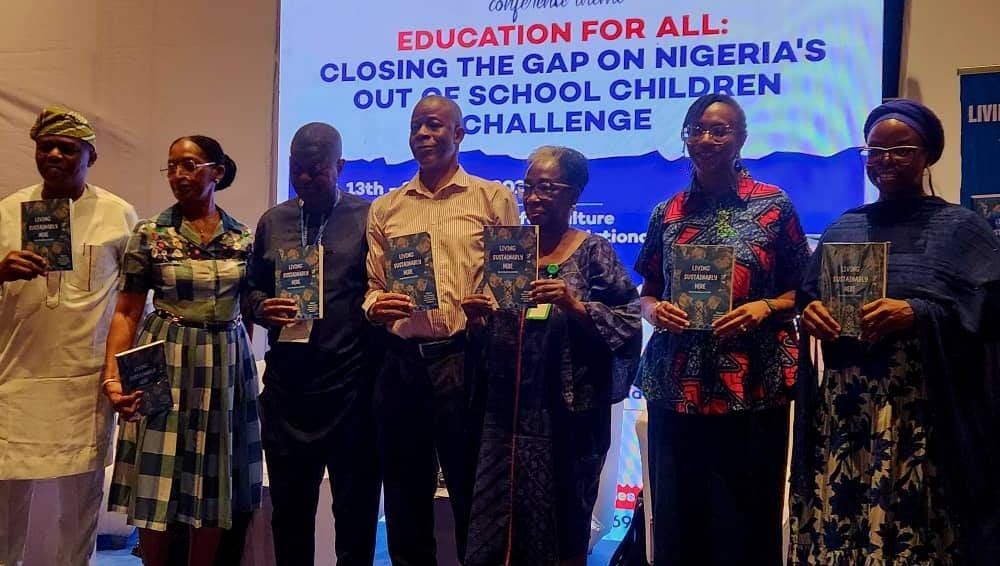
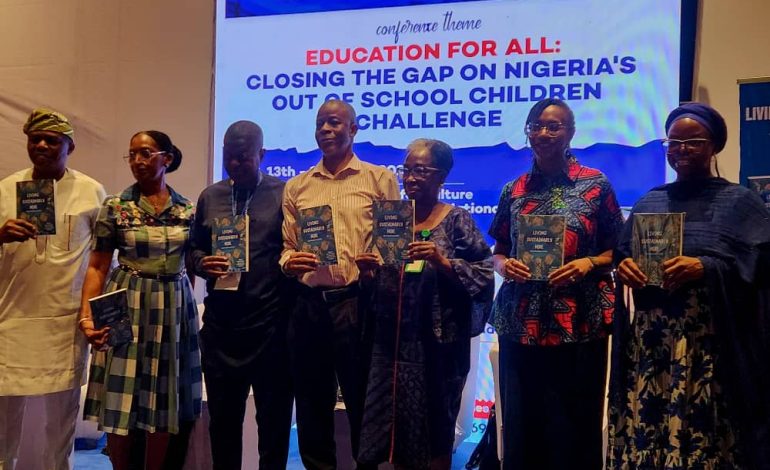
Prof. Rasheed Olaniyi (left); Sade Marriott; Dr. wale Okediran; Richard Mammah; anthology editor, Olatoun Gabi-Williams; Ore Lesi and book session moderator, Bisola ‘Bibi’ Dere at the launch of Living Sustainably Here: African Perspectives on the SDGs…in Lagos
Another contributor to the anthology, Mr. Richard Mammah, agreed with her, saying everyone was paying the price. He acknowledged that knowledge access is infrastructure, and that knowledge is a critical resource that is required by society for advancement and growth.
“So a society that is deficient in knowledge or that has short gaps in access to knowledge and the entire cosmos in that sense has already short-changed itself,” Mammah further submitted. “Part of why we do reading, or the promotion of reading, is to ensure that gaps are filled at different levels of the chain.”
Mammah spoke on where the failure of infrastructure affect development, noting that it is foundational, and that there is a mismatch in the process that has brought Africans to a sorry pass, adding, “But I think it’s important for us to also recognise the fact that if knowledge is important and if knowledge is there, then we can find it if we insist on looking for it again.”
The Secretary-General of Pan African Writers Association (PAWA), Dr. Wale Okediran, said the problem lies with policymakers and those who interpret laws, arguing, “I say this because a year ago, my association, the Pan-African Association, was among the organisations in Africa that were supposed to benefit from the African Development Bank grant. At the end of the day, we were rejected on the premise that the bank’s policy is only to develop structures in Africa. But they don’t believe that knowledge accessibility is also a structure. They were talking of physical structures. And so we were denied that facility.”
According to him, it is this mindset that informs Africans to invest in phantom physical infrastructures while leaving out investing in developing the minds that should behind these infrastructures. Building physical infrastructures without building human capital would be counterproductive, he argued, noting that Africa is paying the price for this wrong interpretation of development model that fails to invest in human capital.
For education advocate and Director of Banana Island International School, Sade Marriott, there is access to knowledge, but raises questions about the type of knowledge being accessed.
“Are we now a nation of skits makers?” she asked. “There is an awful lot of knowledge, but it’s the wrong knowledge. Well maybe, to me, it is the wrong knowledge. What we actually consume now is as important as what we have not consumed. I think that is shaping the choices we make and the choices that our children will make in the future.”
While skits and fashion have their places in an economy, she argued that they should not outweigh Pan-African or social consciousness or even morality or ethical standards in society. She further argued that while some people are paying the price, others are gaining. “If Africa is not conscious and African children are not consuming the right things, some people are gaining.”
The Dean of Arts at the University of Ibadan, Professor Rasheed Olaniyi, who earlier read a review of the book, blamed petty capitalism in the publishing sector for this failure. He explained that this is closely linked with government that changes textbooks almost every session, making it impossible for textbooks to be passed down from older to younger siblings. This means that parents have to pay the price in this case, a situation that affects family budget.
Gabi-Williams argued that a lack of interdisciplinary teaching that STEAM promotes is one of the ways access to knowledge has failed, noting that interdisciplinary approach is what the anthology also hopes to achieve.
“I was thrilled to see that our curriculum has been revised in 2025,” she said. “It’s vast, multidisciplinary. But what I’m looking for, what I really want to see, and I think we need to see, is interdisciplinary, even if it’s one or two hours dedicated to these kinds of sessions every week, where you have real-world problem-solving, where you bring all those disciplines together. And, you know, together, we all wear these hats, but we solve these problems through these different lenses, science, technology, arts, mathematics, and the arts are vast, technology is vast. And also put it in the context of the real world. What’s going on out there? Why does it keep happening? And get the children thinking critically. I think that kind of knowledge is extremely important.”
On whether bookstores are cultural institutions rather than retail spaces, Ore Lesi pointed out that bookstores should be cultural institutions owing to the fact that they are spaces that promote learning and engaging with the world through books. “But I think it probably depends on the person behind the bookshop,” she said. “And I know that there are many spaces that sell books, and for them it is a business, that’s all it is.”
She also argued that bookshops that have a following, because such spaces elevate books beyond mere book retailing only, adding such spaces overtime become where people fraternise with other readers or authors.
“We make Patabah Books a space for learners and readers and creatives and anybody really, the whole family. I feel that there should be vibrant spaces in the community. Yes, so I think that it has to be intentional, you know, the management of the bookstore.”
Lesi stated booksellers could help rebuild the waning reading culture, but noted that it’s not solely the booksellers’ role, as the large part of the responsibility falls on the family. “Booksellers can make sure that they have a wide variety of books across different subjects, and there’s so much that comes back to the family, and it really starts in the home as well. I’m a lifelong reader because I was encouraged to read at home. My parents read and I was one of those few who were lucky enough to have a library that I would go to when I was younger. And my mother mandated that, we borrowed books, read them for two weeks and returned them. And so we were constantly reading. So it needs to start at home. As parents, we need to model the behaviour that we want our children to follow.”
Okediran spoke on the influence literature can have on governance and social justice, when he referenced English books like Uncle Tom’s Cabin and Oliver Twist, saying that they addressed societal ills. He also spoke about the likes of Wole Soyinka and Chinua Achebe, saying that their books effected changes in society. He, however, explained that the idea that a writer should be an agent for social change is debatable.
“And whether the duty of a writer is to change society or just to express his opinion is a debatable thing,” he said. “In fact, the teaching in some literary schools is that a writer’s duty is not to change society. He should not see himself or herself as the messiah that has come to change the world through writing. His duty is like that of a medical doctor: to point out the ills and allow people to judge. It’s not to prescribe, it’s just to show the problems. And then you can now pick it up. Because the danger is that when writers think that they are messiahs or their duty is to judge society, they have this overblown ego, and they think they know everything, which is not true.”
Mammah spoke on making reading a mass movement in Nigeria, explaining that data on libraries and reading spaces need to be found out first, and their functionalities, adding, “Now, after dealing with data, you can now go on now to action, programme, understanding, exchanges, synergies, networks, collaboration. And then resources.” He lamented the inadequate resources and referenced insufficient libraries in a city like Lagos. To Mammah, there is enough understanding of the importance of reading, but that lack of resources was affecting the reading culture negatively.
“I think where we have not hit it is on the matter of resources, because week after week, we get inundated with report, country-wide, about libraries that are not functional, dilapidated, unkempt, not resourced and all that,” he said. “Now, this is already infrastructure to support reading, but it is not being resourced. So it is now a resource constraint. I am not talking about resources that just appear on paper ad capital vote, but resources that actually go to do the job. So, it’s that synergy. I think there is sufficient interest to sustain a vibrant reading culture. It is to put the details together; I think that is what it is.”
Are children being educated for exams or for the future? Marriott maintained that while there has to be some form of measure for the students, they also have to be prepared for the future. “We can educate children for exams, whether we like it or not. There has to be some measure of what the children are studying. The form of that examination is open to debate. So, yeah, we can prepare them for the future and do measurement.
She also commented on whether international school models that is seemingly designed to export children out of the country on exile rather than nationalistic in outlook that seeks to give back and internationalise local systems with global outlook.
“What I have noticed, certainly in the international school system that I work in, is we are preparing children for export,” she said. “We are grooming them for exile. Is that what we want for our public system? I think we can interrogate what is good about the international school system,” referencing the Rwandan and Chinese education system that is nationalistic, as these systems see the problems of their countries and work to resolve them with global tools.
“What does global citizenship mean if it is not addressing our own citizenship?” Marriott said. “What are we doing? We are spending money here to educate these children, and they are going to go pay taxes over there, elsewhere. I am afraid, international education as practised in Nigeria could do a little bit more to address our problems and Pan-Africanism.”
Indeed, Living Sustainably Here: African Perspectives on the SDGs anthology amplifies Africa’s voices to the global stage in ways not seen before. Gabi-Williams’s work has repositioned the continent in a different light. And as a rural schoolteacher testified, though she had not read the book, but the views expressed by the various contributors have further grounded the SDGs in ways she had never known before. Living Sustainably Here: African Perspectives on the SDGs has shed the abstractions associated with the SDGs in a relatable way she could discuss with her pupils. If nothing else, that is a huge success of Gabi-Williams’ anthology.