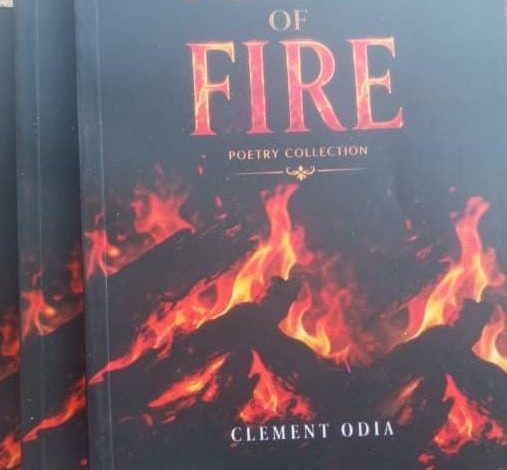
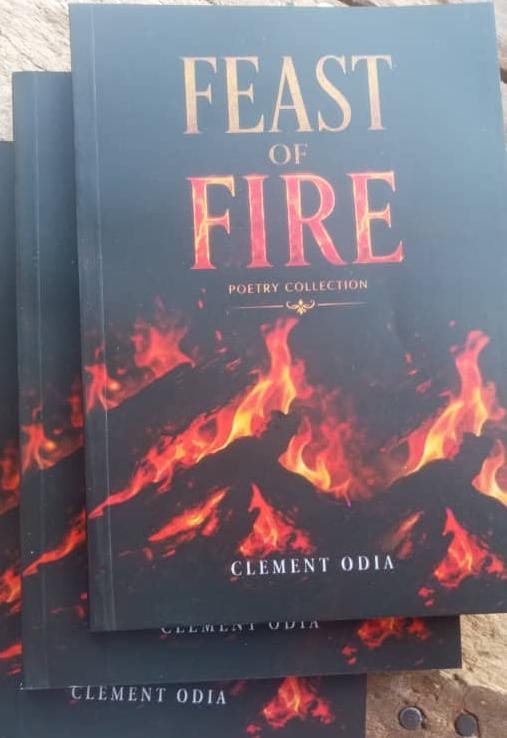
Fire as witness, Fire as reckoning:A critical review of Clement Odia’s ‘Feast of Fire’

By Gegeri Dike-Gegeri
THERE are books of poetry that invite the reader to contemplate; there are others that demand that the reader takes a position. Clement Odia’s Feast of Fire belongs emphatically to the latter category. It is not a collection that permits the luxury of detached reading. From its title to its final poems, the volume insists that poetry must confront the realities of its time, interrogate the structures that produce suffering, preserve the memories that sustain identity, and recover the moral imagination necessary for collective renewal. The poet does not approach contemporary Nigerian reality as a distant observer. He enters it as witness, participant, accuser, mourner, celebrant and, ultimately, a voice of possibility.
The title, Feast of Fire, is itself an arresting paradox. A feast ordinarily connotes abundance, fellowship, pleasure and celebration; fire, by contrast, suggests destruction, danger, purification and transformation. Odia deliberately brings these semantic fields into collision. His “feast” is therefore not a comfortable banquet but a ritual encounter with the combustible realities of a wounded society. The collection’s own authorial note confirms that fire is simultaneously anger, purification, destruction, renewal and “the last grammar of a people pushed to the margins of their own story.” The metaphor consequently becomes much larger than a recurrent image: it is the organising principle of the poet’s moral and aesthetic imagination.
What makes the collection particularly compelling is that its fire is not directed exclusively outward. Odia also subjects the individual and the collective to its purifying scrutiny. The poems ask difficult questions about complicity, silence, memory, courage, spirituality, power and responsibility. The result is a collection that is deeply political without being reducible to political poetry. Beneath its anger lies a sustained inquiry into what happens to a society when corruption becomes normalised, when public office becomes private possession, when suffering becomes routine, and when citizens begin to mistake survival for freedom.
The first section, appropriately titled “Message,” establishes the principal temper of the collection. Its poems speak directly to the Nigerian condition through satire, lamentation, denunciation and prophetic warning. “A Feast of Fire I and II” is the manifesto of this poetic temperament. The poem imagines corrupt political elites being invited to a feast where they are served the consequences of their own actions. The familiar Nigerian symbols of political privilege—limousines, agbadas, motorcades, inflated contracts and ceremonial praise—are converted into images of moral grotesqueness. The poet’s language becomes especially inventive when political corruption is transformed into culinary and grammatical metaphors: the oppressors are made to “taste” the “red grammar of consequence.”
This is one of Odia’s important strengths: he frequently converts political vocabulary into poetic vocabulary. “New Tempter/ment,” for example, transforms the biblical language of scripture into an indictment of contemporary political and religious hypocrisy. The invented expression “New Tempterment” encapsulates a society in which temptation has become institutionalised, where the language of faith can be appropriated by the language of appetite.
Similarly, “One Bag of Rice” refuses the political reduction of poverty to temporary material distribution. The poem insists that rice cannot substitute for structural reform, justice, merit, functional institutions and accountable governance.
Odia’s satire is consequently not satire for amusement. It is satire as civic intervention.
“Overlords” provides another striking example. Here, criminality and political authority become disturbingly interchangeable. Fraudsters acquire titles, kidnappers become socially respectable, ganglords become landlords, and “Area-boys” metamorphose into “area-bourgeois.” The poem’s bitter humour emerges precisely because its absurdities are recognisable. The grotesque becomes a mode of realism.
The collection’s social consciousness is also evident in “The Strait of Hormuz,” where an international geopolitical reference becomes a metaphor for the constricted existence of ordinary Nigerians. Hunger itself becomes a perilous passage. The poet’s central insight is that tyranny is not geographically restricted; its rituals can migrate and its cruelties can acquire new languages. The poem therefore demonstrates Odia’s ability to move from the immediate Nigerian context into a wider global imagination without losing his cultural and political centre.
Perhaps the most persistent emotion in Feast of Fire is anger. Yet Odia’s anger is not merely emotional overflow. It is carefully aestheticised. “Fury Has No Voice” conceptualises fury as something deeper than ordinary speech: a pressure accumulated beneath prolonged obedience. The poem imagines collective anger as a force that eventually exceeds the structures designed to contain it.
This is important because Odia’s political poetry repeatedly moves from silence to speech, speech to anger, and anger to awakening. “A Million Tears,” “A Minute Silence,” “Precarious Conditions,” “Another Epic Fury” and “Fire on the Sell-Out Liars” all participate in this progression. The people are initially represented through hunger, tears, silence and deprivation; eventually, however, those very conditions generate resistance.
The poet’s rhetoric can be deliberately uncompromising. In “Another Epic Fury,” the language of imperial warfare is appropriated and redirected towards the frustrations of the oppressed. The poem imagines a moment when accumulated anger becomes impossible to contain. Yet even here, the poet does not leave the reader in destruction. After the fury and ash comes the possibility of “the first clean rain / of FREEDOM.” This movement is fundamental to the collection. Fire destroys, but Odia is interested in what can emerge after destruction. His imagination is therefore simultaneously apocalyptic and regenerative.
One of the most impressive dimensions of Feast of Fire is the manner in which its political criticism is intertwined with indigenous cultural resources. The transition from “Message” to “Reverence” is not a retreat from social reality. Instead, it demonstrates that Odia’s understanding of justice is rooted in a cultural universe in which the natural, spiritual and human worlds remain interconnected.
“Not Like Them,” “A Chant to Ekuwemwen” and “Eziza” are particularly significant in this respect. Ekuwemwen is invoked as a deity associated with water, truth and justice, while Eziza is imagined through the elemental power of wind and storm. In “A Chant to Ekuwemwen,” the river becomes a moral medium: water carries the speaker’s plea while simultaneously functioning as witness and judge. The poet does not merely insert indigenous names into an otherwise Western poetic structure. He attempts to recover a cultural ontology in which the river, deity, ancestor, land and human community participate in an ethical order.
This cultural grounding gives Feast of Fire much of its distinctiveness. Its political anger does not float in abstraction. It is repeatedly brought into conversation with kola nut, libation, rivers, iroko trees, ancestors, shrines, drums, proverbs and ritual speech. The authorial note confirms this deliberate synthesis of “chant and critique” and “proverb and protest.”
The effect is to make the poem resemble a cultural performance as much as a printed literary artefact. The reader is frequently positioned not simply as an observer but as a participant.
The section titled “Tales” further demonstrates Odia’s investment in oral narrative and indigenous storytelling. “The Steel Stallion,” “The Lawsuit,” “Ekuase,” “Ikpemoba,” “Ighogboya,” “Idami Sequence” and “The Cattle Egret and the Cow” extend the collection beyond lyric protest into narrative, allegory and moral fable.
“The Lawsuit,” for instance, transforms censorship and abuse of power into an animal fable involving the buffalo and the weaverbird. The song becomes more powerful precisely because an attempt is made to silence it. By the end, the song escapes the courtroom and becomes a communal chorus. The allegory is transparent enough to be politically meaningful but sufficiently displaced to retain its literary force.
“The Cattle Egret and the Cow” is another excellent example of Odia’s use of animal figures to expose political parasitism. The animal world becomes a theatre in which human corruption can be viewed from a productive distance. The cow and the egret embody systems of exploitation, while the stripped field becomes a metaphor for the exhausted nation.
In these poems, Odia retrieves the traditional African function of the storyteller: to entertain, certainly, but also to instruct, warn, remember and correct. His tales are therefore not ornamental interludes. They extend the political argument of the collection through allegory.
A lesser poet might have allowed the political anger of the first sections to dominate the entire collection. Odia does something more interesting. He pauses to remember, honour and celebrate.
The “Homage” section demonstrates that the poet’s imagination is not exclusively adversarial. “More Flowers to Efuru,” for example, is both a literary tribute to Flora Nwapa’s Efuru and an autobiographical meditation on literary initiation. Efuru is remembered as the figure who led the poet’s youthful imagination into “the sacred grove of words.” The poem thus becomes a meditation on reading, influence, memory and literary becoming.
Similarly, “The River’s Journey,” written in honour of Prof. Joseph Osagie, uses the river as an extended metaphor for an academic life. The river becomes teacher, nourisher, traveller and bearer of memory. The poem is particularly effective because its praise does not depend merely on conventional encomium; the river metaphor gives the tribute organic coherence.
“Eighty Seasons of Light,” dedicated to Emeritus Professor Raymond Osemwengie Elaho, continues this tradition of academic remembrance. The scholar is imagined as a source of illumination whose influence continues through the students and institutions he has shaped. “The Legacy of Dried Trees,” likewise, transforms apparent decline into usefulness and continued productivity. The dried tree is not simply dead matter; it can become firewood, beam, rack and furniture. The metaphor is ultimately a profound statement about human legacy: usefulness does not necessarily end with the cessation of youthful vitality.
This is an important counterpoint to the collection’s political fury. Odia does not merely destroy; he preserves. He does not only accuse; he remembers those who have contributed to his intellectual and cultural formation.
The “Memories” section introduces another register of the poet’s sensibility. Here the public poet becomes intimate. “A Chant to Uwaila,” “A Chant to Ikuoyemwen,” “A Chant to Ifueko,” “Your Smile,” “A Mourner’s Chant,” “Caffeine Love” and “The Song Ends in Mid Tempo” demonstrate that the same poet capable of thunderous political denunciation is also capable of tenderness, longing, grief and vulnerability.
“Your Smile,” for example, abandons the vocabulary of political confrontation for a vocabulary of emotional refuge. The beloved’s smile becomes shelter, lamp, rain and home. “Caffeine Love” converts romantic longing into the metaphor of sleeplessness and stimulant-like desire. Meanwhile, “A Mourner’s Chant” and “The Song Ends in Mid Tempo” bring death into the ritual world of drum, earth, ancestors and remembrance. These poems are important because they prevent the collection from becoming one-dimensional. They reveal the human being beneath the political consciousness. They also suggest that the poet’s concern with the fate of the nation is inseparable from his concern with the fate of individual human beings.
The sixth section, “Warning,” returns the reader to public danger but now with a heightened sense of impending consequence. “The Voice of This Hour,” “The Fate of the Photographer,” “Cuddle of Death,” “Fettered Freedom,” “City Billionaires,” “Behold, the Gathering of the Spoilers,” “Transferred Aggression,” “Sad Times” and “Hurricane Melissa” constitute a catalogue of contemporary anxieties.
What distinguishes this section is the widening of Odia’s field of concern. His gaze moves beyond corruption to inequality, political manipulation, pharmaceutical profiteering, social aggression, natural disaster and governmental indifference. “Hurricane Melissa,” dedicated to Jamaican hurricane victims, demonstrates that his moral imagination is not confined by national borders. The natural disaster becomes a test of governmental responsibility and human solidarity. The poem’s final movement from devastation towards survival is characteristic of Odia’s poetic ethics: catastrophe must not have the final word.
The final section, “Departure,” is perhaps the most significant structural destination of the volume. It contains “Borrowed Breath,” “Strewn Hearts,” “Fire on the Sell-Out Liars,” “Mission Artemis,” “Resurrection,” “Rectitude by Flame,” “Feasting Fire” and “Burn their Sweetstem.”
The movement from “Departure” to “Resurrection” is especially revealing. Departure ordinarily suggests ending, but Odia turns it into a threshold. “Resurrection” calls upon the people to break out of inherited submission and become agents of their own transformation. The poet’s inventive word formations—particularly in the sequence around “RAIsuWRECKsion,” “RAIsuRISE” and “WRECKsuRISE”—demonstrate his characteristic tendency to fracture language in order to generate new political meanings.
This linguistic experimentation is one of the collection’s most distinctive stylistic features. Odia does not always accept words as finished objects. He breaks, joins, stretches and reconstitutes them. The result is a form of logoclastic poetry in which the destruction of the word becomes a means of constructing new semantic possibilities. “Rectitude by Flame” gives this principle an ethical dimension. The poet warns against replacing one form of tyranny with another. To rise, he insists, is not enough; one must “rise right.” The poem therefore complicates the revolutionary rhetoric of earlier poems by insisting that resistance must be accompanied by moral integrity. This is perhaps the most mature ethical proposition in Feast of Fire: the objective is not merely to change rulers but to change the language and culture of tyranny itself.
Stylistically, Feast of Fire is heavily indebted to oral performance. Repetition, invocation, rhetorical questions, proverbial expressions, chant structures, direct address and rhythmic insistence recur throughout the collection. The poems often sound as though they are designed for the ear before the eye. This is evident in the repeated invocations of “O Ekuwemwen!”, “O Eziza!”, the recurring “Let them come,” “Sweep them away,” “Be still, be strong,” and the incantatory structures of the mourning poems. Such repetitions are not merely decorative. They create rhythm, communal participation and ritual intensity. Odia’s use of Nigerian English, colloquial expressions and indigenous cultural references also enlarges the expressive possibilities of his poetry. Expressions such as “chop-I-chop,” “Make dem chop am,” and “job-bery” are incorporated into a broader poetic strategy that destabilises conventional literary diction. The poet’s language can therefore move rapidly from elevated prophetic rhetoric to Nigerian colloquial speech and indigenous idiomatic expression.
The collection’s own authorial statement is particularly illuminating here: many of the poems are deliberately conceived to be “heard as much as read,” drawing upon traditions in which language is active, communal and performative. This is central to understanding Odia’s poetics.
The most enduring achievement of Feast of Fire lies in its sustained paradox. Fire is destructive, yet it is also cleansing. Anger threatens violence, yet it can become the energy of awakening. Memory wounds, yet it preserves. Departure suggests ending, yet it prepares for resurrection. The poet’s world is therefore not governed by simple binaries. Even the collection’s most incendiary moments contain a longing for reconstruction. In “Fire on the Sell-Out Liars,” the poet calls upon fire to burn betrayal and recover the nation’s voice; in “Mission Artemis,” technological advancement elsewhere becomes a mirror against which the inadequacies of Nigerian governance are measured. The poem’s central argument is that citizens should not be grateful for basic services that government is constitutionally obligated to provide. The concluding logic is consequently regenerative rather than nihilistic. The poet does not burn because he loves destruction. He burns because he believes that something better must emerge from the ashes.
Feast of Fire is ultimately a book about voice: the voice of the oppressed, the voice of the ancestor, the voice of the river, the voice of memory, the voice of the mourner, the voice of the satirist and the voice of the poet. Its deepest anxiety is what happens when a people lose the capacity—or the courage—to speak against their own dispossession. Odia answers that anxiety by making poetry itself an act of resistance.
The collection is not without its moments of rhetorical excess. Indeed, its intensity is sometimes deliberately overwhelming. Some poems pursue their central metaphor or denunciation with such insistence that subtlety gives way to proclamation. Yet this is also part of the book’s aesthetic identity. Feast of Fire does not aspire to the cool detachment of the ivory tower. It comes from the street, the shrine, the classroom, the marketplace, the mourning ground and the public square. Its poetry is consequently participatory and interventionist. More importantly, the collection demonstrates that political poetry need not surrender aesthetic ambition. Odia combines satire, allegory, folklore, lamentation, praise, invocation, religious allusion, indigenous cosmology and linguistic experimentation to construct a recognisable poetic world. His fire is at once political and spiritual, contemporary and ancestral, destructive and regenerative.
The collection’s seven-part architecture—Message, Reverence, Tales, Homage, Memories, Warning, and Departure—is itself revealing. It begins by speaking to society, turns towards cultural and spiritual sources of authority, enters the world of tales and collective memory, honours those who shaped the poet, confronts grief and danger, and finally moves towards departure and renewal.
That trajectory may be read as the deeper architecture of Odia’s imagination: from indictment to invocation, from memory to mourning, from warning to awakening, and from fire to renewal.
Feast of Fire is therefore more than a collection of poems about Nigeria’s political and social troubles. It is a sustained meditation on what poetry can do in a damaged society. It asks whether words can still disturb complacency, recover memory, expose corruption, preserve culture and awaken collective agency. Odia’s answer is unequivocally. Yes.But only if poetry is willing to become fire.And only if, after burning, it has the courage to imagine what should be built from the ashes.
* Dr. Dike-Gegeri is a Senior Lecturer in the Department of Language, English and Literary Studies, University of Delta, Agbor, Delta State, Nigeria