Bukar Usman re-enacts folkloric journey in new book

By Anote Ajeluorou
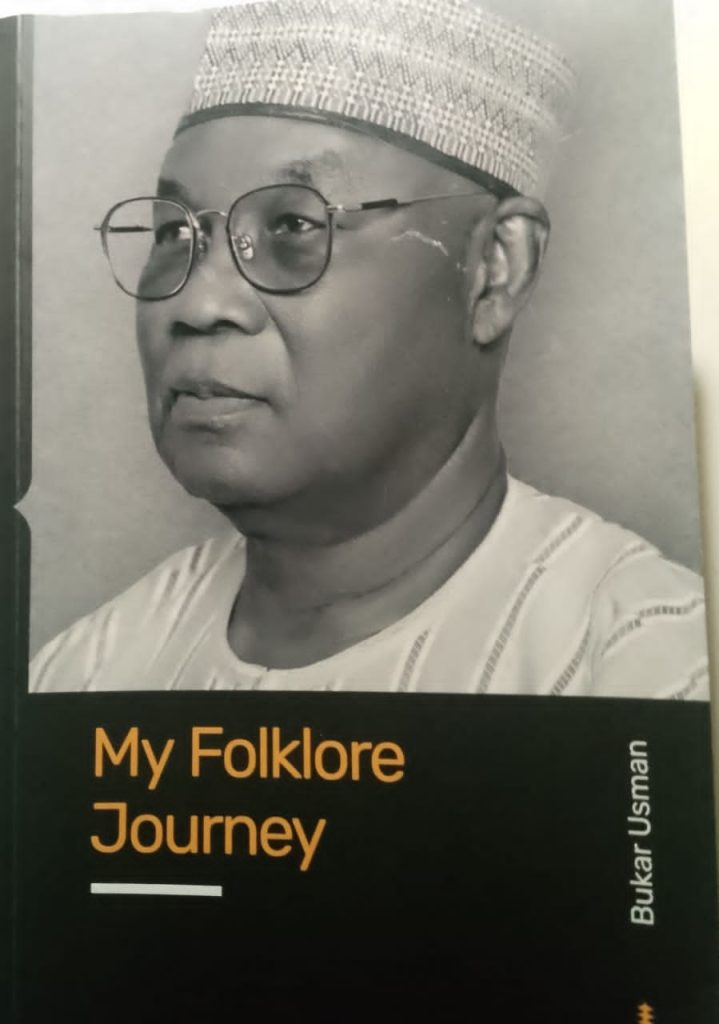
IT started for him like it did for most of us. Listening to mama’s tales, the family’s chief storyteller, after the day’s farm work, meals and chores were done, and the children gathered in her hut with the fire keeping everyone warm. Snacks like roasted corn and groundnuts or garden eggs also played a part to aid in digesting the folktales being told. It was Africa’s informal nursery schools that children looked forward to most evenings before they went to bed. Former Permanent Secretary in the Presidency, President of Dr. Bukar Usman Foundation and Nigerian Folklore Society (NFS), Dr. Bukar Usman, was a pupil in this enchanting African nursery school in the 1950s. And the tales he listened to, as told by his beloved mother, have remained with him over 60 years after. He narrates the experience in My Folklore Journey (Klamidas Communications Ltd, Abuja; 2026)
And as a man who loves to share, Dr. Usman has willingly been sharing this childhood gift with a world that has since moved on from orality to other forms of entertaining and educating children. Rather than remain stuck in the past, Usman quickly recognised a changed world and adapted to it. Usman acknowledges this transition, ineffective though it may seem in failing to convey the peculiar nuances of the oral form, when he says, “From my experience, I can say that having the tales narrated in the manner in which I experienced them as a child is richer than simply reading them. Some tales involve ‘hayeri’ (songs), and these cannot be readily reflected in writing, particularly when the tales are translated from Babur/Bura to a foreign language.”
Today, Usman has not only gifted the world a huge treasure trove of folktales he has also published, he provides explanatory contexts to everyone of his works. The purpose is to deepen readers’ understanding of his work and the insights that informed his creative vision. And in a sense, Usman has become his own scholar; this means that he provides the intellectual and contextual insights that informed his own works. In this context, the word ‘journey’ is significant and even central to his works. Usman feels obliged to take admirers and readers of his work on an exploratory journey to the origins of his works and be better informed.
Usman’s latest ‘journey’ is My Folklore Journey. He previously published My Literary Journey and My Public Service Journey: Issues in Public Policy Administration in Nigeria. In each of these ‘journeys’, Usman further explicates the narrative both about his research efforts and his native Biu that informed his folkloric sensitivity. It is as if the more he ‘journeys’, the more he peels off layers of his work and Biu, and the reader is further immersed both in Usman’s world and Biu Emirate.
Although My Folklore Journey has 10 chapters, the first seven chapters are most significant in this study. The rest, including the appendices, serve to illuminate other aspects of Usman’s scholarly enquiry. Like other ‘journeys’ books of his, photographs illustrate a large part of it to give further context to the man and his many activities in the field of folklore that spans over 30 years of researching and writing. It is an impressive photo gallery that shows personalities with whom Usman has worked in his long and illustrious career in folklore research.
Where else would Usman begin his ‘journey’ in folklore narrative but his mother’s mud hut with thatched roof in his idyllic Biu? He does not only give us a particular folktales session, he provides the relaxing ambience in which tales are told, who his mother was, his father, siblings, neighbours, the topography of his homestead, its layout with diagram, and everything that recreates his 1950s Biu homestead. Usman does not want his reader to forget his humble beginning and how that beginning became the solid foundation on which what he has become means. This recreation is not only nostalgic but emblematic of most origin stories of many highflying Nigerians, who look back down the long road they have travelled to the present. Indeed, Usman is a calligrapher of his past; we cannot but admire the sheer artistry of his work.
Of course, there was the tale session called makumthla yimi-yimi and the quiz session known as makumthla dza-dza. While his mother narrated the former, anyone with a quiz could ask others for answers.
Folktales are not innocent activities, as they embody whole moral burden of educating and inducting young ones into the ethics and philosophy of his or her own people. Usman acknowledges this role when he says, “My folktales beginnings… go beyond folktales, riddles, proverbs and folk songs. Those were only the verbal features of my initiation into Biu folklore which, in a broader sense, includes ‘customs, beliefs, arts and crafts, dress, house types and food recipes…’ This foundation was so strongly laid that even after my father, Usman Namji, years later, pulled down the huts and replaced them with zinc-roofed concrete bungalows, the image of the huts and the mores and lores that rippled from them lingered and are still active in my memory.”
While his native Biu provides the initiation with his mother’s evening tales, his journey to Maiduguri further extended his folklore horizon. In class, tales were being read but in Hausa with slight differences where the tales are similar. This fascinated Usman greatly. With Abubakar Imam’s texts as guide, Usman immersed himself in the tales alongside his studies. From primary school he proceeded to secondary school and only returned occasionally to Biu. By this time, Usman’s worldview had widened as he came into contact with other languages in Biu Emirate.
“Since 1955, when I travelled to Maiduguri to further my primary education, up to 1963, when I finished secondary school, I spent only my holiday periods in Biu,” Usman recalls nostalgically. “My awareness of the material lore of Biu widened during those periods as I utilised the opportunity to spend time outdoors with my peers. Sometimes we went down to the surrounding valleys, to the streams and their green shrubs, to see nature and an occasional crocodile. The latter excited us because of its folkloric and totemic significance in Biu, where it is regarded as a revered water creature.”
In Chapter 3 titled ‘Folklore Is Everywhere’, Usman dwells on what constitutes ‘folklore’ and uses his alma mater, King’s College, Lagos, as reference. He walks his readers through the folkloric traditions observable at his old school and how they apply to other real life situations. Of significance in this chapter is Usman’s involvement in FESTAC ’77, as a committee member that toured parts of Europe to under-study the process. Although he had little contact or involvement with arts and culture at the time, his work in that committee was important and would play some part in his writerly career and involvement in cultural studies decades later. He outlined the objectives of the festival and the colourful durbar that was held in Kaduna, as perhaps the grandest ever held in the country.
Usman pays tribute to his publisher, Mr. Duve Nakolisa of Klamidas Communications Ltd for nudging him in the direction of folklore research and writing. Having almost finished writing his memoir, Hatching Hopes in 2005 and ready for publication, Nakolisa had asked him, “Now that we have virtually concluded this book, what next?” That question, which intrigued Usman at first, would trigger a chain of reactions that would get the 82 years old writer (then younger, of course) in what would become folklore addiction in the next two decades and more.
‘“Why not turn your attention to folktales in your area?” he asked.
‘The question surprised me because prior to that we had not had any discussion about folktales.
“Don’t you have folktales from your area to tell?” he went on.
‘It then occurred to me that in my childhood days I was told a number of folktales. “So, I said, “Yes, there are folktales I know.”
“As he spoke, some of the stories my mother had told me when I was a child and the tales I had learnt as a schoolboy began to flash back in my mind. I told him that I could go to Biu, my home place, to gather the tales.”’
That was the impetus Usman needed to nudge him into action. Having immersed himself in the folktales research and writing them in English, he turned his attention to Hausa, a language spoken in a wider area than his own mother tongue, Babur/Bura. He sought out experts in Hausa to help in this enterprise and made remarkable progress. Having mastered collecting folktales in his Biu area, Usman turned his attention nationwide. This is the kernel of chapter 6. ‘Pan-Nigerian Folktale Narrative Research Project.’ It is perhaps the biggest research on folktales in Africa in terms of its vastness. It produced Treasury of Nigerian Tales (TNT), which has titles including A Treasury of Nigerian Tales (Volumes 1 & 2); A Selection of Nigerian Folktales: Themes and Settings; People, Animals, Spirits and Objects: 1000 Folk Stories of Nigeria and Gods and Ancestors: Mythic Tales of Nigeria.
In Chapter 7 titled ‘Biu Emirate Studies Series,’ Usman focuses on his native Biu, as a community leader and culture promoter. This series would later produce three important books. They include Girl-Child Education in Biu Emirate: The Early Years; Language Disappearance and Cultural Diversity in Biu Emirate and A History of Biu. These important documents are Usman’s gift to his Biu people. They will remain treasures that scholars will return to again and again in their wide sweep of the subject matters they dwell on.
Of course, Usman has included some incisive interviews that further explain his approach to his work of making more Nigerian folktales avaible to the public. The interviews in this book are rich and show the mindset of Usman and the manner in which he deploys his talent to archive and document Nigeria’s rich folklore heritage.
Usman’s My Folklore Journey is indeed another rare treasure from a man who has devoted many years unearthing Nigeria’s treasure of folktales like no other person has done before. His work is immense and defining. Though not a scholar the way we know scholars to be, what Usman has done in the field of folktales far surpasses whatever has been done in the field. His towering status in the field of folklore research stands out. This book bears eloquent testimony to Usman’s work. Students, scholars and general readers alike owe him a debt of gratitude.