‘A great masquerade’: Theatre practitioners reflect on Osofisan’s impact @80

By Godwin Okondo
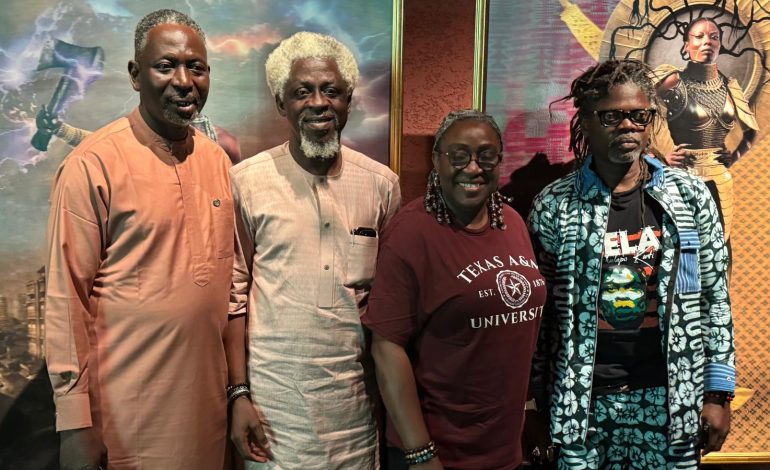
LEADING theatre scholars, directors and cultural workers have described the works of renowned playwright and dramatist, Emeritus Professor Femi Osofisan, as enduring instruments of political engagement, social transformation and cultural preservation, as they gathered in Lagos to celebrate his 80th birthday. The roundtable discussion, titled ‘Interpreting Femi Osofisan for the Stage,’ was held at the J. Randle Centre for Yoruba Culture and History and featured reflections from theatre practitioners and academics whose careers have intersected with Osofisan’s work.
Speaking at the event, professor of Performance Studies at Texas A&M University, Grace Adinku, situated Osofisan within the broader tradition of African theatre, noting that while he shares an affinity with Wole Soyinka in drawing from indigenous mythology, folklore, music and ritual, his work is distinguished by its unwavering commitment to political critique.
“Osofisan combines these traditions with a sustained engagement with questions of power, resistance, democracy and social justice,” she said. “It is this combination of cultural rootedness and political consciousness that makes his theatre unique.”
Drawing from decades of experience as a scholar, costume designer, director and former student of the playwright, Adinku said one of the greatest strengths of Osofisan’s dramatic legacy is its ability to transcend geographical and cultural boundaries while retaining its political urgency.
“When I speak about interpreting Osofisan for the stage, we are discussing how to create a complex theatrical vision within a living performance event. We are speaking of finding ways to embody ideas, activate histories, negotiate cultures and engage audiences in meaningful dialogue,” she said.
Adinku noted that Osofisan’s plays allow designers to achieve profound dramatic and symbolic effects even with limited resources, making them particularly adaptable within African theatre contexts where financial and material constraints are common.
“Designing for Osofisan taught me that visual choices carry intellectual and political significance. Costume is not merely clothing; it can signify authority, tradition, transformation, rebellion or social status,” she said.
Founder of Crown Troupe of Africa and National President of the Guild of Nigerian Dancers, Segun Adefila, described Osofisan’s body of work as consistently engaging and rooted in activism. Asked to identify his favourite Osofisan plays, Adefila cited The Road to Freedom and No More the Wasted Breed, but added that selecting only a few works was difficult.
“Every work of Osofisan, for me, is engaging,” he said. “There is a common thing about his works that I see all the time, and that is activism. He has a way of saying, ‘I’m not saying the gods should not be there, but can they get out of our cases?’”
Adefila further explained how choreographers approach the songs embedded in Osofisan’s plays, noting that movement can emerge either from the soundscape or the lyrical content.
“The lyrics of the songs can be condensed into movement,” he said. “As a choreographer, you can use the sound to create movement and completely ignore the lyrics, or you can choose to use the lyrics and mime whatever they are saying. There can be many approaches to it.”
Also speaking, the founder and CEO of Zmirage Multimedia Limited, Dr. Teju Kareem, argued that Osofisan’s significance cannot be fully understood through literary analysis alone.
“To interpret Femi Osofisan merely as a literary text is to encounter only one layer of his contribution to African theatre,” Kareem said. “His dramaturgy does not end on paper. It breathes fully only when translated into performance through rhythm, movement, silence, metaphor, visual energy, ritual memory and the physical African existence.”
Recalling his first encounter with Osofisan’s work in the early 1980s, Kareem said the playwright’s productions challenged conventional Eurocentric theatre practices by blurring the boundaries between performers and audiences.
“As I developed myself into technical theatre and stage design, I took from him the boldness to remain rooted in the region where the narrative comes from,” he said. “Osofisan’s plays provide profound energy, not only for understanding Afrocentricity but also for allowing visual artists to express themselves while remaining truthful to the cultural origins of the stories.”
Kareem later described Osofisan’s writing as expansive and resistant to rigid categorisation, adding, “Rather than challenge, it is an excitement, and it draws me in. Farewell was my first experience and encounter with Osofisan, and I got stuck in it.”
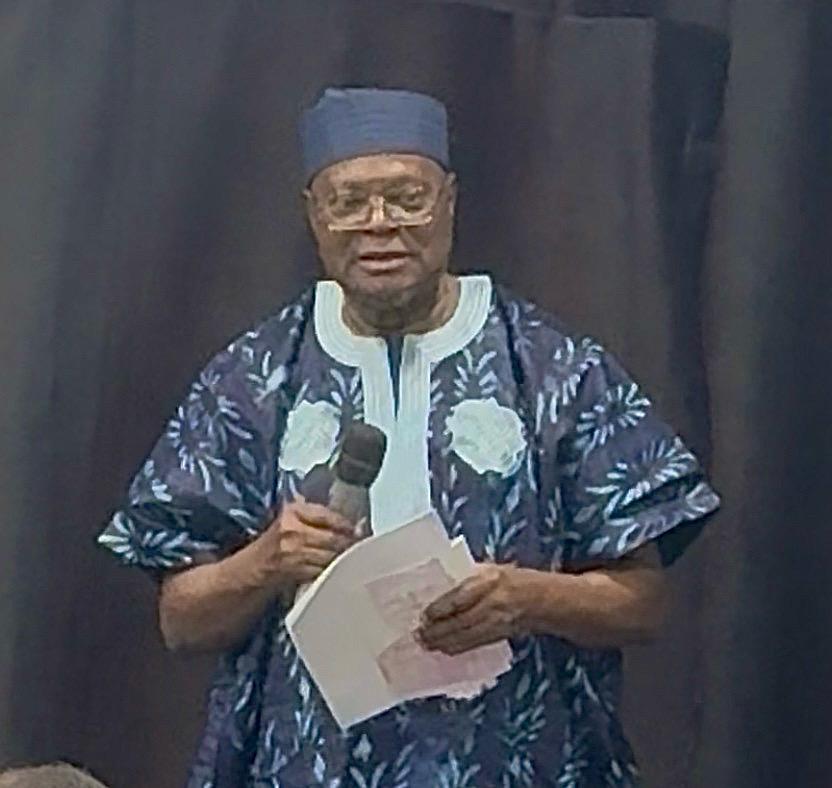
Emeritus Professor Femi Osofisan
Professor Rasheedah Liman of Ahmadu Bello University highlighted Osofisan’s influence beyond Nigeria, particularly his impact on theatre communities in the United States. She recounted her experience during a fellowship at the University of Iowa, where Osofisan’s reputation had already established strong academic and creative connections.
“The first thing the Head of Department asked was, ‘Do you know somebody called Femi Osofisan?’” Liman recalled. “He had been there as part of the International Writers Programme and had co-directed his plays on stage in Iowa. He laid the foundation that made it easy for me to work with the people there.”
According to her, Osofisan’s plays remain remarkably relevant because of their enduring engagement with political themes.
“His plays are highly political, and he does it in such a way that they fit into any age and time,” she said. “By the time you pick any of Osofisan’s plays and stage them, they still make a lot of sense. They remain contemporary and can always be interpreted to suit the happenings of the day.”
Reflecting on her own directorial experience with The Chattering and the Song, Liman said Osofisan’s works demand intellectual attentiveness from directors and performers alike.
“What I found in most of Osofisan’s plays is the political undertone and how to be mentally alert in interpreting them,” she said. “Most of his plays are a cry for freedom, and they are designed to fit into virtually any political issue.”
The event, moderated by theatre director, playwright and scholar Prof. Tunde Azeez of Lagos State University, Ojo, Lagos, formed part of activities marking Osofisan’s 80th birthday celebration and provided an opportunity for scholars and practitioners to examine the enduring relevance of one of Africa’s most influential playwrights.