Bukar Usman bows out, leaves Nigerian Folklore Society in good stead

By Anote Ajeluorou
AFTER 14 years as the president of the Nigerian Folklore Society (NFS), Dr. Bukar Usman has tendered his resignation from the cultural body that organises knowledge and its dissemination around the country’s folklore and indigenous heritage. Usman’s service to the organisation has been sterling in the revival of the body and giving it national and global resonance. His relationships with several academics across board while researching and writing in Hausa language cut his path with many experts already working in the field. Usman harnessed these valuable relationships when he assumed leadership of the Nigerian Folklore Society, where with his relationship with then vice chancellor of Bayero University, Kano, he secured a secretariat from where the body has operated and held annual conferences.
Although Usman did not give any specific reason for resigning, 14 years is a long time to serve any association as president. Perhaps, he felt the need to inject fresh ideas and personalities in the running of the affairs of the cultural body. But knowing Usman and his love for cultural archiving, an area he has distinguished himself over the years, he will continue to contribute his time and resources to the affairs of NFS. His contributions to the body of folk knowledge before and after assuming the presidency of NFS stand out as a testament to a man who has a lifelong mission to expand cultural education and knowledge of Nigeria’s folklore. His dedication has birthed professorial quality contributions for which he has been duly recognised with honorary Doctor of Letters (D. Litt) by Ahmadu Bello University, Zaria and a Fellow of the Nigerian Academy of Letters (fNAL), respectively.
Usman’s cultural administration found a match by his cultural production that resulted in a prodigious literary and archival output. His first output in the folkloric genre is The Bride Without Scars and Other Stories in 2005, which was experimental in nature. He was testing the water for the first time, but it became a spring that would lead to other more ambitious works in folklore narratives that have since enriched our knowledge of Nigeria’s rich folklore tradition. Usman was just venturing into the terrain for the first time, having been egged on by his publisher, Mr. Duve Nakolisa of Klamidas Communications Ltd, shortly after publishing Hatching Hopes in 2005. Usman took on the challenge and began his earnest research in folklore, in his Biu Emirate area, starting with tales told him and his siblings as a boy by his own mother, usually Africa’s top nursery educator in that regard. Those fertile recall from memory provided the bank and plank on which much more was to come in the following years when Usman became an ardent researcher, writer and cultural historian. Many publications in Hausa and A History of Biu emanated from that early cultural and historical adventure.
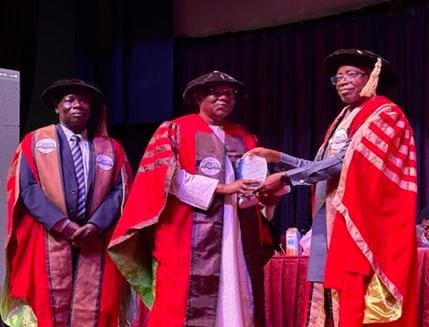
Dr. Bukar Usman (middle) receiving the Fellow of Nigerian Academy of Letters (fNAL) plaque after being inducted in Lagos… in 2024
Backed by the resources of Dr. Bukar Usman Foundation, Usman knew no bounds in his quest to document Nigeria’s oral narratives. Apart from writing and publishing many of these tales himself, he commissioned researchers across the country to harvest oral narratives from different Nigerian ethnic nationalities. The result of this nationalistic endeavour is Treasury of Nigerian Tales (TNT), which has titles including A Treasury of Nigerian Tales (Volumes 1 & 2); Selection of Nigerian Folktales: Themes and Settings; People, Animals, Spirits and Objects: 1000 Folk Stories of Nigeria and Gods and Ancestors: Mythic Tales of Nigeria. These volumes have defining importance for Nigeria’s folk culture in their narrative range and variety in themes and cadence, as many Nigerians will find tales emanating from their own ethnic nations captured.
What is even more enchanting about Usman’s work in folklore is his unstinted generosity in making available to the widest public results of his research and documentation. With the help of Dr. Bukar Usman Foundation, Usman makes available all his works in what is perhaps the greatest cultural philanthropy ever to people and institutions in near and far-flung places. Hundreds of individuals and universities across the globe have been beneficiaries of Usman’s book donation philanthropy. Indeed, Usman has been on a self-appointed mission of global cultural education dissemination. This is not a common feat considering how expensive it is to publish books in this part of the world where the need for profit mostly trumps any other consideration, least of all charity.
As Usman steps down from the presidency of NFS, some in the body might feel a sense of bewilderment and loss. Some others might take it in their philosophical strides considering that life is one ceaseless flow of tide and ebb. Whatever it is, Usman has made an indelible mark in history, cultural knowledge and heritage documentation and preservation. It is the hope that NFS finds another suitable person to steer the affairs of the society to the future with the resourcefulness that Usman brought to the job. Continuity in productivity is perhaps the only currency that will take NFS to the future of organising indigenous knowledge systems and disseminating same to the younger generation who feel distant to their cultural past, as they struggle to come to terms with the technological present and its urgency of trends and demands of virtual virality.
And as Usman leaves the saddle of NFS, there is the inescapable feeling that even at 82 he just might have set his sight on one or two more cultural adventures or journeys that might yet enrich our understanding of our world. Here then is a debt of cultural gratitude both for what Usman has done so far, and in advance for what might come next from his ever resourceful imagination!