
‘Making Babies’: How Giwa-Osagie’s IVF pioneering work broke infertility scourge in Nigeria

By Anote Ajeluorou
IN this part of the world, child-bearing is serious business, a must for everyone, and not having a child is considered a monumental failure, especially when it’s a woman, who patriarchy unscientifically heaps all the blame. While certain lifestyles and personal choices necessarily hinders a women fertile, men also suffer infertility. Culturally, it’s the women that bear greater responsibility in the child-bearing process, and when there’s failure blame easily goes to them.
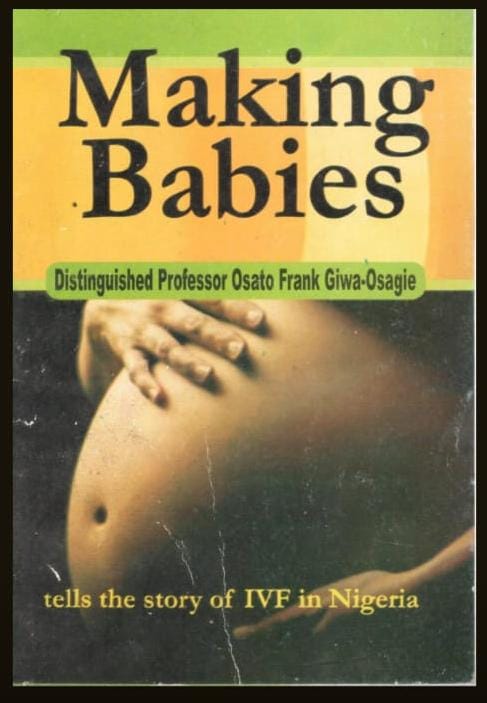
According to Distinguished Professor of Obstetrics and Gynaecology, Osato Frank Giwa-Osagie in Making Babies, the main cause of infertility in women is tubular blockage as a result of sexually transmitted diseases, complicated abortion that is not properly evacuated and giving birth in an unhygienic environments. Stress factor also plays a role among highflying career women.
It’s these thoughts and other critical ones facing Nigeria’s health sector that Nkanu Egbe harvested in a detailed interview with the Obarisiagbon of Benin Kingdom. Considering how important they are, the Dr. Bukar Usman Foundation has neatly put together in a booklet for a wider readership. This explained by the Chairman of the foundation, Dr. Bukar Usman in his foreword to the booklet.
As a pioneering IVF specialist in Nigeria alongside his colleague Prof. Oladipo Ashiru, Prof. Giwa-Osagie gives insight into his work and other healthcare issues in Nigeria that are begging for attention from the relevant authorities. Decentralising healthcare to federal, states and local governments is one such area where Prof. Giwa-Osagie believes the federal government should focus including funding tertiary health system (teaching hospitals) while state governments invests in secondary health and local governments handle primary healthcare system. This clear division, Giwa-Osagie argues, would refocus the entire health sector for effectiveness rather than the needless encroachment that is prevalent now that muddles up the system.
Having trained as an obstetrician and gynaecologist from the University of London in the United Kingdom, he felt obliged to return to Nigeria to start practice and landed a teaching job at Lagos University Teaching Hospital (LUTH). It is from here that he would later begin the pioneering work on In Vitro Fertilisation (IVF), the first of its kind in the whole of Africa at the time. He shunned offers from Europe and the Middle East to remain where he felt the need is greater than elsewhere. This would pay off in the huge interest the procedure generated with many teaching hospitals setting up their own IVF facilities. Rather than stay behind and work abroad, he was of the belief that Africa needed specialists like him more than Europe did. According to him, two hospitals alone performed more IVF in the UK a year than all the facilities in Nigeria. This means that Nigeria is lacking in such facilities amidst the huge need for people who need it, apart from the prohibitive costs.
Like all wise medical counsels, Prof. Giwa-Osagie argues that prevention is the best approach to infertility issues in women rather than cue or undertaking the IVF procedure that is expensive. So he advocates education and awareness, as the best preventive methods. Such education should be about abstaining from sex or using of condom to prevent sexually transmitted diseases that can result in infertility in women. Sharing condoms has been part of prof. Giwa-Osagie’s lifelong career as a medic, both in schools in social circles, as a healthy method of preventing diseases resulting from sex. He attributed Nigeria’s low spread of HIV to such preventive practice.
He is of the firm belief too that sex education should be taken to schools so youngsters learn early enough the dangers of unprotected sex that could leads to unwanted pregnancy. Such pregnancies could also force young women to undertake abortion from unsafe hands that complicates things for them later in life. He advocates also that pregnant women must undergo ante-natal period, so they get proper care from health personnel. A clinic or healthcare facility has the certainty of offering a hygienic environment that is safe for delivery or childbirth.
Indeed, stress is another area that Prof. Giwa-Osagie harps on, especially among highflying female executives or career women who come under work and family pressure to get pregnant. He tasks women in such positions to step back and give their bodies the needed rest and free themselves from stress so they can be ready for pregnancy, as stress and pregnancy tend to be opposing forces.
In Making Babies, Prof. Giwa-Osagie stresses the need for adequate and consistent research funding and investment in health sector that hardly occurs in Nigeria for a well-developed healthcare system, as it is done abroad. He also praises a former Minister of Health, Prof. Olikoye Ransom-Kuti, for his insistence on primary healthcare system, arguing it is the bedrock of medical practice in a society like Nigeria. However, Giwa-Osagie stretches the argument to include secondary and tertiary healthcare systems, noting that primary healthcare is where proper education of citizenry takes place asince its closer to the people. While Prof. Ransom-Kuti was initially focused on primary healthcare, he later began to invest in secondary and tertiary healthcare. In all Prof. Giwa-Osagie believes that a country’s healthcare system needs consistent investment to bring it at par with global standards.
In spite of his busy schedule as a consultant and board member of many organisations, Prof. Giwa-Osagie still manages a healthy social life among his friends. From Ikeja Country Club to Ikoyi Club 1938, Prof. Giwa-Osagie has a presence and is involved with a number of sporting project like cricket. His clubbing habit provides him avenue to share condoms to his club members and others.
In spite of the many offers to ship out for greener pastures abroad and the perennial problems plaguing Nigeria’s healthcare sector, Prof. Giwa-Osagie’s approach is a study in patience and patriotism. He did not only stay behind, he pioneered a unique medical field that brings joy to embattled women who are plagued with infertility. For all these, Prof. Giwa-Osagie is contented with ‘Distinguished Professor’ title as compliment for his years of dedication in teaching, practice and pioneering a complex field of medicine. For him patience is a virtue. His is a noble-noble-minded virtue indeed.
Making Babies is a thoughtful and well-intentioned booklet designed to assist families struggling with infertility but which are desirous of having babies. It informs of health facilities across the country where IVF help can be accessed, including artificial insemination. It cautions women to be mindful of how they deploy their sexuality in their youth, so as to avoid the scourge of infertility that would plague them later in life.