What happened to Ben Enwonwu’s ‘The Drummer’ at former NITEL headquarters?

By Dr. Mudiare Onobrakpeya
EVERY nation tells its story through the monuments it chooses to preserve—and through those it allows to disappear.
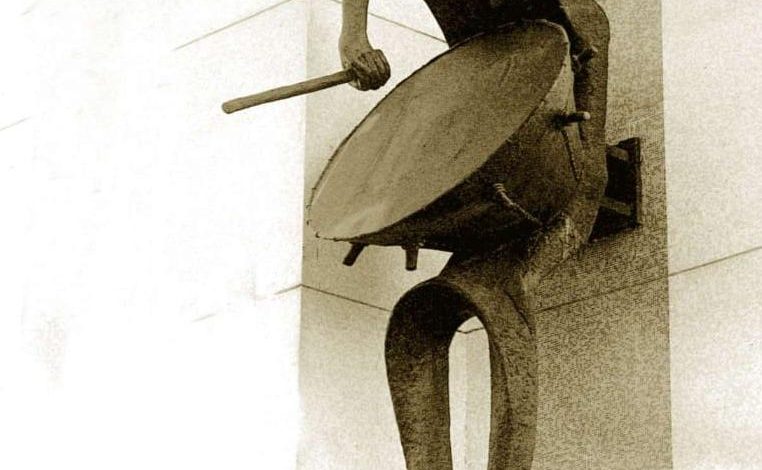
For decades, a monumental sculpture by the great Nigerian artist stood within the grounds of the former NITEL headquarters in Lagos. It was more than an architectural embellishment. It was a public declaration that art belongs not only in museums and private collections, but also in the shared spaces where a nation’s citizens live, work, and imagine their future.
Today, that sculpture is gone.
Its disappearance is not merely the loss of an object. It is the possible erasure of a fragment of Nigeria’s cultural memory.
In an effort to understand what happened, I undertook my own inquiries. The explanation I received was both plausible and deeply unsettling.
According to individuals familiar with events at the site, the sculpture had deteriorated over the years and eventually collapsed. Its remains reportedly extended towards the adjoining roadway, creating what was perceived as a danger to motorists and pedestrians. I was informed that state sanitation officials threatened sanctions if the obstruction was not removed immediately. Faced with the urgency of the situation, those responsible for the property are said to have ordered the prompt disposal of the fallen structure so that it would no longer constitute a public nuisance.
If this account is correct, it explains why the sculpture disappeared.
It does not explain why its remains have disappeared as well.
My subsequent efforts to trace the debris have yielded nothing. No public record appears to exist documenting where the fragments were taken. No institution has acknowledged receiving them. No storage facility has identified them. No conservation report has surfaced. To date, every trace of the sculpture seems to have vanished.
This is the question that should concern every Nigerian.
How does a monumental work by Ben Enwonwu—widely regarded as one of Africa’s greatest modern artists—simply disappear?
Across the world, nations treat the works of their leading artists as part of their civilisational inheritance. Even when damaged by war, natural disasters, or neglect, sculptures by artists of international significance are meticulously documented, carefully recovered, and preserved for restoration, research, or historical record. They are rarely, if ever, treated as refuse.
That standard should not be beyond Nigeria.
The issue extends far beyond a single sculpture. It exposes a profound weakness in the way we value and manage our public art. We have invested enormous energy in celebrating Nigerian artists on the international stage. Their works command global respect, appear in leading museums, and attract collectors from every continent. Yet within our own public institutions, too many significant works remain undocumented, uninsured, unprotected, and vulnerable due to neglect.
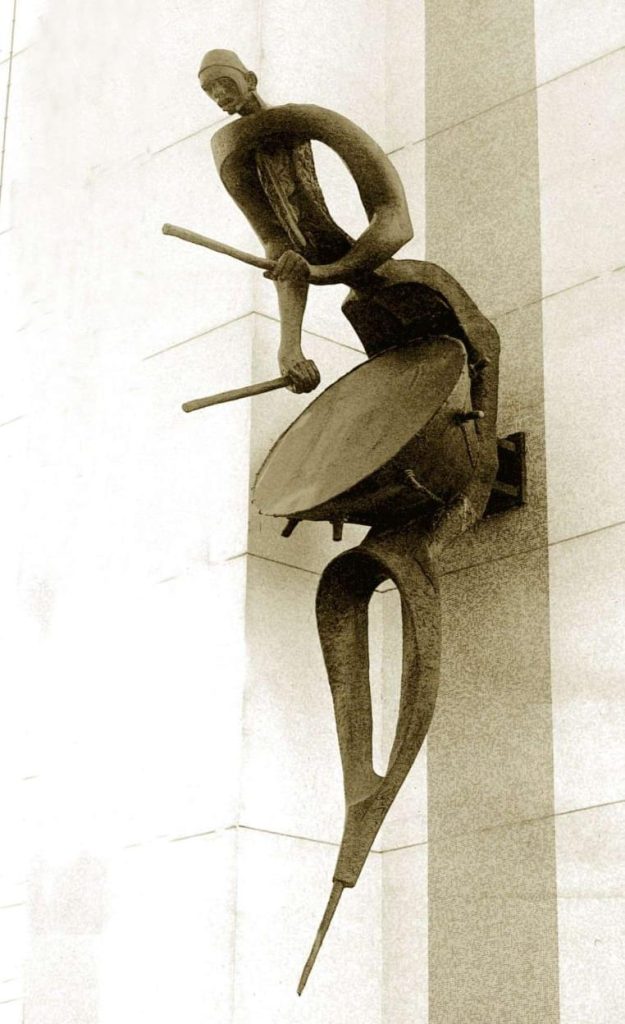
Ben Enwonwu’s ‘The Drummer’
A nation cannot claim to value its culture while permitting its artistic landmarks to disappear without explanation.
This episode should prompt an independent inquiry—not to assign blame where emergency circumstances may have existed, but to establish the facts, recover whatever may still survive, and learn the lessons necessary to prevent such losses in the future.
It should also encourage the creation of a comprehensive national register of public artworks, supported by legislation requiring documentation, conservation assessments, and professional oversight whenever a work of public art is moved, dismantled, or threatened. Such systems are standard practice in countries that understand that cultural heritage is not an ornament of nationhood; it is one of its foundations.
Ben Enwonwu devoted his life to giving visual form to the aspirations of a modern Nigeria. His sculptures and paintings helped define how the world came to see African creativity in the twentieth century. The disappearance of one of his public monuments should therefore trouble not only art historians and curators, but every citizen who believes that a nation’s memory deserves protection.
The fate of this sculpture remains uncertain.
Perhaps somewhere, its fragments still exist, waiting to be identified and preserved. Perhaps records remain undiscovered in institutional archives. Perhaps those who supervised its removal can still help reconstruct the truth.
Until those questions are answered, however, the silence surrounding the disappearance of this important work of art will remain a powerful reminder that cultural heritage can be lost not only through war or catastrophe, but also through indifference.
When a nation loses the physical evidence of its memory, it loses something immeasurably greater than stone or bronze.
It loses part of itself.