‘We need ‘Artistic Intelligence’ tools, too’

By Anote Ajeluorou
WHILE there’s rave across the world, including Nigeria and in all sectors, about the power of Artificial Intelligence (AI) as a tool, both its merits and demerits, some of those who ply their trade in the culture sector are calling for a different type of ‘AI’ in what President of National Association of Nigerian Theatre Arts Practitioners (NANTAP), Mr. Adeniran Makinde, called ‘Artistic Intelligence’ as a tool to aid culture production in a digital age. Makinde anchored his call on what he described as Nigeria’s inability to optimise and harness latent energies in the country’s national and cultural life. He blamed the perennial hiccups the country’s educational system suffers with policy summersaults that are rife. For instance, the Minister of Education recently said mother tongues have been cancelled for only English as medium of instruction in schools across the country, in what some see as a victory for the vanquished colonial empire, Britain, 65 years ago.
“The system of education has to change,” Makinde canvased at the 27th edition of the ongoing Lagos Book and Art Festival 2025 at Freedom Park, Broad Street, Lagos during the CORA-SONTA Dialogue on ‘Prospects of the Performing Arts in the Digital Age’. “These are deliberate steps, but no deliberate steps being taken to make things better. Nigeria is full of accidental steps like ‘Detty December’. How are you building on the cultural and economic boom of ‘Detty December’, build on it and make it better? How were our people, the Yoruba, able to compile all of Ifa corpus and oratory without written art? What are we doing now that approximates that intellectual genius of our forebears? Have we gone lazy? No, we haven’t gone lazy but something has gone wrong with us. Is it knowledge that we don’t have? No, we do. We are full of importing things, only now we may be importing people. We have to go back to the cultural artistry by going to our roots. Now parents want kids to speak English than mother tongues. We need artistic intelligence tools too to help us.”
Moderated by a professor of theatre arts Tunji Azeez, who probed the issue deeply, the panel session also had dancer, choreographer and CEO of Dexterous Empire, Oluyale Favour Aramide and filmmaker and tech enthusiast, Mr. Babatunde Lawal, who offered remarkable insights into the intersection of AI and digital cultural productions.
For Aramide, mentorship is needed for young culture makers, so they’re not just better informed but also manage the processes of production. She said she plunged into after initial fears and reservations about what she wanted to do, noting, “You still need mentorship even when you go to YouTube to learn dance, someone to help you do it very well,” she said. “Theatre is a field that you have to start feeding until it starts feeding you. You have to feed theatre before it starts feeding you. I was afraid of starting, and then I had support and started dancing and summoned courage and the vision to do it right. I had the right mentors and couldn’t go back on them. I had to innovate on what I was doing.”
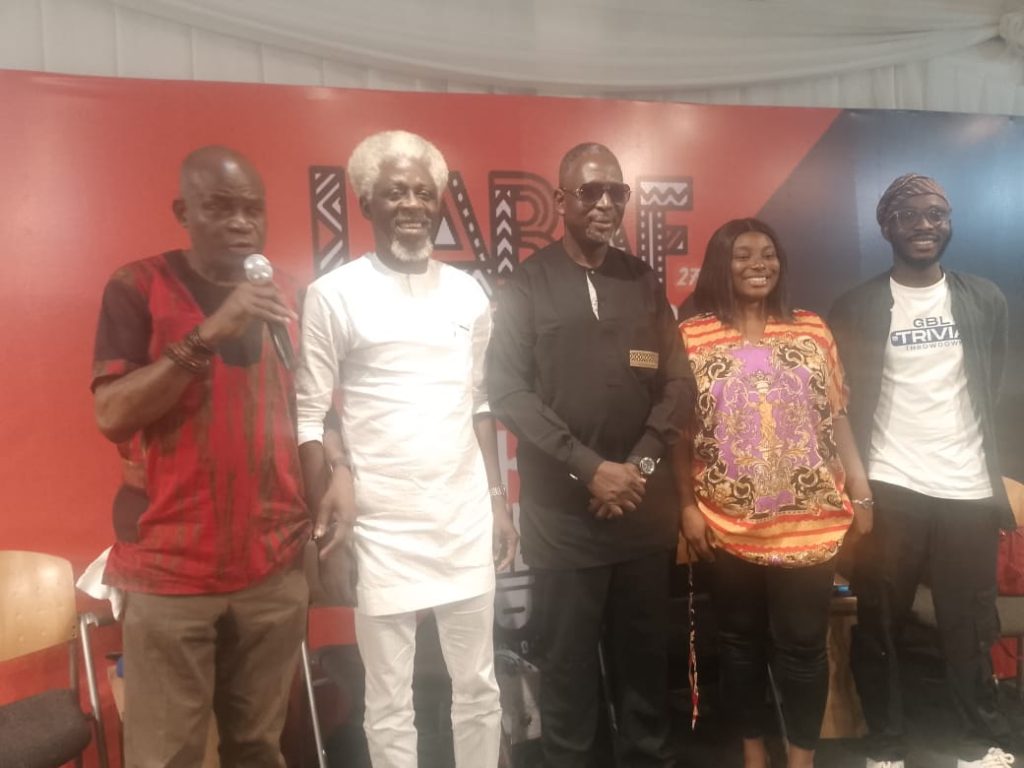
Programme Chair, jahman Anikulapo (left); NANTAP Pesident, Adeniran Makinde; Prof. Tunji Azeez; Oluyale Aramide and Babatunde Lawal… in Lagos
Although finding the right momentum took a while, but Aramide said she started by sending proposals to sponsors, boldly proposing that hers was a dance company and that anyone doing end of year parties could invite her company to entertain guests with dance. Although social media has become a leveller of sorts, Aramide said some culture contents on social media “don’t have depth but we push quality into what we do unlike most social media contents.”
Aramide also said as a choreographer, she said she uses AI to assit in her work, adding, “it’s about getting the patterns right. It’s about asking AI to give block patterns and expand it. This makes our world a global space. We made a production and people were watching us from London. We were contacted to perform and put a projector to it. We can use AI to push ourselves to make art a global product. Indeed, digital development has been helpful to our work.”
Also for filmmaker and tech enthusiasts, Lawal said writers were still safe in age of AI, saying it would take a long while if ever that the machine learning tool could displace writers, as some fear.
“As at now we are safe, but U don’t know about the future,” he said. “Machine learning doesn’t know what we do yet. I have a fear that when AI catches up with the stuffs we do, things will get bad. There’s no depth to what AI does. There’s a way the human touch does things that’s different and which AI can’t imitate. You can just tell something that doesn’t have the human touch in it. But AI’s growing. We should take is as a collaborator and not substitute. AI can act as a reviewer and assistant to our work as writers and culture workers. We can use it to sustain ourselves.”
However, Lawal expressed fears about the abuse people would put AI, and tasked bodies like Society of National Theatre Arts (SONTA) to police the use of AI.
“Generally, it’s a human thing to abuse things like AI,” he said. “The first thing is for bodies like SONTA to police the use of these tools. In US, there’s a percentage of human efforts that must go onto a cultural production before you can put it out. How do you incorporate AI such that humans can still get jobs? There has to be about 40/60 human efforts, not sure the percentage, before it can be allowed. If we can get to that point, then there’s ethical use of AI. If people know that there’re ethical guidelines to how AI is done, then it will be a lot better.
“What AI does is share knowledge. When we eventually get ready, what should we do? If black engineers are working on machine learning tool, it will use people like us to build the tools so it’s not generic and racially biased. We should have people who know about our culture to feed these tools with our knowledge system. Otherwise we will just keep using what others (western engineers) have done and not get the best out of AI.”
Aramide agrees with Lawal on feeding AI with Afrocentric knowledge that are compatible to our knowledge systems.
“We need to start working on tools that recognise us,” she said. “We are used to getting things from outside. This awareness has to be taken seriously. People trying to come up with tech should be encouraged and given the right prompts. I pushed out a particular play to foreigners and they said, ‘no’; they said they want something African from the 1960s. I’d infused tech into the play, but they didn’t want it. They felt we couldn’t do stuffs with tech.
“How do we retain many old African dance steps? We need to start from the youths. I push theatre plus, that’s what I try to do. I’m very proud of our culture. It’s the way you feed AI is how it works. Our culture, food, taboos should be incorporated into AI.”
In 10 years from now, Makinde said as an actor there was safety, as AI still won’t be able to replace actors, saying, “Actors are very safe; they probably may make more money in the future. As an actor, I’m at home but you’re using my face and voice. So, it’s the designers that I’m afraid for. AI may take their jobs in future. Actors may not be able to do without signing contracts. Actors are scared of signing contracts. They may then know the importance of signing contracts, as they sit in their homes and make money.
Makinde also spoke about the advantages of using technology and ethics, noting that there are a lot of advantages in the areas of research tools and characterisation. “There are a lot of materials out there that we can’t tap into that tech will help with. My fear is that we abuse that elements, ability to know what you prompt for what you need. I cannot readily point to disadvantage to what we do technologically. It’s an advantage to what we do. It can aid what we do. Rehearsals now take place digitally across the world and then the director can synchronise.”