Travelogue: A return to Guinea Conakry

By Wale Okediran
SECURITY was tight at the Sekhoutoureya presidential palace of the President of Guinea, with the capital in Conakry, His Excellency, Mamady Doumbouya that warm April afternoon. After several security checks, my team of writers, ministers, diplomats and government officials were finally ushered into a large conference room for our meeting with the 42-year old former military general now civilian president. Moments later, two large iron doors at one end of the hall were suddenly flung open as the tall and imposing president, spoting dark glasses and surrounded by a tranche of heavily armed body guards, made his entry.
Currently the fifth President of Guinea, Doumbouya led a coup d’etat on 5 September 2021 that overthrew President Alpha Conde. On 1st October 2021, he was sworn in as interim president. He maintained the position until the 2025 Guinean presidential election which he won when he was elected as the country’s substantive president.
After a number of speeches, I was called upon for my own presentation.
“You have five minutes,” the Chief of Protocols whispered to me as I made my way to the dais where the president and his ADC sat. In my speech as the Secretary General of Pan African Writers Association (PAWA), I thanked President Doumbouya for his support for literature and culture in Guinea Conakry and, by extension, in Africa in general. I also lauded President Doumbouya for his commitment to education as exemplified in the high quality 2026 edition of the ‘72 Hours of the Book’, which was well supported by the Guinean government. In addition, the recently inaugurated Presidential Literature Prize which was generously endowed, as being worthy of emulation by other African presidents.
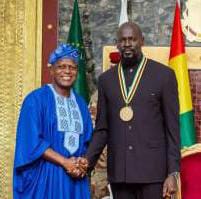
In appreciation of the president’s efforts, I went on to decorate him with a medal as the Grand Patron of PAWA. As I slipped the gold-plated medal around his neck, and later shook his hand, the whole hall erupted into a hearty applause as guests gave the president a standing ovation.
For the first time since the meeting commenced, President Doumbouya removed his dark glasses while his previously placid and weary face was momentarily graced with a hearty smile that lit up his youthful face.
I had come to Guinea to participate in the 2026 edition of the ‘72 Hours of the Book’ event under the theme: ‘Youth & Digital Technology’ with a focus on creativity, innovation, and engagement. The major international event, which was graced by publishers and writers from numerous countries in Africa and beyond, provided a unique forum for reflection and discussion about books and their challenges, in line with Conakry’s vision as a UNESCO Creative City of Literature.
It is on record that Guinea Conakry is the first city in francophone Africa to be nominated with the World Book Capital title in 2017, the year my engagement with the city began. In addition to Alexandra, Egypt (2002), Port Harcourt, Nigeria (2014) and Accra, Ghana (2023), Conakry, Guinea, is also the third African city to be so honoured by UNESCO.
Located on the Atlantic Coast, Conakry places literature at the heart of its cultural activities which earned it the designation of UNESCO World Book Capital in 2017. Home to more than 500 authors, including renowned Guinean writers such as Camara Laye and Thierno Monemembo, the city organizes hundreds of book-related activities throughout the year, including book fairs, literary clubs, competitions, literary awards, etc.
With a high level of literary production per year, Conakry also has a strong network of institutions which maintain the book sector and generate economic and social benefits for its citizens. Its Franco-Guinean Cultural Center (CCFG) has been the main infrastructure actively involved in supporting literary activities in Conakry since 1990, housing more than 20,000 books and documents.
PAWA also used the occasion to officially release a book in honour of the late Tanzanian president, John Magufuli. The book, which was the third published by PAWA on some iconic African leaders, is a collection of poetry and essays, edited by the PAWA President, Prof. Bill Ndi of the Tuskegee University, US. With contributions by 46 writers from 27 African countries, including the diaspora, the book was a tribute to Magufuli’s legacy as a symbol and statesman, highlighting his reforms and his role in reshaping national ethos.
Conakry is a bustling metropolis that serves as the country’s economic, cultural, and political hub. Located on the Atlantic coast, the city stretches across Tombo Island and the Kaloum Peninsula, offering a unique blend of natural beauty and urban energy.
After a 7-year interregnum, I returned to Conakry in 2024 for that year’s edition of ‘72 Hours of the Book’. It was the time of the military rule when the city was full of military checkpoints, armoured cars at street junctions and siren-blowing columns of soldiers. I also encountered a rustic downtown with decrepit buildings and congested traffic despite the allure of the beautiful Atlantic ocean as it pounded some of the city’s overcrowded shanties.
Despite my personal misgivings about military rule, Guineans seemed to be happy with their lot in the belief that ‘an accountable military government is far better than a corrupt civilian government.’
Dr. Wake Okediran (left) and President Mamady Doumbouya of Guinea
As I mingled with the happy throng of school children, writers and publishers and listened to drama and poetry presentations, I was left in no doubt that the 2026 Book Fair was a vast improvement to those of the previous years.In addition to the expertise of the Book Fair team, ably led by the Fair’s Commissioner General, the energetic and highly resourceful Sansy Kaba Diakite, gratitude also goes to President Doumbouya, who generously funded the fair.
At every stage of the 5-day event, the signature of the youthful Guinean President as well as those of his equally youthful administrative hands could be seen. It was a great evidence of a new generation that is helping to redefine the country’s destiny.
From the window of the conference hall came to me the rumbling sounds of a train followed by the hoot of its horn. Peeping outside, I saw a goods train loaded with some sandy stuff. “That’s bauxite. The train is on its way to the harbour,” a writer sitting next to me said. I will later learn that Guinea Conakry is a global leader in bauxite production as well as a growing hub for iron ore, gold, and other mineral extraction, with major international and local companies driving the sector.
According to GlobalData, the Republic of Guinea was the world’s largest producer of bauxite in 2023, with output up by 11% in 2022. In addition, the country holds the world’s largest bauxite reserves, accounting for approximately 23–25% of global resources, making it the second-largest exporter after Australia since 2019. Gold is another significant resource, with exports totaling 3.1 million ounces valued at USD$5.8 billion in the same year. Guinea also has commercially viable quantities of graphite, manganese, nickel, and uranium, though these are not yet exploited.
I was also informed that most of these mineral exports go to China, a country that has a long-standing relationship with Guinea. According to information, Guinea was the first country in sub-Saharan Africa to establish diplomatic relations with Beijing in 1959, and economic ties have expanded steadily over the decades. Bilateral trade reached more than USD$18 billion in 2025, reflecting growing cooperation between the two countries.
Outside the conference rooms and book stalls, I managed to do some sightseeing, courtesy of my good friend, former Secretary General of Conakry Writers Association and member of the country’s Electoral Commission, Djely Mory Dioubate, who took me round some interesting places in the city. The highly ebullient Dioubate also loaded me with delicious helpings of rice and fish followed by generous cups of coffee which, according to him, “will counteract the likely sedative effect of your large gastronomic exercise.”
Beyond its rusty facade, Conakry reveals its true richness through the people who call it home. One of the city’s greatest assets is its linguistic and cultural diversity.
In my Hotel Kaloum on Avenue de la Republique, I was attended to by a hotel staff from Nigeria while another friend, poet and secretary of Conakry Writers Association, Amadou Keita, has a Liberian mother. It was Amadou who later introduced me to the owner of a business centre next to the hotel who was a Togolese married to a Guinean lady.
Furthermore, along the streets of the colourful Kalou market, Fulani mixes with French and a smattering of English and other local languages. This polyphony has been shaped by the imprint of a history forged by the influences of colonialists and indigenous peoples, each leaving a lasting mark on the Guinean people.
It was gladdening to see that some of the slums and shanties (informal settlements) which I saw during my previous visit in 2024 especially in Kaloum and Sonfonia-Tayaki areas were being developed into massive new city projects. While the Kaloum intervention mainly involved forced relocation of the previous residents, that of the Sonfonia-Tayaki area involved the construction of a brand new city called ‘Dream City.’
Twilight was setting when Mr. Dioubati’s driver nosed the vehicle towards the Conakry port with its busy cargo-laden vessels against the vast expanse of the Atlantic Ocean to reveal a coastline where sky and sea merge.
In addition to its importance as a commercial gateway, the sea is also a veritable source of livelihood to fishermen who make the city’s markets come alive with their aquatic merchandise of fish and other sea food.
This intimate relationship with the sea is perhaps the live wire of the coastal city and, by extension, a country that is currently undergoing a steady development driven by its desire to wriggle out of its former chequered and difficult past.