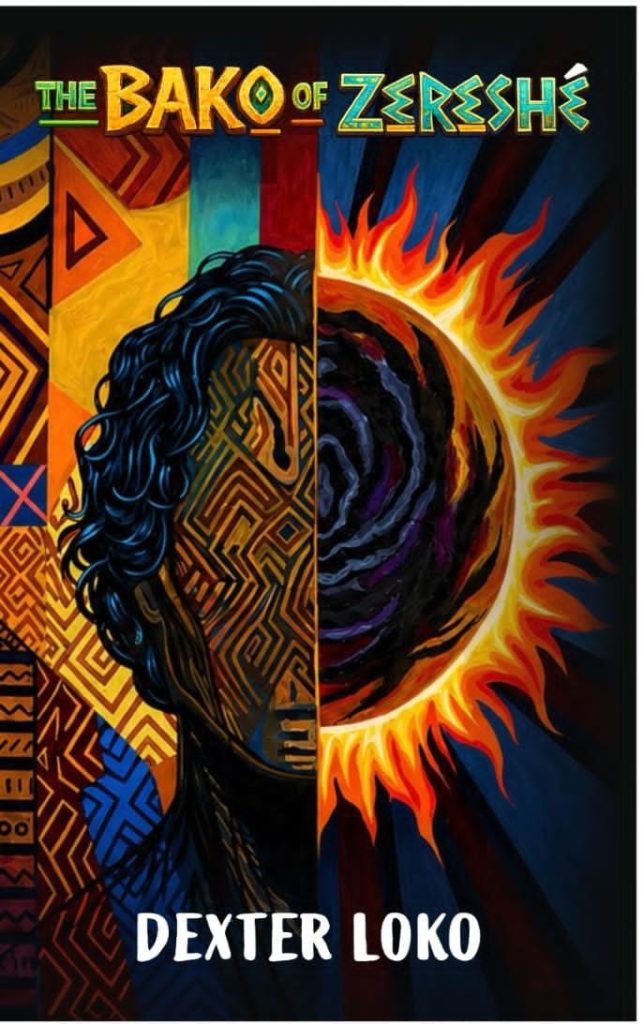
‘The Bako of Zereshé’ by Dexter Loko: A review

By Betty Zainab
THE journey of every hero, and indeed the thread of every great story, begins with a deep-seated longing for more. The urge to be more, to do more, to tell the incredibly fascinating. It is the curse of a legend. Like every legendary feat, Dexter Loko’s The Bako of Zereshé (GrandTouch Press, Lagos; 2026) pierces the veil between the natural and the supernatural, the ordinary and the extraordinary, and reality and fantasy. At its heart, this novel is an epic of ideas. It is a story about civilisation and the memory of what came before it. It explores the correlation between a man’s inheritance and his identity. To describe this book as a science fiction or fantasy novel would be a great injustice to the author’s ambitious writing.
That ambition becomes apparent from the opening pages. The novel begins with an imprisoned primordial being, betrayed by his own kin and sustained by humanity’s descent into violence. It is a mythic opening, almost biblical in cadence, yet unmistakably modern in its implications. Here, chaos is not merely a force of destruction, but a tool of political and spiritual warfare, feeding off human failures. Before the reader fully explores the implications of this imagery, the narrative shifts continents and tone, introducing Jeremy Fletcher, a disillusioned young BBC journalist in London whose life appears painfully ordinary. The transition is startling but deliberate. Loko juxtaposes the cosmic with the mundane, inviting the reader to discover the invisible thread connecting both worlds.
Many novels attempt to balance multiple narrative registers. Few manage to do so without sacrificing coherence. The Bako of Zereshé moves between domestic realism, investigative journalism, political thriller, mythological fantasy and speculative fiction with surprising assurance. Rather than competing with one another, these modes gradually converge until the boundaries separating them begin to dissolve. Jeremy Fletcher proves an effective guide into this increasingly complex world. On paper, he risks becoming a familiar archetype, the restless young man searching for purpose beyond the comfortable life he has inherited. Yet Dexter grants him enough emotional vulnerability to prevent him from becoming merely symbolic. Jeremy’s dissatisfaction with his privileged upbringing, his fractured relationship with his mother, his quiet devotion to his incapacitated father and his hunger to pursue meaningful journalism establish him as something more complicated than an adventurous protagonist. His search is not simply geographical, but also existential. This emotional foundation becomes increasingly important once the story leaves England for Nigeria.
At 22, quietly suffocating in a life that looks, from the outside, like the one everyone told him to want, Jeremy is desperate for a story that will make his journalism career feel like it means something. Jeremy gets his wish in the worst way possible. An assignment to cover a Boko Haram kidnapping in north-eastern Nigeria ends with his plane crashing over an unmapped territory. He wakes up in Zereshé, a hidden nation of the “children of the sun” who draw magic from blood offered to their gods, where political tension brews between purists and reformists, and where a foreigner, a bako, is either a threat or a miracle from the gods. What follows intertwines a slow-burn romance and political drama with the mythic unfinished business of a god whose followers have spent centuries working toward his return.
The novel’s real achievement is refusing to let Zereshé be a paradise an outsider discovers and improves, or a museum of “authentic” tradition preserved for his benefit. Instead, the narrative is one of a functioning, flawed state, one with a treasury bled dry by an oligarch family who control the mines, a prime minister compromising his principles enough to keep the power he needs to do some good, and a citizenry genuinely split on whether opening their borders to their neighbours would invite further hardship. The most instructive touch, though, is a grim historical fact tucked quietly into the background: an entire caste of magic-users, the aether-commanders, was wiped out by their own countrymen in 1916, out of a fear later revealed to be baseless. Loko doesn’t dwell on it, but its presence is enough. It is a reminder that nothing is perfect, not even in an imaginary world, that the same people who built a sanctuary from persecution were fully capable of persecution among themselves. This is the clearest evidence that Loko is interested in a deeper thematic exploration.
Contemporary speculative fiction often mistakes quantity for depth. Readers are inundated with invented terminology, elaborate maps, dynastic histories and encyclopaedic lore. Loko adopts a different philosophy. Zereshé unfolds gradually, almost cautiously. Rather than explaining its mythology through lengthy exposition, the novel trusts readers to assemble its cosmology piece by piece. Ancient orders, forgotten histories, mystical institutions and supernatural hierarchies emerge naturally from character interactions and unfolding events. The effect is a fictional universe that feels discovered rather than manufactured. The reader is treated to a genuine, cinematic pleasure comprising underground cavalry mounts erupting from the sand in bronze armour, teleportation reflected as an unremarkable social skill rather than a plot device wheeled out for effect, a wedding that tips, in the final pages of the book, into something closer to an apotheosis. Readers who enjoy fantasy will find that Loko has curated a magical world with perfect architecture, a rare feat in a market flooded with magic systems that exist to look on a fantasy map.
Perhaps even more impressive is the manner in which African cosmology informs the novel without becoming decorative folklore. Too often, African-inspired fantasy merely substitutes European dragons with African spirits while leaving the underlying narrative architecture unchanged. The Bako of Zereshé avoids that trap. Its mythology feels embedded within its philosophical foundations. Questions of ancestry, communal memory, spiritual obligation and historical continuity shape both the plot and characters in the book. The supernatural is not presented as an interruption of reality, but another dimension of it. This, arguably, is where the novel makes its most original contribution. African speculative fiction has enjoyed deserved international attention in recent years, yet much of the conversation has understandably centred upon correcting historical underrepresentation. Loko’s novel suggests another possibility. Rather than asking whether African stories deserve space within speculative fiction, The Bako of Zereshé explores a world where speculative fiction becomes richer when its philosophical assumptions are no longer exclusively Western.
It is worth mentioning that the novel has a rather slow pace. But the reader is rewarded with the elaborateness of the conversations and vividness of descriptions employed. A reader who loves to consume their book in bits would find this book a delight. This is not to say that fast-paced readers would be bored; rather, they are guaranteed an introduction into an adventure that unfolds with every turn of the page. As the narrative expands, earlier details acquire unexpected significance. Casual remarks return transformed. Seemingly isolated episodes reveal intricate connections. Characters introduced quietly assume astonishing importance. The pleasure lies not simply in discovering what happens next but in recognising how carefully the foundations had been laid long before events unfold. Perhaps the highest compliment one can pay The Bako of Zereshé is that it inspires curiosity beyond its own pages.
Adventurous readers, young people and lovers of mythology will find this a wholesome read worthy of recommendation.
* Zainab, a lawyer, is the author of a poetry collection, Sycamore