
‘Stop building concrete jungles, plant trees’: Our people need to see climate issues as an emergency

* ‘There is an assumption (in the global North) that Africa is somehow emblematic of the past, not the future’
By David Emokpae
GLOBAL warming persists despite warnings, fueled by excavation and use of fossil fuels and the effects of greenhouse gases. Efforts like curbing deforestation, slowing own or eliminating industrial emissions and adopting renewable energy still fall far short. Experts say these are a drop in the ocean. Real impact demands radical overhaul of economic and social systems driving the crisis.
At the 27th edition of Lagos Book and Art Festival 2025 held on November 14, 2025 at Freedom Park, Lagos, a panel of experts dissected the criticality of tourism as a climate change agent. The session was curated by the Co-founder of Let the Earth Breathe Initiative (LEBI), Mr. Osaze Samuel, and had the Co-founder of One Million Tree Initiative, Josfyn Uba, Edo State-based tourism promoter and Giwa Mata of Ososo Kingdom, Olori Rebecca Obaitan, an environmental activist and Senior Lecturer in Political Economy at Manchester University, UK, Dr. Carl Death and Chairperson, Bandung Africa and Ajoba Development Foundation, Chief Yetunde Asika, with moderation by journalist, writer and Co-founder of LEBI, Mr. Anote Ajeluorou.
While responding to his area of expertise on the environment and his latest book on it, Dr. Death stated that the United Nations Climate Change Conference of the Parties or COP conferences and international conventions on climate change issues are dominated by the global North, giving little space for the experiences and perspectives of the global South, especially Africa. Carl referenced his book entitled, African Climate Futures, saying that the book contains how to imagine what living in a future changed by climate would be, adding that the global North is usually focused on what effects climate change would have on them while ignoring African experience and perspectives that tend to be marginalised on their agenda.
“For many in the global North, there is an assumption that Africa is somehow emblematic of the past, not the future,” Death said, adding that for many in the global North, “Africa stands as a warning of what the rest of the world might be like if it fails to adapt to climate change, and that the future of the rest of the world could be like Africa’s present.” Carl expressed that this line of thought is problematic, adding, “I think this is deeply problematic and it ignores and marginalises the diverse and plural ways in which African futures are being imagined by creative and also activists and politicians.”
Dr. Death stated that his book is an attempt to look at the two ways in which climate futures are being imagined in Africa. One of the ways of doing so is political strategies, noting, “Many governments do have strategies for low-carbon development or net-zero development. Nigeria has its own long-term strategy for low-carbon development…,”arguing in his book that these strategies (African strategies and strategies from the rest of the world) are dry and technocratic.
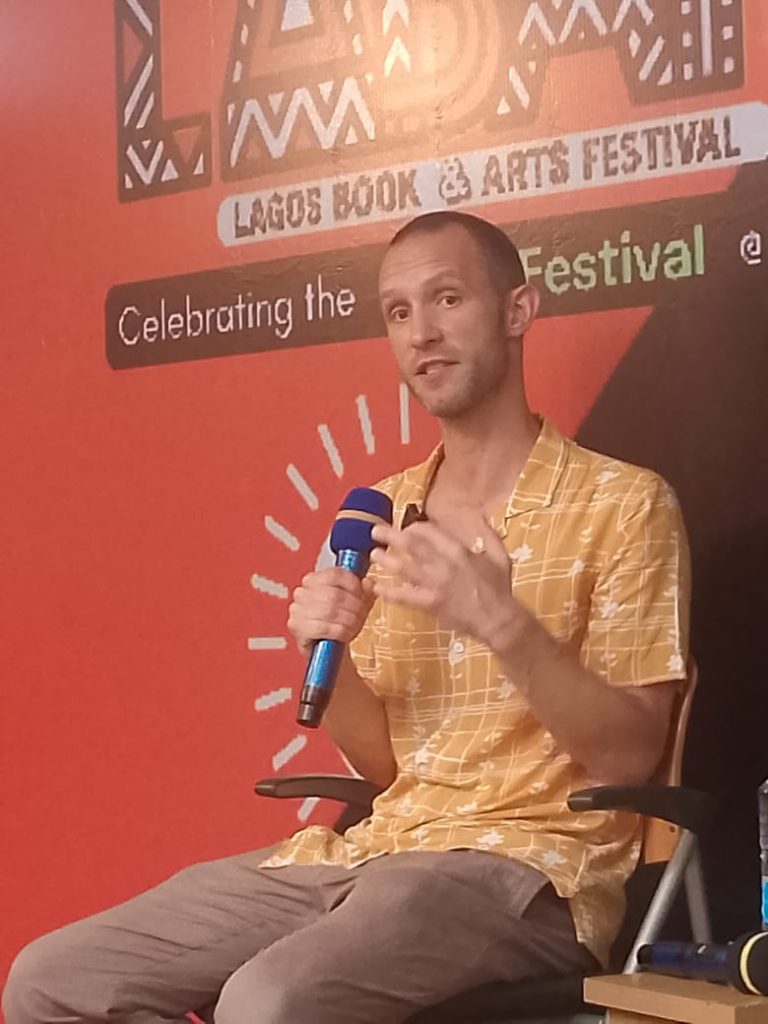
Dr. Carl Death
“They don’t help us imagine what it might be like to live in a climate-changed future,” he said. “And in order to try to open up some perspectives on how we might imagine the future, the book turns to fiction, novels, short stories, and films set in and written by African authors to look at some of the ways in which African futures have been imagined in the creative industries and how these can challenge some of the limitations of the political strategies that governments might put together but don’t seem to address some of the questions of power and inequality or give us much of a chance to imagine what it actually might be like to experience climate change.”
Uba said climate change discussions in Nigeria usually focus on technicalities that do no t amount to much, adding that the green wall is about living a sustainable life, adopting sustainable practices that can help to alleviate the impact of climate change, and help us to live a greener life. She stated that green lifestyle or greening the environment has economic and environmental benefits that are accruable to a healthy lifestyle.
“As much as tourism has its own economic benefits, you know, by helping people to promote activities that are friendly to communities and societies, it also has its own dark side when it comes to the carbon footprints,” Uba said, adding that these footprints are responsible for most of the gas emissions. “So when you talk about tourism and climate change, it is a dual issue. I would say that it is double-edged. Because this way it contributes to economic benefits by helping to promote activities that are good for the community… On the other side, they are also responsible for most of the emissions… most of the airplanes and aircraft and the activities of tourists and tourism—they are largely responsible for the emissions we are talking about.”
The One Million Trees initiative, which Uba co-founded, is geared towards environmental preservation and conservation through planting of trees. “We have planted trees in various cities and communities in Nigeria, in schools, in communities,” she said. “And we have planted well over 6,000 trees in the last five years,” and attributed the causes of disasters such as wildfires, flooding, and illnesses to climate change, saying that trees are “the lungs of the earth,” as they are immensely beneficial to the environment.
Chief Asika conceded that “Nigeria has made real strides in environmental policy and awareness, for example, in our climate commitment. It aims to cut emissions by 32% by 2035 and achieve net-zero by 2060. And the new road map requiring companies to disclose climate-related risks by 2027 is another important step that we have done.”
However, there is still a big gap between policy on paper and impact on the ground, according to Asika, noting, “If you look at initiatives like the National Renewable Energy Master Plan and the Great Green Wall project, for example, this shows real progress, and it shows long-term vision as well. But we now need to connect that policy momentum with supporting local innovation and ventures that create rural jobs and equip young people with climate-smart skills.”
But Uba lamented inadequate funding of climate-related projects, saying that organisations like One Million Tree Initiative face funding difficulties and urge government has to support these policies with funding. “At the root of it is just about funding and involving the communities to make it work,” she said. “We need to do more than just policies. Government has to support foundations like One Million Tree and other groups on the field.”
A member of Ososo royal family in Akoko Edo LGA, Edo State, Nigeria, Mrs. Rebecca Obaitan, who joined the conversation virtually, spoke on the work that has been done to green Ososo Kingdom for tourism. She said that there hasn’t been any external intervention per se, but that they have done some tree planting in the past that form a canopy of trees despite Ososo’s rocky terrain. She said, “From our standpoint, it’s not that we’ve built some attraction for people to come and see, it is nature itself. So, everything we do, we keep that in mind as far as preserving the nature.”
Mrs. Obaitan said that Ososo is interested in tourism as a sustainable effort, adding that they are in a unique position to shape what that looks like for their community. “Historically, we are a tourism kingdom,” the American-Nigerian said. “Expats and Nigerians alike used to come because of our high elevation and cooler temperatures… It’s very exciting for us to be able to share Ososo to the world from a standpoint, again, of being able to shape what that tourism looks like.”
Mrs. Obaitan, speaking from a conservation standpoint, added that they are conscious of footprints that tourism creates as they promote infrastructure that really fits into the landscape rather than stick out from it. “We like to talk about things like guiding traffic patterns, waste management, tourism districts and things like that,” she said.
Further, Dr. Death also spoke on the apprehension many Africans have regarding European or Caucasian interference in African issues, specifically the issue of climate change, stated that “people from the global North have to be aware of the positionality and standpoint from which they speak, and to consciously reflect on and try to disown the traditions where people from the global North go to the global South to tell people what they should be doing, thinking, and what the solution is. My research is on the issue of climate change in Africa as a means of speaking to academics in the global North and drawing attention to the marginalisation of perspectives from the global South.
According to British academic, “I see my research very much as speaking to academics in the global North, and potentially policy makers, if they were willing to listen as well, in order to draw attention to the marginalisation of perspectives from the global South and amplify the work of fantastic artists and creatives and activists in the global South.”
He also spoke on funding and partnership prospects, saying that the process of acquiring funding for the global South is highly competitive and bureaucratic, adding that there is a lot of talk and policies about climate change in the global South, but that these policies are rarely implemented.
“In terms of funding and partnerships—I think this is incredibly important and there is interest and enthusiasm for institutions,” he said. “Let me just speak about my own institution, the University of Manchester, for partnering with initiatives and projects in the global South… It’s the tension we talked about earlier between nice-sounding words and then putting these into practice. The University of Manchester will talk good talk about the importance of funding local partners in the global South. And then as anywhere, the funding is not infinite. It’s a very competitive process, and then once you get into that process, you realise the level of bureaucracy and the blockages at every stage in actually putting those into practice.”
Chief Asika spoke on collaborations with other organisations in communities and parts of Africa, noting that it was why she has an office in Kenya to strengthen regional aliances. “Collaboration is at the heart of what we do,” she said, “because climate and environmental issues are inherently multi-stakeholder… we make it a point to try and partner with as many local NGOs, community organisations, women’s groups, government agencies and also international institutions. Without collaboration, without all these entities coming together, it’s not going to work. There has to be collaboration.”
According to Asika, the role of women is crucial in climate change endeavours, saying, “You need the women to be at the forefront of climate action. They need to be the forbearers,” saying her organisation collaborates with as many people as are ready to collaborate with them.
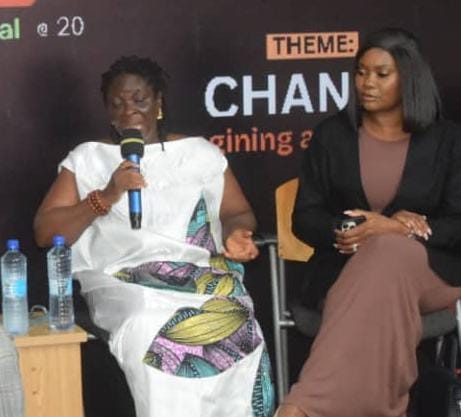
Co-founder of One Million Tree Initiative, Josfyn Uba (left) and Chairperson, Bandung Africa and Ajoba Development Foundation, Chief Yetunde Asika
Uba, whose One Million Trees Initiative has planted some 6,000 trees so far, spoke on her tree-planting process, stating that her organisation does not just plant trees for the sake of it, but plant trees for sustainability, adding that the organisation monitors the trees to see what becomes of them at every stage. Uba said her organisation makes use of volunteers to get the work done.
“We use volunteers. We also have community people—we do much of community engagement. And students are also involved, because we know that children are at the heart of our future,” Uba said.
Uba said her organisation names the trees when they are planted, a throwback to Africa’s ancient practice where trees were planted in the name of newborn babies, adding that this practice not only have environmental benefits, but also spiritual benefits. Uba said with their umbilical cords buried beside the trees, “we lost this practice when we started building concrete jungles. I would say when we build, and then we plaster and concretise everywhere. So, we lost the greenery, and then we keep cutting down (trees). Why do we cut down (trees)? Because we feel that these trees are old. But even when they are old you can replant. And that’s part of what we are doing. Until our people begin to see these climate issues as an emergency, we are not likely to do much. We need to take concerted actions like planting trees, watching out for plastic waste and working on our waste disposal efforts. Everybody is a stakeholder; it is a collective effort.”
Mrs. Obaitan said what has been done in Ososo could be replicated in other places, adding that people need to be taught how to monetise their landscape, as it would make them to become interested in protecting it.
“We’ve spoken a lot about the fact that you need the buy-in from the communities and that’s what we really try to foster,” she said. “You know, we’ve had films shot in our location because of the beauty. I talked about how, historically, we’ve been a tourist place. But we’re bringing in film crews. It’s become a content creator’s heaven just because of the (fascinating) views. So it’s getting a lot of attention in a professional way.
“If we are inviting film crews in, we can sustain the economy of the place… So, we get the buy-in from the people, because the messaging is there to tell them how they can make money from this. And then all of a sudden, they are engaged because they are making a sustainable living. A film crew comes in. We are now talking about the hotels making money, catering businesses making money, tailors, day workers, tour guides, all of these things. So, they start to see that an economy is forming and now they have a little money in their pocket. Now they’re interested in protecting it.”