Sani: Unveiling the writer and literary activist in Abuja

By Denja Abdullahi
WHAT come across to most people about the man Shehu Sani is that of someone, a kind of gadfly, that has, from early in the days of his youth, been involved in pro-democracy and human rights activism. He seems to have been born inside the trenches of human rights and pro-democracy activism and appears not have left those rough and abrasive terrains, even after having served a tenure in the Nigerian parliament from 2015-2019 as a senator. He stands out, among very few from his natal origin up the Niger, for his commitment to building a pan-African and pan-Nigerian alliance against injustice, oppression and retrogression of any kind. That iconoclasm in his socio-political temperament has led him into so many brushes with the establishments that spiralled into hounding and long imprisonment over the 1995 phantom coup during the brutal military regime of General Sani Abacha.
He is also one of the few, out of the large clan of Nigerian activists that fought for the return of democracy in 1999, that did not abandon the political space to military collaborators and apologists, who later took the democratic laurels for a war they never fought. He was elected into the Nigerian parliament as a senator, served a term and later got caught up against the malevolent and godfather-driven Nigerian politics. Though he is not in any political or elective position at the moment, he has remained constant in his criticism against political chicanery, social and economic injustices.
Sani as writer and author has the following non-fiction texts to his credit: Killing Fields (2007), Poverty in Northern Nigeria (2007), Political Assassination in Nigeria (2007), Scorpions Under Pillow (2007), Civilian Dictators of Africa (2008), Always Wrong, Can Yar’Adua Get It Right (2009), Betrayal and Society (2009), The Children of Kaduna (2011), The Children of Jos (2011), Protest and Freedom (2012), Rebellious Ideas ( 2013), Nigeria and Ethiopia: An Analysis of Historical Ties (2013), The Emperor and the War: Haile Selassie and the Nigerian Civil War (2013) and Hatred for Black People (2013). Sani’s fictional texts, which cut across the genres of poetry and drama, like his non-fiction writings, display a commitment to engaging reality from a radical disposition, often leading to the ruffling of societal conscience. There are poetic volumes such as Prison Anthology (2007), The Poems of Peace in the Season of Bloodshed (2007) and plays such as The Phantom Crescent (2009), Thugs at the Helm (2009), The Prisoner’s Life (2007) and The Defiant Emir (2012).
The other side of Sani as a writer and literary activist came prominently to the fore at the recent presentation of his latest book, The Perilous Path to Europe: The Sahara Odyssey and the premiere of his play, The Village and the Vigilante on January 15, 2026 at the Mamman Vatsa Writers’ in Abuja. The occasion , which witnessed a packed hall of over 300 persons made up of about a dozen diplomats from across the world, writers, academics, students from secondary schools and higher institutions around Abuja and journalists from the electronic and print media, was delivered with precision and premium entertainment by the Orpheus Literary Foundation. The day, which was also the Armed Forces Remembrance Day, began solemnly with a minute silence called by the compere for prayers to be said in remembrance of Major General Mamman Vatsa and other fallen heroes of the Nigerian military.

President, Association of Nigerian Authors (ANA), Dr. Usman Akanbi (right); the author, Sen. Shehu Sani; Colombian Ambassador to Nigeria, Amb. Maricel Romero Cantillo; a guest and Dr. Jummai Ahmadu displaying book copies at the event
The event proceeded with a welcome address delivered by the founder and chairman, Orpheus Literary Foundation, Mallam Denja Abdullahi, in which he stressed that it was about time Sani should be engaged and interrogated as a writer, thinker and literary activist, going by the large body of works he has spanning fiction and non-fiction. He pointed out that a cursory look at all his works would reveal the impact that his human rights activism, pan-Africanist vision, love for his country, progressive ideals, struggles against social injustice and religious extremism have had on them. The President of the Association of Nigerian Authors (ANA), Dr. Usman Akanbi, who spoke next itemised a litany of support Sani has given to the association in the past and recent times and his unflinching identification with the literary community at all times.
The event itself was themed around the subject matter of the non-fiction book that was presented at the occasion and formed the focus of the keynote speech delivered by a renowned international scholar and writer, Prof. Emeka Aniagolu, who spoke on the “socio-economic implications of unbridled and irregular migration.” The theme was further dissected by a panel of experts in the field , Dr. Loitse Adam, Dr. Kabura Zakama, Dr. Dele Kogbe who joined from Belgium and moderated by Esther Adelana. The insightful panel discussion was followed by a book review by Salamatu Sule who posits that Sani’s The Perilious Paths to Europe… “documents the tortuous journeys of migrants chasing hope and imagined greener pasture… also functions as a warning about the dire consequences of a battered system.” The book was then unveiled by the galaxy of dignitaries at the event, including the text of the play to be performed.
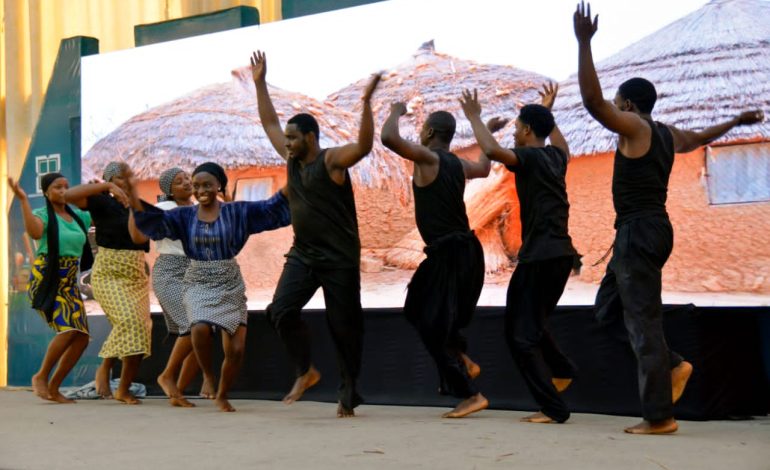
Sani in his speech, prefacing the performance of the play, which was the star attraction of the day, spoke eloquently on the need for a communal response to the menace of banditry and insecurity across Nigeria. He recalled the long history of successful interventions of the Nigerian military in various flashpoints across the world since the 1960s and the successive Nigerian governments’ support for noble causes across Africa and the world. He maintained that the solution to the hydra-headed insecurity problem in Nigeria cannot come from abroad or from a world power and that the country should look inward honestly to find solutions that are sustainable. He called on people in the audience not to die without writing their own books. He thereafter announced that he had put down his thoughts on the solutions to the menace of banditry prevailing in the society in a dramatic text, The Village and the Vigilante, which he promised to take around flashpoints in Nigeria in the manner of a travelling theatre. He thus set the stage for Orpheus Literary Foundation Playhouse, which in 50 minutes, electrified the stage with a total theatre performance of songs, dances, hair-raising dialogues and multimedia projections, enacting scenes after scenes of a village in a courageous conflict with banditry. The villagers emerged victorious at the end in an interplay of ingenuity, cooperation among the sexes, concerted actions, display of courage and the exercise of sacrificial leadership. As the applause died down for a well presented debut performance of the play that focussed on an insistent societal problem, Prof. Udenta O.Udenta, delivered a vote of thanks, stressing the fact that art, as seen in the play, could be used to guide society out of a self-inflicted quagmire.
The event came to an end, drawing attention to the other side of Sani as a writer and literary activist with both books, one presented and the other enacted, distributed free of charge to the mammoth attendees in the bowel of the auditorium of the Chinua Achebe International Conference Centre of the Mamman Vatsa Writers’Village in Abuja.
* Abdullahi, a former President of Association of Nigerian Authors (ANA), is the founder of Orpheus Literary Foundation