Ogba-Urhie Festival 2026: Bridal ardornment as Ughievwen re-enacts migration story

* Egbada War Dance, Udje Classics, Igbe-Emete (Maidens Dance), Ikelike Acrobatics, Eki-Eruo Epha (Bridal Pageant), Craft-Fashion Expo, Prizes will charactrise Ogba-Urhie Festival 2026 scheduled to hold on Tuesday, August 25 at Otughievwen Communit Townhall at 12.pm. It’s powered by Urhobo Arts Heritage Company Ltd
By G. G. Darah
THE Ogba-Urhie Festival of the Ughievwen people is held in August every year at Otughievwen, headquarters of Ughelli South LGA of Delta State, Nigeria. The festival is in memory of the successful exodus of the Ughievwen in ancient times from the creeks of Ogobiri in present-day Bayelsa to their first abode in Otughievwen.
The term “Ogba-Urhie” means “The Mighty Power of the Waterways”. This is a reference to how mysterious marine forces aided the Ughievwen navigators through the hazardous waters to safety at Otughievwen. The journey was made in wooden rafts during the early flood season when the tides run in one direction to the Atlantic Ocean.
The cause of the exodus is traced to an intra-family conflict that arose over problems of sharing an animal killed in a joint hunting (ibefi) expedition. According to folk legend, the Ughievwen, Eghwu, and Ijaw groups lived as one big family then. History shows that all three groups and Olomu had the same great grandfather called Kor; Ughievwen and Eghwu being born of the same mother.
The fracas over the killed animal allegedly caused the death of an Ijaw fellow. There were threats of revenge. To avert more crisis, the Ughievwen and Eghwu families evacuated ancient Ogobiri in the Amassuomo district where the Niger Delta University is located.
The Ughievwen sojourners used what is now Okpare Creek to access their site of settlement. The Okpare is a tributary of River Forcados. The Ughievwen expeditionists were coordinated by pilots, medicine men, and dedicated leaders. Among them was a brave woman, Bioghwa, who was in custody of the emblems/symbols of the arsenal of Ughievwen protective institutions. The emblems were re-established at the Otughievwen primary settlement.
Aparently, the Ughievwen family was already structured into the four units of Orhoghwe, Owahwa, Ukpedi, and Uhurie, all males, as they are now. From the Otughievwen metropolis, the sub-groups hived off to found various communities, now 32 in all.
The Ogba-Urhie is a grand congregation of several religious and artistic establishments. Early in their history, the Ughievwen developed fraternal organs or lodges to which men and women belonged. The four organs are Ade, the alumni of the affluent and aristocratic elite; Ebo, the faculty of philosophers, medicine, heaing, well-being, and prosperity. Only the Court admits females, making it the most popular and networked. The other institutions are Igbun-Oto for administration, security, law and order and Igbun-Eshovwin in charge of defence, law-enforcement, surveillance, immigration, arbitrators. Each of these courts has a temple (Oguan) and pontif/head (Odede). The courts are still operated till this day.
The Ogba-Urhie Festival serves as a convocation ground for all the fraternities and their associated bodies. On the opening day, their priests, ritual officers, coordinators, and members observe an all-night vigil at the Ogba-Urhie Sacred Beach. The vigil is concluded with sessions for thanksgiving, benediction, spiritual cleansing, boon-seeking, and feasting.
At the vigil and open-day programmes, members don raffia-dominated costumes/sachels, complete with staffs and headgears. On the festival day proper diverse events take place in various Fraternity Courts (Eguan) where old and aspiring members converge for offerings and feasting. Throngs of female votaries (Irheren, aka Egbekuon) besiege different reception centres to felicitate and celebrate solidarity, achievement, well-being, and goodwill. The women congregants (Irheren), especially, transform Otughievwen and environs to one sprawling mass of happiness, fun, and revelry. They engage music orchestras and entertainers to spread laughter like healing balm. It is an Ughievwen version of Cultural Olympiads or Carnivals.
However, the highlights of the Ogba-Urhie festivity take place several months earlier in all the communities with Epha-Eyavwon, the rites of passage from maidenhood (omote) to womanhood (aje-orovwen). From about June, every maiden of puberty age undergoes this initiation rite. It is an elaborate and expensive ceremony, covering many stages. In olden times, the maiden was made to go through clitoderectomy (yavwen-hwo). This set her on the route to the final status of a bride (opha). Her suitor completed necessary matrimonial obligations such as paying brideswealth (emu-ebro) and related matters. In those days, these marital obligations were concluded before a suitor “knew” his bride.
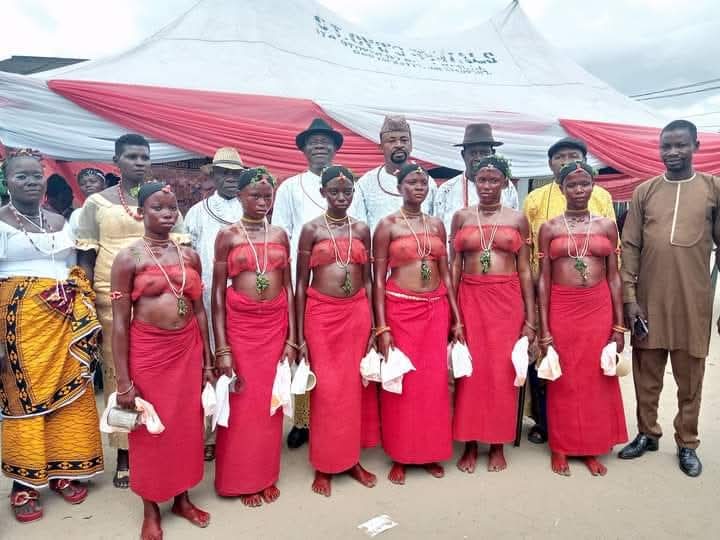
Bridal parade during Ogba-Urhie festiva
The more exacting and money-guzzling ceremonies go on after this stage. The bride’s family would construct a bridal chamber (ehwa-opha) inside the sitting room. The decor around the bed includes a bridal mat (Eghwere-Opha) decorated with intricate, colourful designs and lines of weaving. An “Igbe-waren” bed chamber was erected near the ceiling area, accessed by a ladder via which bridesmaids (Iko-opha) attended to the bride’s needs for about three months. From this stage the Opha was fed and pampered like a princess. Her special meals contained nutritious protein of high-grade smoked fish like ovwia (china nose), black beans, spices, and palm oil. She was excused from any physical work. At the end, the Opha was expected to have rotund body, smooth and glistening skin, and contented outlook.
During the weeks of seclusion, the Opha wore costumes of scarlet hue and rubbed camwood ocre (ugboro/isele). I think these sharp colours symbolised royalty and grandeur.
A public cooking place (utughe) was erected by the veranda to handle the preparation of meals for family and numerous guests fed free. Fuelwood was supplied free by the community’s womenfolk (Eghweya). The bride’s suitor (Oshare-Opha) would visit at intervals with friends; his dress would be smeared with camwood dye to mark him out as a married man.
Exchange of gifts (Oghwa-ekron) followed. Paternal and maternal families brought gifts, mostly consumables and domestic wares. These gifts were called Omiovwonvwerhan (literally, the joys of motherhood). A typical song chanted en route was:
Omiovwon vwerhan yo,
Ye omiovwon vwerhen,
Omiovwon vwerhan Inene vwie bun,
Omiovwon vwerhan yo,
Omiovwon vwerhen,
Inene vwie bun,
Omiovwon vwerhan,
E he eeeee.
Motherhood is an bonour,
Yet a mother hardly sleeps,
Motherhood is great,
My mother has a multitude,
A mother is an esteemed status,
Motherhood is a blessing,
Yet mothers sacrifice a lot,
Our mother has a full house,
Salutations, congratulations.
The suitor’s gifts (Ekpaebe) were more elaborate – expensive textiles, new fashion designs, silverware, various ornaments/ trinkets, cosmetics, food items, including a live pig hoisted on poles and borne by hefty males. The rear line of the gift bearers was occupied by males holding softwood twigs; each was decorated with an average of Ten Shilling coins worth about one-twentieth of a Pound Sterling in the days of yore. The more of such twigs a suitor presented, the more affluent he was rated to be.
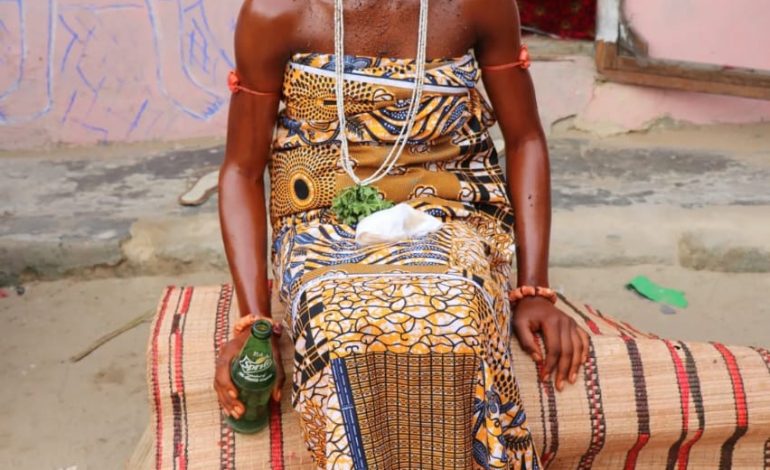
The bridal procession (Eki-eruo) was the dramatic and theatrical climax. Each bride would be decked in wardrobe bests, royal hair-do (Igoron-opha) and scented leaves (ugbuduma). With a body dripping with camwood and kernel pomade (amiibi), she would hold a hankerchief in one hand and a goblet in the other. The bride bared her top body, including breasts. Strings of beads tied around the waist line enhanced feminine robustness.
The bride would stand under a cloth canopy held aloft by about six tall men. On each side of the convoy a gaily dressed female orator, holding a woolen fan, broadcast encomiums of the bride and her family. With drums, songs and praise-choruses, the Opha processed majestically to a ceremonial arena.
This processional phase engendered romantic poetry of feminine panegyrics. Some phrases described the bride as a paragon in elegance. Others would apply hyperboles like “ironron”, that is, smooth-skinned pearl. The women chanters would hail: “Behold the prettiest woman ever seen”; “the golden, diamond mermaid”, “the charming princess dazzling like sunrays”. Every epithet of the sublime was invoked to extol the bride’s physical and ethical attributes.
At the ceremonial arena, a ritual officer (male) would administer ablutions such as feet-cleansing, sacrifice of kneaded palm oil plantain stuff (emaren), and benediction (erhovwon) for good luck in marriage, prosperity, long life, and child-bearing/procreation. Gun shots (ikoroje) would be fired to proclaim the grand event. The reverse procession repeated some of the scenes already described.
It is instructive to observe that the Ughievwen rites contained allusions to ritual observances common among the Igala/Nupe peoples of the Niger-Benue confluence areas of present-day Kogi State. Some of the items of the bride’s apparel bear names that are rather obscure and archaic in Urhobo language. An instance is the word “ikoroje” for gunshot already noted. There are more curious ones such as “igoron” (coral bead attached to the rear of the bride’s hair-do), “eguene” (bangles), and “igbe-waren” (the brides aerial bed chamber). In fact, the names of some Ughievwen ritual-medicinal paraphenalia do not seem to be easily rendered in Urhobo.
Take, for example, “igbele” and “ibiabo” for energy charm, “ilehweri” for love potion, “amwo” for warfare/battle, “igbefa” for knife/iron weapon and “etakpa” for mysterious bio-chemical missiles.
One of the bridal chants in the Ughievwen repertoire runs thus:
‘Luwe ododo e-ee/Luwe laba luwe.’
In Urhobo “ododo” means flower or floral elegance. The word has a similar meaning in Igala and Yoruba languages. But the other nominal items in the chant: “luwe laba luwe” have defied easy translation into Urhobo. There is the probability that these expressions flowed into Ughievwen dialect through cultural exchange along the River Niger Basin centuries ago. It is a matter that calls for more detailed ethnographic and archaeological studies. The outcome of such studies might throw light on the probable routes of Ughievwen migrations in ancient Ogiso times, from sites like Udo near Okomu through Ora lands, Afemai-Auchi, Agenebode by the River Niger bank, and thence via the waterways south to Aboh, the River Nun and Ogobiri where the Ughievwen, Eghwu, Olomu, and fragments of Ijaw settled temporarily. These are interesting migration issues thrown up by the Ogba-Urhie institution and its ceremonials.
Following the Eki-Eruo (bridal pageant), a proclamation was issued from the Odede-Ade Court for every bride to be formally escorted to her spouse’s home. It was forbidden for a bride to skip this mandatory step. If any bride failed to observe the order, she was required to do at the next available opportunity, otherwise the defaulter lost her right of admission into married women league (Eghweya).
Bounties of textiles, house-keeping utensils, foodstuff, and sundry gifts accompanied the bride to her new home. The escort comprised female family members and counsellors, as well as the bridesmaids (ikopha).
Each bride was received with fanfare and generous hospitality. Refreshment of drinks, biscuits, and groundnuts were served to all. Singing and dancing would continue late into the night. At daybreak, the bride and her maids would go round homesteads to partake in domestic chores. They would collect laundry items, wash, sun-dry them gratis and return to their owners, usually with aromatic perfumes sprinkled on the wears. Sometimes, the bride’s team would sweep and clean compounds and public places, also for free. These exercises of voluntary labour lasted about a week. The dedication and cheerfulness the bride exhibited in these chores helped the older married women and the general public to assess how useful the bride would be as a member of married women league. Thus, character moulding and appraisal were carried out by the people in the husband’s community, not those in her natal home. In this way, goodwill was earned and merited, not procured through nepotism.
The bride’s visit to the husband’s home was done three times. On the third round, the bride stayed back and settled down to her conjugal duties. The purpose of staggering the visits was to ease the psychological trauma of permanent separation from her parents. Our ancients truly mastered the processes of building stable families and communities.
At this point, we can reconnect the narrative with the Ogba-Urhie Festival programme. It should be noted that the majority of the Ogba-Urhie celebrants do not know or bother about rituals executed in various sacred sites and venues. Rather, their primary focus is on the multiple forms of artistic and aesthetic gratification offered freely and seamlessly.
On the day of the grand finale, there is an array of performance arts. As already described, members of the various fraternities engage artistic groups to entertain. Lavish meals and gifts are provided. Gestures of healthy banter, jokes, rumours, and laughter are exchanged. The female contingents (Irheren) of the Ebo Fraternity are the main sponsors of the artistic events.
Many of the female initiates (Irheren) appear in uniform dress code that includes raffia-made mufflers, micro wooden totems of wealth, prosperity, and procreation. Their eyes are rimmed with white chalk (orhen) symbolising purity and spiritual visual clarity or luminescence. The Egbekwon women crave recognition and appreciation. They are generously greeted with the appellation of “Ogbekwon” to which they would respond saying “Ohwevwen”, meaning “Hunger” or “Not yet satisfied”. This may allude to the idea that the womenfolk are ever expecting more attention from their spouses and the general public. It is a kind of gender pressure to elicit equitable and egalitarian distribution of the commonwealth.
The Ogba-Urhie ceremonies are concluded with religious and artistic events held in everyone of the Ughievwen communities. The organisational structure is patterned in a manner that spreads the beatitudes of the Otughievwen convocation to every family unit in all Ughievwen comnunities. Thus, the immediate aftermath of the Otughievwen events features Ore (Ancestor Veneration) of offer of food and drinks to Esemo (Family Fathers) and Iniemo (Family Mothers).
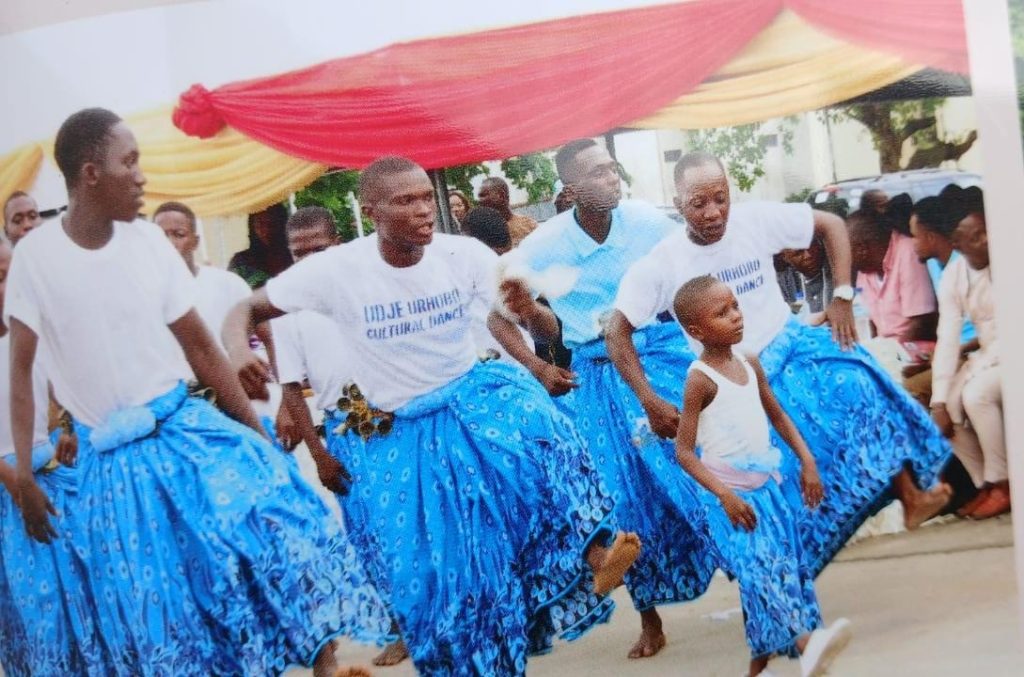
Udje dancers spicing up Ogba-Urhie festival
During the week, each family unit (Orua) holds feasts of ritual meals, prayers, and stock-taking at Family Halls (Eguan-Orua). The meals and liquors are funded from family budgets.
These ceremonies were the indigenous versions of what Christian sects observe as “Holy Communion”.
The oldest male member (Okpako-Orua) presided. In the benediction, the name of each deceased member is called, invoked, and saluted. At this point, the deceased are assumed to be alive or living ancestors. It is instructive that only the names of those who lived to old age, had children, and lived righteous lives are recalled and celebrated. Those who died prematurely, had no offstring, and left notorious memories behind are excluded from veneration.
This discrimination underscores the strict ethical hygiene that governed traditional Urhobo society. If one lived an immoral and ethically impure life, the penalty and sanctions reached beyond the grave.
After sessions of prayers and boon requests, the communal meals and refreshments are shared and consumed. The presiding Okpako-Orua would round off the ceremony with the saying: “O yovwin me/O yovwin r’avwan” (“May I benefit/prosper/May you all benefit/prosper”).
Udje performance of dance and songs followed the Ancestor Feasts. As scholars of Udje art like J. P. Clark, David Okpako, Tanure Ojaide, and Godini G. Darah have demonstrated, the Udje carnivals were artistic instruments employed by rival communities to “sing one another to a fall”. The competitive spirit was intense, poet/composers made new songs every season to expose and ridicule persons known or suspected to have breached communal norns.
The poetic mechanism of invective (ekan) and innuendo (iten) aided the songstars (ebo-ole) to range far and deep in themes and stylistic nuances. The cultural contexts of the Udje literature was informed by the reasoning that the songs of abuse were an artistic extension of the overall business of cleansing and healing the society to regenerate and renew itself for holistic development. The Udje art form was popular in seven Urhobo Kingdoms: Ughievwen, Udu, Olomu, Eghwu, Arhavwarien, Okparebe, and Uwherun.
For the 2026 Ogba-Urhie Carnival, the Urhobo Arts Heritage Company Limited has outlined what is likely to be a memorable programme of events. As in previous editions, performance groups will feature Egbada War Dance, Udje, Igbe-Emete (Maidens Orchestra), Ikelike Acrobatics, and popular folk dances like Opiri, Adjuya, and Fashone. There will be the thrill of Bridal Pageant (Eki-Eruo Epha), Fashion/Designs, as well as exhibition of craft works like Eghwere-Epha (Bridal Mat), farming and fishing gears. Lucrative prizes are lined up to inspire and encourage various talents and stars.
The Ogba-Urhie Festival is similar to other Nigerian ethno-fiestas like the Igue of the Bini in Edo State, the Osun-Oshogbo, the Eyo masquerade of Lagos, and Muslim Durbars in places like Kano, Daura, Bauchi, Borno, and other Northern groups. The Ogba-Urhie is comparable to the New Yam festivals in Igbo communities, the Calabar Carnival, the Sun City extravagannza in South Africa, the Rio de Janeiro Carnival of Brazil, and the New Year Homecoming fiesta of China.
The sustenance of the annual Ogba-Urhie Carnival is one way the Ughievwen, Udu and other Urhobo sub-cultures hope to stem the tide of erosion and neglect of vital socio-political and artistic practices that gave a sense of identity, pride, and integrity to the Urhobo people in Africa and the world.
* Prof. Darah, Ogba-Orien of Ughievwen Kingdom, is a Fellow of the Nigerian Academy of Letters (FNAL)